Let’s be honest for a second. You’re spending a fair bit of money on marketing. Whether it’s Google Ads, local SEO, or just the time you spend posting on Facebook, you’re working hard to get the phone to ring.
But then the phone actually rings while you’re on a job, or an email lands at 8:00 PM on a Tuesday while you're finally sitting down for dinner. You miss the call. You don't reply to the email until the next morning. By the time you get back to them, they’ve already booked with the guy down the road who answered his phone on the second ring.
It feels like money down the drain, doesn't it?
Most UK service businesses, from plumbers and electricians to accountants and solicitors, suffer from what we call "The Leaky Bucket." You’re pouring leads in at the top, but they’re pouring out of holes in the bottom because you don't have a system to catch them.
The knee-jerk reaction is usually: "I need to hire an admin person." But hiring is expensive, risky, and takes months to get right.
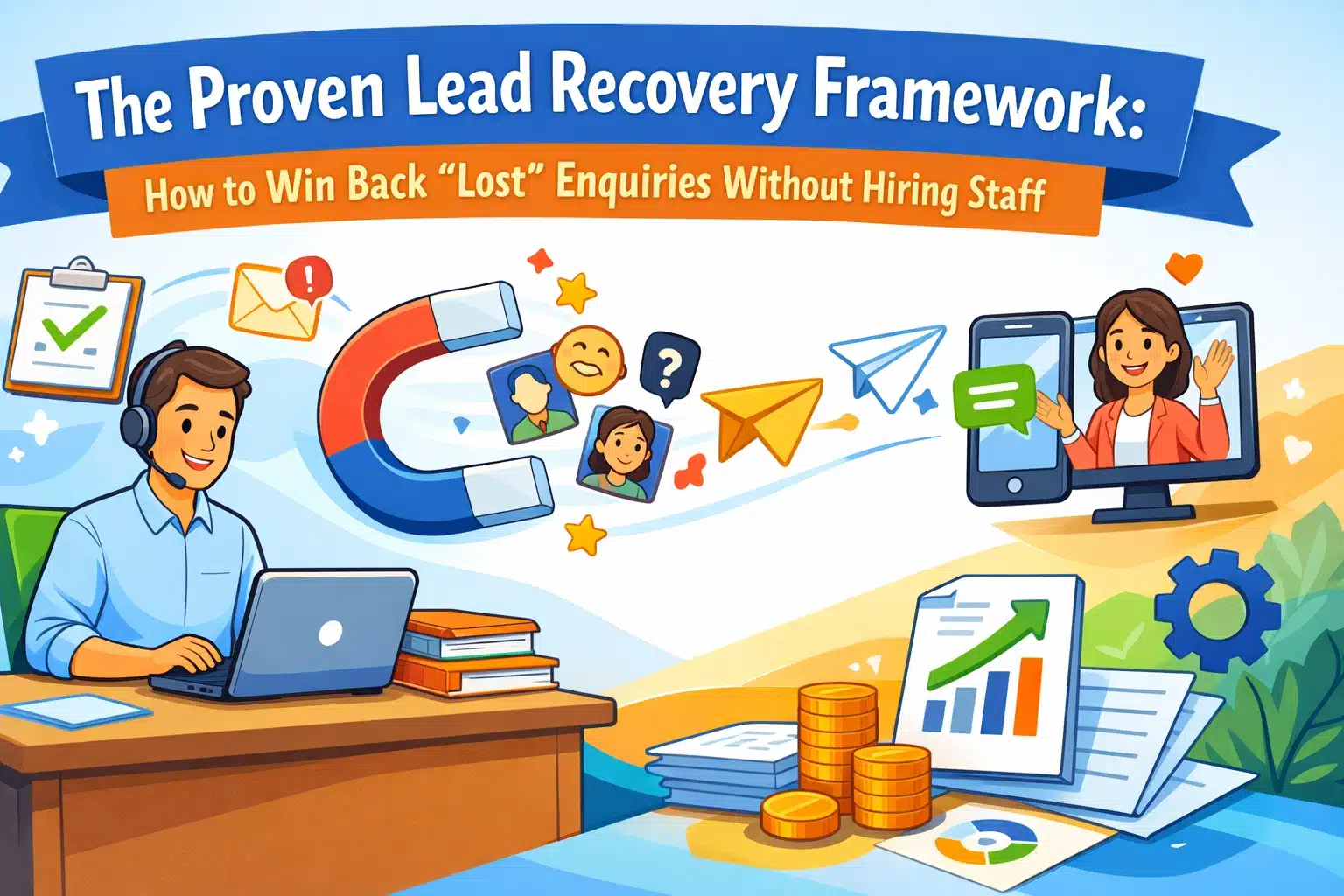
There is a better way. I’m going to walk you through our Proven Lead Recovery Framework. It’s built on the principles of Visibility, Response, and Conversion. It’s designed to help you win back those "lost" enquiries without adding a single person to your payroll.
The Reality of the "Lost" Enquiry
When a lead doesn't convert immediately, we often label it as "bad" or "tyre-kickers." We assume they weren't serious.
But research from the Harvard Business Review shows that most businesses are simply too slow. If you don't respond to a lead within five minutes, your chances of qualifying them drop by 10 times. In the UK service sector, if you aren't the first to reply, you've likely already lost the job.
The "lost" enquiry isn't usually lost because they didn't want your service. It’s lost because your process failed them. To fix this, we need to move through three specific stages.

Phase 1: Visibility – Identifying the Leaks
You cannot fix what you cannot see. Most business owners I talk to have a "gut feeling" they are missing leads, but they don't know exactly how many or where they are going.
The Audit of Silence
Start by looking at your call logs and your inbox.
- How many missed calls did you have last week?
- How many of those did you call back within 10 minutes?
- How many contact form submissions are sitting in your "info@" folder with no reply?
If you want to know the true impact, check out our guide on how much missed calls are really costing your business. The maths is often eye-watering.
Stop Using Spreadsheets
If you are still managing your enquiries via a spreadsheet (or worse, your memory), you are losing money. Spreadsheets are where leads go to die. They don't remind you to follow up, and they don't give you a clear picture of your conversion rate.
Visibility means having a central hub, a CRM or a simple enquiry management system, where every single "hello" is recorded automatically. When you can see that you had 50 enquiries last month but only 10 turned into quotes, you have the visibility needed to start the recovery process.
To understand why this is so critical, read about why spreadsheets are killing your growth.
Phase 2: Response – The 2-Minute Rule
In the digital age, speed is a service. It doesn't matter how good your craftsmanship is if the customer can't get hold of you.
The "Response" phase of our framework is about one thing: Velocity.
The First Reply Wins
We live in an "on-demand" world. If I want a pizza, I want it now. If I want a boiler repair, I want to know someone is coming now. The first business to acknowledge the enquiry almost always wins the work. This is the "First Reply Wins" mentality.
We advocate for the 2-minute rule. If you can respond within 120 seconds, you disrupt the customer’s search. They stop looking for other options because they are now talking to you.
Why You Don't Need a Human to Do This
This is where SMEs get stuck. You're on a roof or in a meeting; you can't reply in two minutes.
This is where a Digital Receptionist comes in. It’s not a person sitting in an office; it’s a system that automatically triggers a text message or an email the second a lead comes in.
- Scenario A: Customer fills in a form. You see it 4 hours later. They’ve already called someone else.
- Scenario B: Customer fills in a form. 30 seconds later, they get a text: "Hi, it's Martyn from Every Enquiry. I've got your message about the website audit. I'm on a call right now, but can I buzz you at 2:00 PM?"
Scenario B wins every time. You haven't hired anyone, but you’ve "recovered" a lead that would have otherwise gone to a competitor.

Phase 3: Conversion – The Recovery Framework
Now we get to the meat of it. How do you actually win back the ones that went cold? Maybe they enquired three weeks ago and disappeared. Most people give up. We don't.
Our Lead Recovery Framework uses a structured follow-up sequence. We call it the "Help, Don't Sell" method, heavily inspired by Marcus Sheridan’s They Ask, You Answer.
1. The Acknowledgement (The "Did You Get What You Needed?" Email)
Seven days after an enquiry goes cold, send a short, plain-text email.
- “Hi [Name], I noticed we haven’t spoken since you asked about [Service]. Did you manage to get the information you needed, or are you still looking for some help with that?”
It’s low pressure. It’s helpful. It often restarts the conversation.
2. The Educational Value Drop
If they don't reply to the first one, three days later, send them something useful. Don't ask for the sale. Give them advice.
- “Hi [Name], most people looking at [Service] are worried about [Common Problem]. I thought you might find this short guide we wrote useful while you're doing your research.”
This positions you as the expert, not just another salesperson.
3. The "Permission to Close"
After 14 days of silence, it’s time to clear your desk.
- “Hi [Name], I haven't heard back, so I'm assuming your priorities have changed or you’ve gone in a different direction. I’ll close your enquiry for now so I don't clutter your inbox. If you need us in the future, we're here.”
Paradoxically, this is often the email that gets the highest response rate. People don't like losing access to a helpful resource.
Comparing the Options: Hiring vs. Systems
Many business owners think the only way to handle more leads is to hire a part-time admin person or a virtual assistant. Let’s look at how that stacks up against a structured Lead Recovery Framework.
| Feature | Hiring an Admin Person | The Lead Recovery Framework |
|---|---|---|
| Annual Cost | £20,000 – £30,000 + NI/Pension | Fraction of the cost of one salary |
| Availability | 9-5, Monday to Friday | 24/7, 365 days a year |
| Response Speed | Depends on workload/phone lines | Instant (under 2 minutes) |
| Consistency | Varies based on mood/training | 100% consistent every time |
| Scalability | You have to hire another person | Handles 10 leads or 1,000 leads easily |
| Management | Requires HR, training, and 1-2-1s | "Set and forget" with monthly reviews |
As you can see, for most SMEs, jumping straight to a new hire is a massive financial burden. Implementing a system that fixes your leaking enquiries is almost always the smarter first move.

Addressing the "Elephant in the Room": Why Do Leads Go Cold?
In They Ask, You Answer, Marcus Sheridan talks about the importance of being honest about why customers don't buy. If we want to recover leads, we have to understand why they left in the first place.
Usually, it’s one of three things:
- Friction: Your contact form was too long, or you didn't answer the phone.
- Fear: They aren't sure how much it will cost and they're afraid of being "sold" to.
- Forgetfulness: Life got in the way. They intended to reply, but the kids started screaming or a meeting started.
Our framework addresses all three. We reduce friction with instant responses. We reduce fear by providing educational content rather than a hard sell. And we solve forgetfulness with our automated follow-up sequence.
The Hidden Cost of "Doing It Later"
Every day you operate without a lead recovery system, you are essentially burning money. If your average job value is £500, and you miss just two calls a week, that’s £1,000 a week in lost revenue. Over a year, that is £52,000.
Could you use an extra £52k in your business?
You don't need more leads. You need to handle the ones you already have better. You need to stop the hidden cost of missed enquiries from eating your profits.

How to Implement the Framework Starting Today
You don't need a degree in computer science to do this. Here are the three steps you can take right now:
1. Set Up an Auto-Responder
Whether it's on your website form or your Facebook page, ensure that anyone who messages you gets an immediate reply. Not a "we will get back to you in 24 hours" reply. A "Hi, we've got your message, here is what happens next" reply.
2. Use a "Speed-to-Lead" Tool
Consider a tool that notifies your phone instantly when a lead arrives and allows you to trigger a pre-written text message. If you want to see how we do this, take a look at our 5 steps to stop losing leads.
3. Schedule Your Follow-Ups
Open your calendar and block out 15 minutes every Tuesday morning. Use that time to look at any enquiries from the previous two weeks that didn't book. Send them the "Did you get what you needed?" email. It’s manual to start with, but it proves the concept. Once you see it working, you can automate it.
Final Thoughts: It’s About the Customer
At the end of the day, lead recovery isn't about being "salesy" or pestering people. It’s about providing a better service.
When you respond quickly, you’re being helpful. When you follow up, you’re showing that you actually care about their problem. In a world where most service businesses are notoriously difficult to get hold of, being the one who actually communicates is your biggest competitive advantage.
You don't need to hire more staff to grow. You just need to stop losing the people who are already trying to give you money.
Frequently Asked Questions
Isn't following up multiple times a bit "pushy"?
Not if you do it right. If you’re just saying "Buy from me!" it's annoying. If you’re asking "Did you get the help you needed?" or "Here is a useful guide," you’re being helpful. Most people appreciate the reminder because they simply got busy.
How much does it cost to set up an automated system?
It varies, but it is always significantly cheaper than the cost of a new employee. Usually, the system pays for itself with the very first "recovered" job. You can find more about the ROI of these systems in our post about the real cost of slow follow-ups.
Will this work for a very small business, like a solo tradesperson?
Actually, it works better for solo businesses. Because you are the one doing the work, you are the one most likely to miss calls. A recovery framework acts like a virtual assistant that never sleeps, allowing you to focus on the job at hand without worrying about the phone.
What if I don't have a website?
You can still use these principles! You can set up auto-replies on WhatsApp Business, Google Business Profile, and Facebook. The "framework" is a mindset of speed and follow-up, not just a piece of software.
What is the most important part of the framework?
Speed. The "Response" phase is the most critical. If you win the race to the first reply, the "Recovery" phase becomes much easier because you've already established a connection. Check out our guide on prompt responses to see why.