You’re spending money on ads. You’ve got a website that looks the part. You’re posting on social media. On paper, your marketing is working because the phone is ringing and the inbox is filling up. But at the end of the month, the bank balance isn't reflecting that activity.
Where is the money going?
In most UK service businesses, the money isn't lost in the "marketing." It’s lost in the "gap." It’s the gap between a prospect showing interest and a deal being closed. We call this the enquiry handling gap, and for most SMEs, it’s a leaky bucket that’s draining thousands of pounds in potential revenue every single week.
At Every Enquiry, we’ve seen it time and again. A business owner complains that "the leads are rubbish," but when we look under the hood, we find that 30% of calls go to voicemail and the average email response time is 24 hours. In today’s "on-demand" economy, that’s not just slow, it’s a business killer.
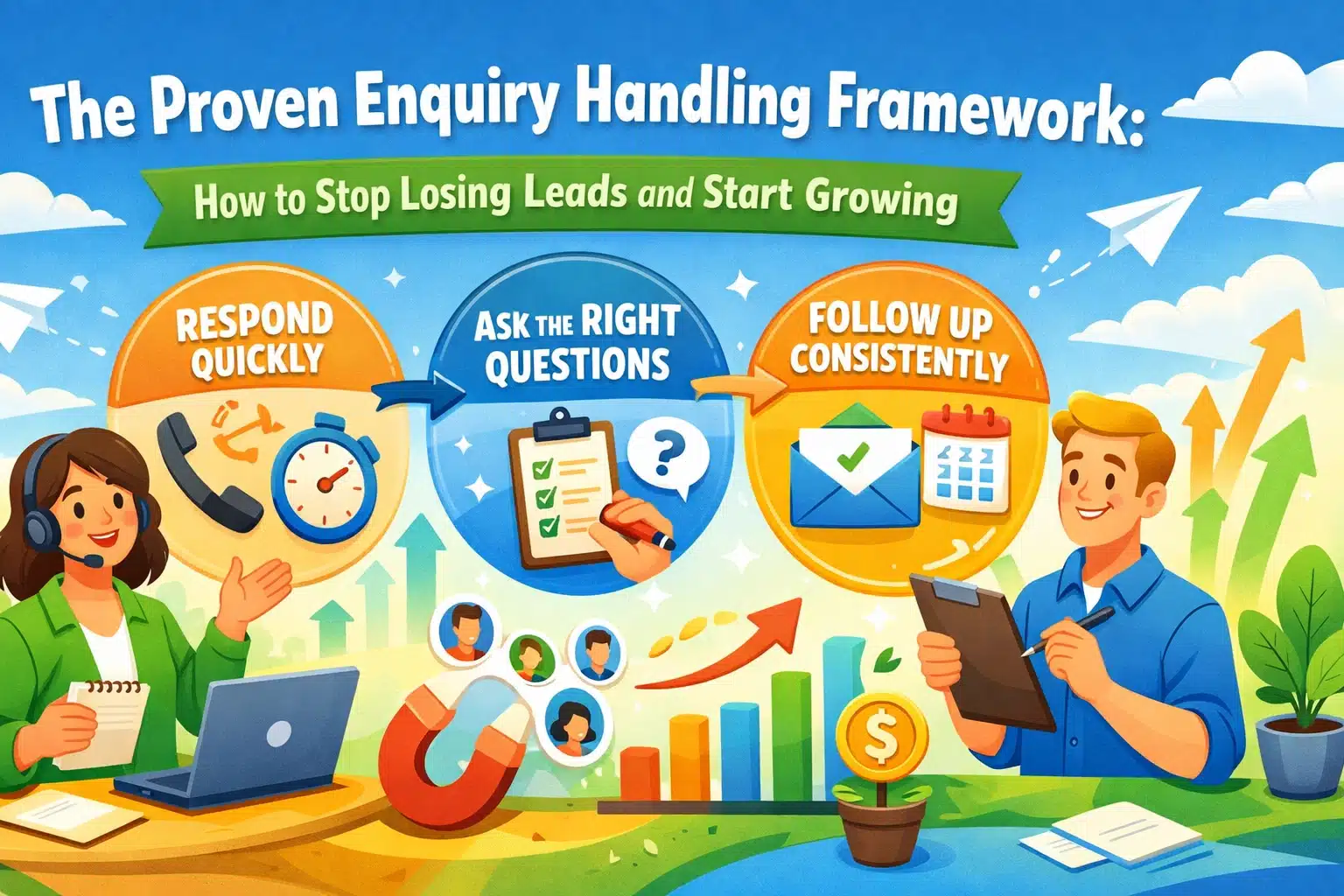
If you want to stop the leak and start growing, you need a system. Not a "hope for the best" approach, but a proven framework. This post outlines the exact Enquiry Handling Framework we use to help businesses regain control.
The Brutal Truth About Why You’re Losing Leads
Before we dive into the framework, we need to address the elephant in the room. Why are you losing leads in the first place?
According to research published by Harvard Business Review, businesses that try to contact potential customers within an hour of receiving a query are nearly seven times as likely to have a meaningful conversation as those who wait even 60 minutes.
The problem is that most small businesses aren't waiting an hour; they’re waiting a day. Or two. Or they’re missing the call entirely because they’re on-site, in a meeting, or driving.
When a prospect reaches out to you, they are at their "peak of interest." Every minute that passes after that initial contact, their interest wanes, and their likelihood of picking up the phone to your competitor increases. If you want to win, you have to be first. As we often say, first reply wins.
Phase 1: Visibility – You Can’t Fix What You Can’t See
The first pillar of our framework is Visibility. Most business owners have no idea how many enquiries they actually get. They might see the emails in their inbox, but what about the missed calls? What about the Facebook messages? What about the "contact us" form that’s been broken for three weeks?
Without visibility, you are flying blind. You’re guessing which marketing channels work and guessing how well your team is performing.
1. Audit Your Ingress Points
Where can a customer find you? Make a list of every single entry point:
- Main office phone line
- Mobile numbers on business cards
- Website contact forms
- Direct emails (info@, sales@)
- Google Business Profile (messages and calls)
- Social media (Facebook, Instagram, LinkedIn)
- WhatsApp for Business
2. Centralise the Data
The biggest mistake SMEs make is keeping enquiries in silos. The admin person has the call log, the owner has the emails, and the marketing guy has the Facebook logins. This is how leads die. You need a single source of truth, typically a CRM (Customer Relationship Management) system.
If it isn't in the CRM, it doesn't exist. This transition from "mental notes" to "digital records" is why spreadsheets are killing your growth.
3. Track the "Missed" Metric
You need to know your "Missed Call Rate." If 10 people call and you answer 7, you have a 30% failure rate at the first hurdle. For most service businesses, a missed call is a missed £500, £1,000, or £5,000 job. When you do the maths, the cost of missed calls is staggering.

Phase 2: Response – The Need for Speed
Once you can see the enquiries, you have to respond to them. But "responding" isn't enough. You have to respond fast.
We live by the 2-minute rule. In an ideal world, every digital enquiry (form, email, message) is acknowledged within two minutes. Why? Because the prospect is likely still sitting at their computer or holding their phone. If you catch them then, you’ve stopped them from Googling your competitor.
The "Always-On" Mentality
Most SMEs operate 9-to-5. Most customers browse and enquire 6-to-10 PM or on weekends. If you only respond during "business hours," you are missing the prime window for conversion.
This is where a digital receptionist or an outsourced enquiry management team becomes a game-changer. You don't need to be awake 24/7, but your business systems do.
Standard Operating Procedures (SOPs) for Responses
Don't wing it. Every response should follow a template that:
- Acknowledges the specific problem (Empathy).
- Sets expectations (Transparency).
- Offers a clear next step (Call to Action).
Marcus Sheridan’s "They Ask, You Answer" philosophy suggests that we should be the most helpful teacher in our industry. Your response shouldn't just be "I'll call you back." It should be "I’ve received your enquiry about [Service]. While I prepare your quote, here is a guide on [Common Question] that might help you."
Improving Response Times
If you’re struggling to keep up, you need to improve your response times by removing the human bottleneck. Automation can handle the "First Reply," while your expert team handles the "Meaningful Conversation."
Phase 3: Conversion – Turning "I’m Interested" into "I’m Buying"
Visibility tells you the lead exists. Response gets you the conversation. Conversion is where the money is actually made.
Most businesses stop after the first follow-up. They call once, leave a voicemail, and then "wait for the customer to call back." Newsflash: They won't call back. They’re busy. They’ve forgotten who you are. Or they’ve been called by someone more persistent.
The Power of the Follow-Up Sequence
A proven conversion framework requires at least 5 to 7 "touches." This might look like:
- Day 0: Immediate phone call + follow-up email.
- Day 1: Text message check-in.
- Day 3: Case study or "How we work" video sent via email.
- Day 7: Final "Are you still looking for help with [Problem]?" check-in.
This isn't being "pushy"; it’s being professional. You are solving a problem for them. If you stop following up, you’re essentially saying you don't care if their problem gets solved or not. This is one of the 10 reasons your lead conversion isn't working.
The "Leaky Bucket" Comparison
Let’s look at how a systematic framework compares to the "Standard SME" approach.
| Feature | Standard SME Approach | The Every Enquiry Framework |
|---|---|---|
| Enquiry Tracking | Post-it notes and memory | Centralised CRM / Real-time dashboard |
| Average Response Time | 4 – 24 hours | Under 5 minutes (Digital) / Instant (Voice) |
| Missed Call Strategy | "They'll leave a voicemail" | Immediate "Sorry we missed you" SMS + Auto-callback |
| Follow-up Consistency | One call, then forgotten | 5-7 touchpoint automated sequence |
| Data Visibility | "I think we're busy" | Exact Cost Per Lead and Conversion Rate data |
| Out-of-hours Handling | Voicemail / "Closed" sign | Digital Receptionist / AI-powered responses |

Why Most SMEs Fail to Implement This (And How to Succeed)
If this framework is "proven," why isn't every business doing it? Because it’s hard to maintain while you’re actually doing the work. If you’re a heating engineer, you’re fixing boilers. If you’re a solicitor, you’re in court. You don't have time to be a full-time lead manager.
This is why your enquiries are leaking. The "Human Bottleneck" is the single biggest ceiling on small business growth.
To succeed, you have three options:
- Hire more staff: Expensive, requires management, and they still take lunch breaks and holidays.
- Do it yourself: Leads to burnout and a plateau in growth because you can't scale your time.
- Build a system: Use a mix of smart software and dedicated enquiry management services to handle the "Visibility" and "Response" phases, leaving you to handle the high-value "Conversion" conversations.
We’ve found that businesses that implement even a basic version of this framework see an immediate 20-30% jump in revenue without spending an extra penny on advertising. You don't need more leads; you need to stop losing the leads you already have.
The Psychology of the Modern Buyer
We need to talk about why speed is now more important than quality or price in the initial stage.
According to Forbes, 78% of customers buy from the company that responds to them first. It’s not about who is the "best" anymore; it’s about who is the most "available."
In the mind of the consumer, your responsiveness to an enquiry is a direct indicator of your quality of service. If you take three days to reply to a sales enquiry when you’re trying to take their money, how long will you take to reply when there’s a problem after they’ve paid you?
That’s the question your prospects are asking themselves. Slow follow-up is a red flag. It’s higher than you think, it’s a total loss of trust before the relationship has even started.
Implementing the Framework: A 30-Day Action Plan
If you want to adopt the Proven Enquiry Handling Framework, here is how to start:
Days 1-7: The Audit
Track every single enquiry that comes in for one week. Use a simple tally chart if you have to. How many were calls? How many were emails? How many did you miss? Be honest. It might be painful to see how much money is slipping through your fingers, but is your website losing you money? You need to know.
Days 8-15: The "First Response" Fix
Set up an auto-responder for your emails and contact forms. But don't just say "We'll get back to you." Give them value. Link to your pricing page, your FAQ, or a video of you explaining your process. This keeps them engaged on your site instead of wandering back to Google.
Days 16-23: Solve the Phone Problem
If you can't answer the phone 100% of the time during business hours, get help. Whether it’s a dedicated virtual assistant or an automated SMS-back system for missed calls, ensure no caller ever hits a "dead end."
Days 24-30: The Follow-Up Habit
Go back through every enquiry from the last 30 days that didn't book. Call them. Email them. Ask if they’ve solved their problem yet. You’ll be amazed at how many people just "got busy" and are grateful for the reminder.
Summary: Predictable Growth is a Process
Growth isn't a mystery. It isn't reserved for the businesses with the biggest ad budgets. It belongs to the businesses with the best systems.
By focusing on Visibility (knowing your numbers), Response (winning the race to the lead), and Conversion (consistent, helpful follow-up), you move away from the "feast and famine" cycle of small business life and into a world of predictable, scalable growth.
Stop blaming the marketing. Stop blaming the "quality of leads." Look at your framework. If it’s broken, fix it. If it doesn't exist, build it.
Your business, and your bank balance, will thank you.
Frequently Asked Questions (FAQ)
1. I’m a one-person business; how can I respond in 2 minutes?
You can't do it manually, and you shouldn't try. Use automation. An automated SMS that triggers the moment a form is filled out or a call is missed can do the heavy lifting for you. It buys you time to finish the job you’re on while letting the prospect know you’ve heard them.
2. Isn't following up 5-7 times a bit "spammy"?
Only if you’re being annoying. If your follow-ups are educational, "Hey, I thought this article might help you decide on the right material for your project", then you are being helpful. If they tell you to stop, you stop. But until they say "No," assume they are just busy and need your help.
3. What is the most important metric to track?
"Speed to Lead" (average time to first response) and "Missed Call Rate." If you fix those two, almost everything else in your sales process will improve automatically.
4. Do I really need a CRM? Can’t I just use my inbox?
Inboxes are where leads go to be forgotten. A CRM allows you to set reminders, track the total value of your pipeline, and see exactly where people are dropping off. For any business wanting to grow beyond a certain point, a CRM is non-negotiable.
5. How much does a "leaky bucket" actually cost?
Calculate your average job value. Now, multiply that by the number of enquiries you don't reach or don't follow up with each month. If your average job is £1,000 and you miss 5 enquiries a month, you are losing £60,000 a year in potential revenue. That’s usually more than enough to justify investing in a better system.