Let’s be honest for a second. You’re spending a small fortune on marketing. Whether it’s Google Ads, local SEO, or social media management, you’re doing the hard work of getting people to notice you. But then the phone rings, or an email drops into the inbox, and… what happens next?
For many UK service businesses, this is where the wheels fall off.
At Every Enquiry, we see it every day. Small to medium-sized enterprises (SMEs) are often brilliant at the "doing", the plumbing, the legal advice, the landscaping, the consulting, but they are unintentionally sabotaging their own growth because of how they handle (or don't handle) their leads.
It’s like filling a bucket with a massive hole in the bottom. You can keep pouring more water (leads) in, but you’re never going to get a full bucket if the hole stays there.
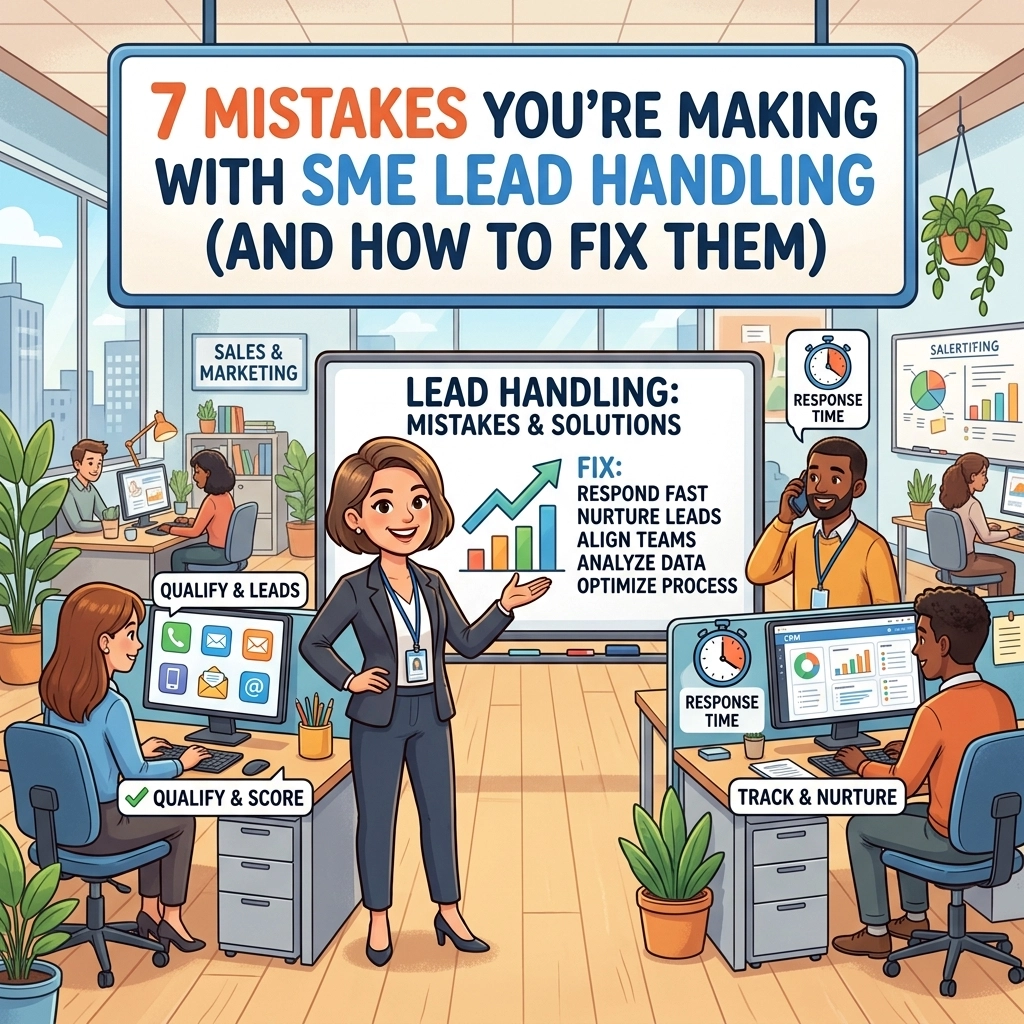
If you feel like you’re working harder than ever but your bank balance isn't reflecting the effort, you might be making one of these seven common lead-handling mistakes. Let’s break them down using our framework of Visibility, Response, and Conversion.
Section 1: Visibility – If You Can’t See It, You Can’t Fix It
Visibility is the foundation of any enquiry management system. If you don't know where your leads are coming from or where they are going, you are flying blind.
Mistake 1: The Spreadsheet Cemetery
I get it. When you started, a spreadsheet was easy. It was free. But as you grow, spreadsheets become the place where leads go to die. They are static, they aren't real-time, and they don't remind you to call someone back.
Using a spreadsheet means you have zero visibility over your sales pipeline. You can’t easily see which leads are "hot" and which have gone cold. More importantly, spreadsheets don't talk to your marketing. You have no idea if that lead came from a £50-a-click Google Ad or a random Facebook post.
The Fix: You need a dedicated enquiry management system. This isn't just about "software"; it's about having a central hub where every single phone call, contact form, and WhatsApp message is logged automatically. Moving away from manual entry reduces human error and gives you the data you need to make actual business decisions.
Check out why spreadsheets are killing your growth and how a system change can save your sanity.

Mistake 2: Treating Every Lead Exactly the Same
Not all leads are created equal. A "lead" could be someone ready to spend £10,000 today, or it could be a student doing research for a project. If your team is treating both with the same priority, you’re wasting your most valuable resource: time.
When you lack visibility into lead quality, your sales team (or you, if you’re wearing the sales hat) ends up chasing "tyre-kickers" while the high-value prospects get frustrated and go to your competitor.
The Fix: Implement a basic lead scoring or qualification framework. Ask a few qualifying questions on your web forms to filter the serious buyers from the browsers. By categorising leads as they come in, you can ensure your best people are talking to the best prospects immediately.
Mistake 3: The "Black Box" of Marketing ROI
Do you know exactly which marketing channel is delivering your most profitable enquiries? Most SMEs don't. They know they spent £1,000 on "digital marketing," and they know they got some jobs, but they can't connect the dots.
Without this visibility, you might be doubling down on social media when your best leads are actually coming from local search. You’re essentially guessing with your marketing budget.
The Fix: Close the loop. Your enquiry handling system should track the source of every lead. When a lead converts into a sale, you should be able to look back and see exactly which ad or search term brought them to you. This is the key to predictable business growth.
Section 2: Response – The Need for Speed
Once a lead is visible, the clock starts ticking. In the world of modern service businesses, speed isn't just an advantage; it's a requirement.
Mistake 4: The Deathly Slow Response
According to research published in the Harvard Business Review, businesses that try to contact potential customers within an hour of receiving a query are nearly seven times as likely to have a meaningful conversation as those who wait even 60 minutes.
If you’re waiting until the end of the day, or worse, the next day, to reply to an enquiry, you’ve already lost. The prospect has likely called three other businesses in the meantime. The first person to pick up the phone usually wins the job.
The Fix: You need to aim for the "2-minute rule." Even if you can’t give a full quote in two minutes, an automated SMS or a quick call to say, "I've seen your enquiry, I'm just finishing a job, I'll call you at 4 PM," sets you apart from 90% of your competition.
Read more about why the 2-minute rule is your best sales tool.
Mistake 5: The Expensive Sound of Silence (Missed Calls)
Every missed call is a missed opportunity. For an SME, a missed call isn't just a nuisance; it has a literal price tag. If your average job value is £500 and you miss five calls a week, that’s £2,500 in potential revenue gone. Over a year, that’s £130,000.
Can your business really afford to lose six figures because you were "too busy" to answer the phone?
The Fix: You don't necessarily need to hire a full-time receptionist. A digital receptionist or a professional enquiry handling service can ensure that every call is answered by a real human, 24/7. This ensures you never "leak" leads simply because you were on a ladder or in a meeting.

Section 3: Conversion – Turning "Hello" into "Hire"
Visibility and Response get you to the starting line. Conversion is how you win the race.
Mistake 6: Giving Up Too Soon (The One-Touch Wonder)
Most SMEs follow up on a lead once. Maybe twice. If they don't get a response, they assume the prospect isn't interested and move on.
This is a massive mistake. Research from HubSpot suggests that 80% of sales require at least five follow-up calls after the initial meeting. Yet, 44% of sales reps give up after just one follow-up.
People are busy. They get distracted. They forget. Your job isn't to be "annoying"; it's to be helpful and persistent.
The Fix: Create a structured follow-up cadence.
- Day 1: Initial call and email.
- Day 2: Follow-up SMS.
- Day 4: Second follow-up call.
- Day 7: "Are you still interested?" email with a helpful resource.
By systematising this, you take the emotion out of it. You aren't "bugging" them; you are following your process. This is how you turn enquiries into sales without spending more on marketing.
Mistake 7: Ignoring the "Not Ready Yet" Leads
Sometimes a lead is genuinely interested but the timing isn't right. Maybe their budget hasn't been approved, or they’re waiting for another project to finish.
Most SMEs simply delete these leads or let them rot in the "spreadsheet cemetery." This is a waste of the money you spent to acquire that lead in the first place.
The Fix: Lead recycling. If a lead isn't ready to buy now, move them into a long-term nurture sequence. Send them a monthly newsletter or a helpful guide related to your service. When they are ready to buy in six months, who do you think they’ll call? The person who stayed in touch.
Comparison: Manual vs. Systematised Lead Handling
To help you visualise the difference, let’s look at how the two approaches stack up.
| Feature | The "Old Way" (Manual) | The Every Enquiry Way (Systematised) |
|---|---|---|
| Data Entry | Manual spreadsheets (often forgotten). | Automatic logging of every touchpoint. |
| Response Time | "When I get a minute" (Hours or days). | The 2-minute rule (Instant or <5 mins). |
| Follow-up | One call, then forgotten. | Automated 5-8 step follow-up cadence. |
| Lead Source | "I think they saw us on Google." | Precise tracking of every marketing penny. |
| Missed Calls | Go to voicemail (and then to a competitor). | Answered 24/7 by a professional system. |
| Conversion Rate | Low (5-10%). | High (25% or more). |
The "They Ask, You Answer" Perspective: Why is this so hard?
You might be reading this and thinking, "Martyn, this sounds great, but I'm just one person (or a small team). I don't have time to be a 'sales ninja' while also doing the actual work."
We hear this all the time. The reason SME lead handling is usually a mess isn't because business owners are lazy. It’s because they are overwhelmed.
They fear that "automation" means losing the personal touch. They fear that a CRM will be too complicated. They fear that hiring help will be too expensive.
But here is the honest truth: The most expensive thing in your business is a lead that doesn't convert.
If you spend £1,000 on marketing and get 10 leads, each lead cost you £100. If you only convert one of them because your follow-up was slow, your "Customer Acquisition Cost" is £1,000.
If you fix your lead handling and convert four of those leads, your cost per customer drops to £250. You’ve just made your business four times more efficient without spending a single extra penny on ads.

How to Start Fixing Your Lead Handling Today
You don't have to fix all seven mistakes by Monday morning. Start with the "big wins."
- Stop the Leaks: Get a system in place to ensure no call goes unanswered. Whether that’s a digital receptionist or a better phone routing system, this is your quickest win.
- Audit Your Speed: Send a test enquiry through your own website. How long does it take for someone to get back to you? If it’s more than 10 minutes, you have a problem.
- Ditch the Spreadsheets: Even a basic CRM is better than a spreadsheet. Move your data into a system that allows for enquiry management.
If you’re struggling to figure out where your enquiries are leaking, we have a 5-step framework to stop losing leads that can help you get started.
The Real Cost of Doing Nothing
The UK market is getting more competitive. Customers have more choices than ever, and their patience is at an all-time low. If you don't provide a professional, rapid, and consistent experience from the very first "hello," your competitors will.
The hidden cost of missed enquiries is higher than you think. It’s not just the lost job today; it’s the lost lifetime value of that customer and the lost referrals they would have brought you.
Frequently Asked Questions (FAQ)
1. I’m a small business; do I really need a "system" for leads?
Yes. In fact, small businesses need systems more than big ones. Large companies have teams of people to manually fix mistakes. You don't. A system acts as a force multiplier, allowing you to handle the volume of a much larger company without the massive overhead.
2. Is automated follow-up too impersonal for a service business?
It doesn't have to be. You can write your automated emails and texts in your own voice. The goal of automation isn't to replace the human connection; it’s to make sure the human connection actually happens. An automated text saying "Hi, it's Martyn. I'm on a job but saw your enquiry: can I call you at 4 PM?" feels very personal to the recipient.
3. How much should I be spending on lead handling?
Instead of looking at the cost, look at the "opportunity cost." If a professional enquiry handling system costs you £200 a month but helps you close just one extra £500 job, it has paid for itself and made you a profit. Most businesses find that fixing their lead handling is the highest ROI "marketing" they ever do.
4. What is the biggest mistake you see UK SMEs making?
Without a doubt, it’s speed of response. We live in an "Amazon Prime" world. If someone fills out a form at 8 PM on a Tuesday, they expect a response quickly. If they don't get one, they keep searching. First reply wins isn't just a catchy phrase; it's a statistical reality.
5. Can Every Enquiry help me if I already have a CRM?
Absolutely. A CRM is just a tool; Every Enquiry is about the process. We help you optimise how that tool is used, ensuring that your visibility, response times, and conversion sequences are all working together to grow your business.
6. What if my leads are "low quality"?
Then your system needs better "Visibility" and qualification. By adding specific questions to your intake process, you can automatically sort leads. You shouldn't stop handling "low quality" leads, but you should stop letting them distract you from your "high quality" ones.
7. How long does it take to see results from fixing these mistakes?
Usually, the results are almost instant. As soon as you start answering more calls and responding to emails within minutes rather than hours, your booking rate will climb. Most of our clients see a noticeable difference in their conversion rate within the first 30 days.
Ready to stop the leak?
Don't let another lead slip through the cracks. If you're tired of the "feast and famine" cycle and want a predictable way to grow your service business, it's time to look at your enquiry handling.
You’ve done the hard work of getting people to find you. Now, let’s make sure you don't let them go. Check out our guide on 5 steps to stop losing leads without hiring more staff and start building a more resilient, profitable business today.