If you run a service business in the UK, you’ve likely felt the frustration of watching a promising lead go stone-cold. You’ve paid for the marketing, your website did its job, the enquiry landed in your inbox, and then… nothing. Silence.
Most business owners react to a dip in sales by trying to "get more leads." They pump more money into Facebook ads or Google PPC, hoping that a fresh batch of enquiries will fix the revenue gap. But there’s a massive problem with that logic. If your bucket has holes in it, pouring more water in won't fill it up. It just wastes water.
Strategic lead recovery is the process of patching those holes. It’s about going back to the people who already expressed interest in you but didn't buy, yet. Research shows that re-engaging ghosted leads costs 60-70% less than acquiring brand-new ones.
In this guide, we’re going to show you how to build a systematic lead recovery process that generates more profit from the leads you already have, without the need to hire a single new member of staff.
The Reality of the "Leaky Bucket"
Let's be honest: SME owners are busy. Whether you’re running a plumbing firm, a law practice, or a consultancy, your day is a whirlwind of operations, staff management, and firefighting. When a new enquiry comes in, you try to get to it. If they don't answer or they say, "I'll think about it," they usually fall into the CRM graveyard (or worse, stay buried in your "Sent" folder).
According to a study by the Harvard Business Review, the average response time for companies that responded within 30 days was 42 hours. In today’s "I want it now" culture, 42 hours is an eternity. By the time you follow up, the lead has likely moved on to a competitor who was faster.
But those "lost" leads aren't necessarily dead. They might have just been distracted. Life happens. A kid got sick, a deadline loomed, or they simply forgot. If you don’t have a system to recover them, you’re essentially throwing money away. You can see how much missed calls and leads are really costing you here.
Phase 1: Visibility – Auditing the "Graveyard"
You can’t fix what you can’t see. The first step in strategic lead recovery is gaining total visibility over your past enquiries.
Many small businesses struggle because they use what we call "disjointed systems." A bit of paper here, a spreadsheet there, and a few dozen unread emails. If you’re still using spreadsheets to manage your business growth, you’re likely killing your potential.
The CRM Audit
Go into your CRM or your email history and look for leads from the last 6 to 12 months who:
- Requested a quote but never replied to it.
- Had an initial discovery call but didn't book a follow-up.
- Said "not right now" or "maybe later in the year."
Categorise these leads. Are they "high-value" prospects that just went quiet? Or were they just tyre-kickers? Using Marcus Sheridan’s They Ask, You Answer principles, we want to focus our recovery efforts on the people who actually have the problems we solve, not just anyone with an email address.

Identifying the Why
Why did they leak? If you want to stop losing leads in the future, you have to understand the point of failure.
- Did you take too long to respond? (Check out the 2-minute rule).
- Was your quote confusing?
- Did you fail to answer their biggest fears or questions about price?
Visibility isn't just about looking back; it's about looking at your current process and admitting where it’s broken. If your website is losing you money because it’s hard for people to get a clear answer, that's where you start.
Phase 2: Response – The Art of Re-Engagement
Once you’ve identified who to target, you need a strategy to reach out. Most businesses fail here because their follow-up is desperate. "Hi, just checking in to see if you want to buy yet?" is not a strategy. It’s an annoyance.
To succeed in lead recovery, your response must be value-first.
The "They Ask, You Answer" Re-Engagement
Instead of asking for a sale, provide an answer. Think about the most common questions your customers ask.
- "How much does X cost?"
- "What are the common problems with Y?"
- "How do I compare Company A vs. Company B?"
If a lead went cold six months ago, send them an educational piece of content.
“Hi [Name], I remember we spoke back in September about your roofing project. We recently put together a guide on the 5 things to look for in a contractor to avoid being overcharged. Thought it might be useful for you. No pressure, just wanted to share!”
This positions you as a teacher and an authority, not a salesperson. This is the core of how to turn enquiries into sales without spending more on marketing.
Multi-Channel Recovery
Don't just rely on email. Inboxes are crowded.
- LinkedIn: If you’re in the B2B space, a quick "Congratulations on the new role" or a meaningful comment on their post can spark a conversation.
- WhatsApp: For many trades and local services, WhatsApp is the preferred communication tool. A quick, casual message is often more effective than a formal email.
- Digital Receptionist: Sometimes, the best way to recover a lead is to ensure the next time they call, someone actually answers. A digital receptionist can handle the initial triage so you never miss the window of opportunity again. Find out if your business needs one here.
Speed is Still King (Even in Recovery)
If a cold lead suddenly replies to your recovery email, you must be on it immediately. The "first reply wins" rule applies to re-engaged leads just as much as new ones. If you take three days to reply to a revived lead, you’ll just kill it again. Learn how to beat your competition with faster response times.
Phase 3: Conversion – Closing the Gap Without New Hires
The goal of lead recovery is to increase your conversion rate. If you can move your conversion from 10% to 15% just by following up with old leads, you’ve grown your business by 50% without spending an extra penny on ads.
To do this effectively without hiring more staff, you need systems, not "hustle."
Comparison: Manual Follow-up vs. Strategic Lead Recovery Systems
| Feature | Manual "Hustle" | Strategic Recovery System | Hiring a New Salesperson |
|---|---|---|---|
| Cost | High (Your time is expensive) | Low (Software + Process) | Very High (Salary + National Insurance) |
| Consistency | Low (Depends on how busy you are) | High (Automated or Scheduled) | Medium (Depends on the individual) |
| Scalability | Poor | Excellent | Difficult/Expensive |
| Lead Quality | Variable | High (Re-engaging warm leads) | Variable |
| Focus | Firefighting | Predictable Growth | Management Overhead |
As you can see, a system beats manual effort every time. This is how you move from being "busy" to being "scalable".
The Strategic "Breakup" Email
Sometimes, the best way to convert a lead is to let them go. The "Breakup Email" is a powerful tool in lead recovery. It uses the psychology of loss aversion.
“Hi [Name], I’ve reached out a few times and haven’t heard back, so I’m assuming this project isn't a priority for you right now. I’m going to close your file for now so I’m not clogging up your inbox. If you ever want to revisit this in the future, you know where I am.”
This email often gets a 30-40% response rate. Why? Because people don't like doors being closed on them. It forces a "yes" or "no" and cleans up your pipeline.

Tactical Experiments You Can Run Today
You don't need a month of planning to start recovering leads. You can start this afternoon. Here are three experiments that take less than 30 minutes:
- The 3-Minute Reconnect: Pick 5 leads from 4 months ago. Reply to the last email thread with: "It’s been a while since we spoke about [Subject]: did you ever get that sorted, or is it still on your to-do list?"
- The "News Share": Find a recent industry change (e.g., a new regulation for landlords or a change in material costs). Send it to 10 dormant leads with a note: "Saw this and thought of our conversation. Might affect your plans for next year."
- The CRM Clean-up: Go through your "leads" folder. If someone hasn't replied in 90 days, send the "Breakup Email" mentioned above.
These small actions create momentum. They turn the "static" in your business into "signal." For a more structured approach, you might want to look at our 5-step framework for improving response times.
Why This Works for SMEs (And Why You Shouldn't Hire Yet)
Many SMEs think the answer to "we have too many leads to follow up on" is "we need an admin person."
But hiring is expensive, risky, and takes time to manage. Before you hire, you should optimise. Strategic lead recovery uses technology and smart messaging to do the work of a full-time employee. By implementing the 3 systems that fix enquiry leaks, you might find that your current team (even if that's just you) is perfectly capable of handling more volume: once the "waste" is removed.
Address the Elephant in the Room: "I don't want to be pushy"
This is the number one fear of UK business owners. We don't want to be the "annoying double-glazing salesman."
But there is a massive difference between pestering and persisting.
- Pestering is asking for things (time, money, attention).
- Persisting is providing value (answers, insights, help).
If you follow the They Ask, You Answer philosophy, you aren't being pushy. You’re being helpful. You’re ensuring that the person who had a problem six months ago actually gets it solved. If they don't buy from you, they might buy from someone worse. It is your professional duty to follow up.
Moving Toward Predictable Growth
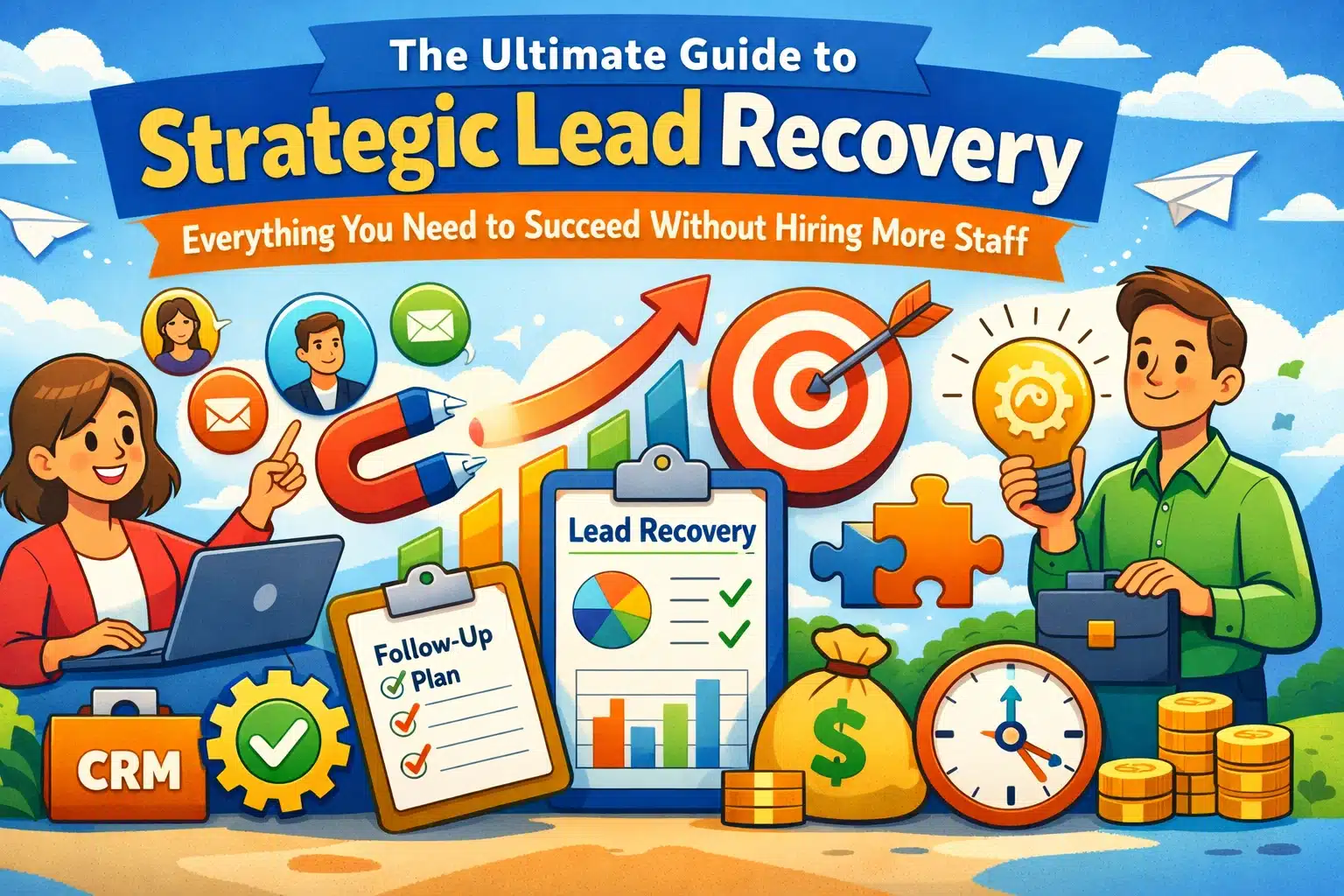
Strategic lead recovery is not a one-time event. It should be a core sales motion in your business. When you combine visibility (knowing who went cold), response (providing value-first outreach), and conversion (using systems to close the gap), you create a predictable engine for growth.
You don't need a bigger team. You need a better system. You need to stop the leaks, answer the questions your customers are actually asking, and show up when your competitors have given up.
If you’re ready to stop losing leads and start recovering the "gold" sitting in your CRM, it’s time to look at your enquiry handling. Whether it's through better website optimisation, social media management that actually converts, or a digital receptionist to catch every call, the path to growth is already in front of you.
Frequently Asked Questions (FAQ)
1. Isn't lead recovery just "spamming" people who didn't buy?
Not if you do it right. Spam is irrelevant, unsolicited, and self-serving. Strategic lead recovery is relevant (they contacted you first), timely, and value-driven. If you provide a helpful answer or a useful resource, most people will appreciate the follow-up, even if they aren't ready to buy yet.
2. How far back should I go when looking for "cold" leads?
For most service businesses, 6 to 12 months is the sweet spot. Anything longer than that and the person's circumstances have likely changed too much. However, for large projects (like home renovations or long-term consultancy), leads can remain viable for up to 2 years.
3. I’m a "one-man band": how do I find time for this?
This is exactly why you need a system. You shouldn't be manually emailing every person. You can use simple CRM automations or scheduled "power hours" once a week. Alternatively, using a digital receptionist service can free up your time from answering new calls so you can focus on closing the high-value leads you already have.
4. What if they tell me to go away?
That’s actually a good thing! A "No" is the second-best answer in sales. It allows you to stop spending time and energy on that lead and move on to someone who is actually interested. The "Breakup Email" is designed to get exactly this result.
5. Do I need expensive software to do this?
No. While a good CRM helps, you can start lead recovery with just your email sent folder and a basic calendar. The strategy and the tone of your messaging are far more important than the tools you use. As you grow, you can move away from spreadsheets to more structured enquiry management systems.
6. How many times should I follow up before giving up?
Research suggests it takes between 5 and 12 touchpoints to close a sale. Most SMEs give up after one or two. A strategic recovery sequence might involve 3-4 value-driven emails over a few weeks, followed by a final breakup email. If there’s still no response, you can move them to a long-term "nurture" list.