Let’s be honest. You’ve probably spent a small fortune on your website, your SEO, or those Google Ads that seem to get more expensive every single month. You’re doing the hard work. The phone is ringing, the contact forms are landing in your inbox, and your DM notifications are buzzing.
But here is the painful truth most SME owners don’t want to admit: getting the lead is the easy part. Managing that lead so it actually turns into money in the bank? That’s where most UK service businesses are failing.
If you’ve ever found a contact form from three days ago buried in your junk folder, or if you’ve "meant to call that guy back" but forgot his name by 5 PM, you have a leaky bucket. You are literally pouring marketing budget into a container full of holes.
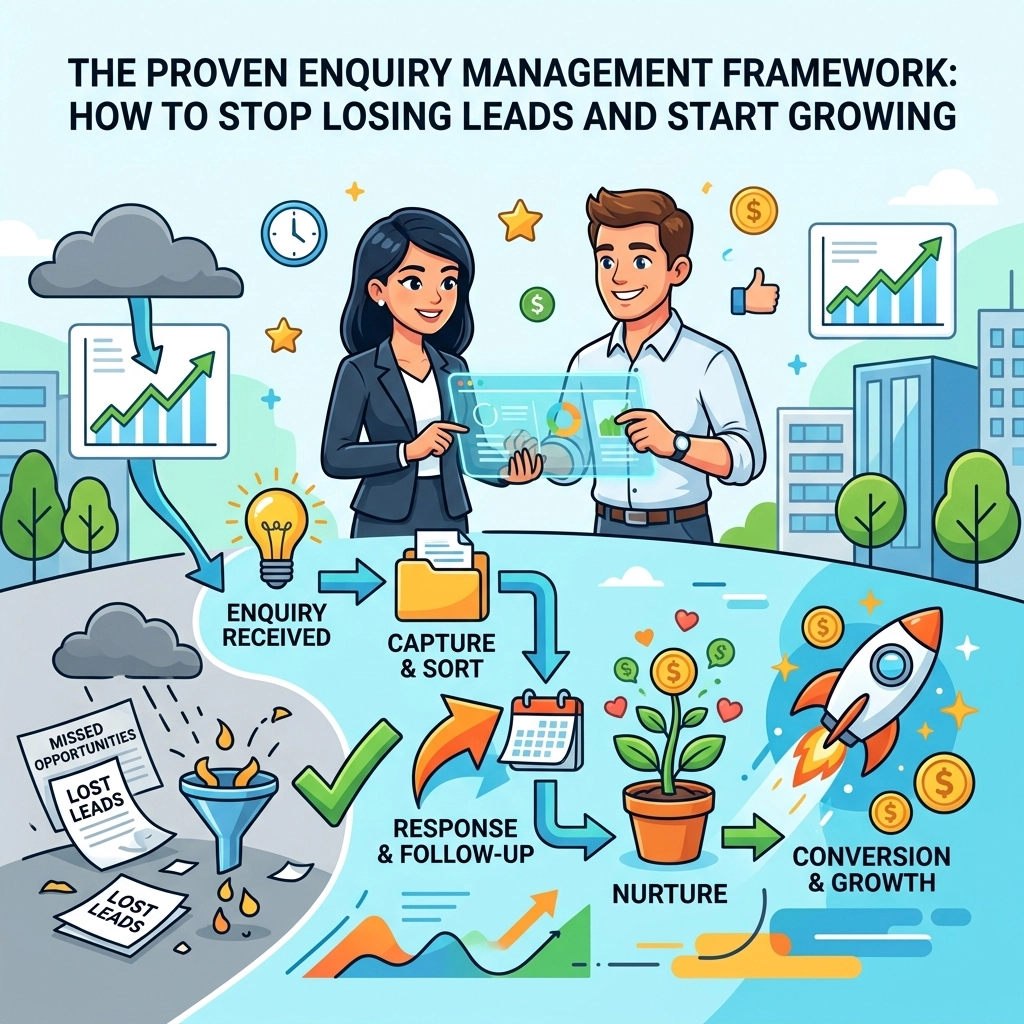
At Every Enquiry, we’ve seen this play out hundreds of times. We call it the "Enquiry Gap." It’s the space between someone saying "I’m interested" and someone actually paying you. To bridge that gap, you don't need more leads. You need a better framework.
In this guide, I’m going to walk you through our proven three-stage framework: Visibility, Response, and Conversion. This isn't just theory; it’s the exact system we use to help trades and professional firms stop losing leads and start growing.
Phase 1: Visibility – If You Can’t See It, You Can’t Sell It
Most SMEs think visibility means "being seen" on Google. While that’s part of it, true enquiry management starts with internal visibility. You need to know exactly where every single lead is coming from and exactly where it is in your "pipeline" at any given moment.
The Problem with the "Mental CRM"
Many business owners manage their enquiries via their memory or a cluttered email inbox. This is a recipe for disaster. According to research by Forbes, businesses that use a structured system to manage leads see a significant increase in revenue compared to those that wing it.
When you rely on your memory, things get missed. You forget the lead who called while you were on a loud construction site. You miss the email that came in at 9 PM on a Sunday. To fix this, you need to centralise.
Centralising Your Enquiries
The first step of the framework is to ensure every single enquiry, whether it’s a phone call, a website form, a Facebook message, or a WhatsApp, lands in one place.
- Phone Calls: If you miss a call, do you have a log?
- Contact Forms: Do these go to a general "info@" email that everyone ignores?
- Social Media: Are your DMs sitting unanswered for days?
By centralising these, you gain visibility. You can see that you had 20 enquiries this week but only booked three jobs. That data is gold. It tells you exactly where the "leak" is. If you're wondering why your current setup isn't working, check out our breakdown of 10 reasons your lead conversion isn’t working.
"They Ask, You Answer" Content
Visibility also means being transparent with your prospects before they even reach out. Following Marcus Sheridan’s "They Ask, You Answer" principles, your website should be answering the "Big 5" questions:
- Pricing and Costs.
- Problems (the stuff that could go wrong).
- Comparisons (you vs. the other guy).
- Reviews/Best of lists.
- The "What’s in it for me" factor.
When you address these openly, the leads that do come through are higher quality. They already trust you because you’ve been honest. This makes the next stage of the framework much easier.

Phase 2: Response – The Need for Speed
Once you have visibility, the clock starts ticking. In the world of UK service businesses, whether you’re a plumber, an accountant, or a landscaper, the first person to reply usually wins the job.
The 2-Minute Rule
We live in an era of instant gratification. If I’m looking for a boiler repair, I’m not going to wait 24 hours for you to check your emails. I’m going to call the next person on the list.
Research suggests that you are 21 times more likely to qualify a lead if you respond within five minutes versus waiting 30 minutes. At Every Enquiry, we push for the 2-minute rule. Speed of response is your most powerful sales tool.
Why You’re Failing at Response
Most SMEs fail here because they are too busy doing the actual work. You’re on-site, you’re in meetings, or you’re driving. You can’t pick up the phone.
This is where the concept of a "Digital Receptionist" comes in. It’s not just an answering service; it’s a system that ensures every enquiry gets an immediate, professional, and helpful response. If you’re not sure if this fits your business, read more about what a digital receptionist actually is.
The "First Reply Wins" Strategy
If you can’t answer the phone personally, you need a backup. This could be:
- Automated SMS: "Hi, thanks for calling [Business Name]. I'm on a job right now, but I can call you back at 2 PM. Is that okay?"
- Instant Email Call-Backs: As soon as a form is filled, an automated response goes out with a link to book a time in your calendar.
The goal is to stop the prospect from looking at your competitors. If you give them a quick, professional response, they feel looked after, and they stop searching. We’ve written a deeper dive into how to improve response times and beat your competition.

Phase 3: Conversion – The Fortune is in the Follow-Up
You’ve got the lead (Visibility). You’ve replied quickly (Response). Now, you need to turn that conversation into a sale (Conversion). This is where the framework separates the pros from the amateurs.
Stop Using Spreadsheets
If you are still using a spreadsheet to track your sales, you are killing your growth. Spreadsheets are where leads go to die. They are static, they don't send reminders, and they are difficult to manage on the go.
To convert at a high level, you need a system that prompts you to follow up. You can read more about why spreadsheets are killing your growth here.
The 5-Touchpoint Rule
Most SME owners give up after one or two failed attempts to reach a lead. "They must not be interested," you tell yourself.
The reality? Most sales require between five and seven touchpoints before a decision is made. A touchpoint isn't just a phone call. It can be:
- A helpful case study sent via email.
- A "How-to" guide relevant to their enquiry.
- A quick text to check if they have any more questions.
- A video testimonial from a similar client.
By using the "They Ask, You Answer" approach, your follow-ups shouldn't be "just checking in" (which is annoying). They should be "I thought this might help you make a decision." This builds authority and keeps you top-of-mind.
Handling the "Price" Objection
When a prospect asks "How much?", most business owners get defensive or vague. Following our framework, you should address price early and often. Even if you can’t give an exact quote without seeing the job, you can explain the factors that influence the price.
When you are transparent about costs, you filter out the "tyre-kickers" and convert the serious buyers much faster. For more on this, check out our guide on how to turn enquiries into sales without spending more on marketing.

Comparing Your Enquiry Management Options
Not all systems are created equal. Depending on the size of your business and your growth goals, you have a few ways to handle this framework.
| Feature | The "DIY" Approach | Basic Answering Service | Every Enquiry Framework |
|---|---|---|---|
| Response Speed | Whenever you’re free | Within 5-10 rings | Instant (under 2 mins) |
| Lead Tracking | Your memory/Email | Message taking only | Full CRM integration |
| Follow-up | Rare/Inconsistent | None | Automated & Manual |
| Cost Transparency | Avoided until the end | N/A | Addressed upfront |
| Conversion Focus | Low | Low | High |
| Scalability | Non-existent | Limited | Built for growth |
As the table shows, the "DIY" approach: while free: is actually the most expensive option because of the hidden cost of missed enquiries.
Why SMEs Struggle to Implement This (And How to Fix It)
We get it. You're a business owner, not a systems engineer. Implementing a framework like this feels like another job on top of an already massive workload.
The most common fear we hear is: "If I automate things, will I lose the personal touch?"
The answer is actually the opposite. By automating the "boring" stuff: like initial responses and appointment reminders: you free up your time to actually talk to your customers when it matters most. You aren't losing the personal touch; you're making sure you have the capacity to deliver it.
Step 1: Audit Your Leakage
Spend one week tracking every missed call and every late email reply. Use our simple maths guide to work out how much money you’re leaving on the table. Usually, it's enough to pay for a professional system ten times over.
Step 2: Fix the Response
Don't worry about a fancy CRM yet. Just fix the response speed. Whether that's hiring a digital receptionist or setting up basic auto-replies, ensure no lead waits more than 10 minutes for a "Hello."
Step 3: Implement the Follow-Up
Commit to five touchpoints. If someone doesn't book immediately, don't write them off. Send them a helpful article from your blog. Show them you’re the expert. If you need a starting point, here is our 5-step framework to stop losing leads without hiring more staff.

Final Thoughts: Growth is a Choice
Growth doesn't happen by accident. It happens when you stop focusing solely on getting leads and start focusing on managing them.
The Visibility -> Response -> Conversion framework is designed to take the pressure off you as the business owner. It’s about building a system that works even when you’re not "on the clock."
Remember, the goal isn't just to be busy. The goal is to be profitable. And in 2026, profitability belongs to the businesses that respond the fastest and follow up the best.
If you’re tired of seeing leads slip through your fingers, it’s time to take action. You don't need more traffic; you need a better bucket.
Frequently Asked Questions
1. How quickly do I really need to respond to an enquiry?
Ideally, within two minutes. Data shows that lead conversion rates drop off a cliff after just five minutes. If you can't respond personally that quickly, you need an automated or managed system to do it for you.
2. Is enquiry management software expensive for a small business?
It’s much cheaper than losing a single £1,000+ job. Most SMEs find that the "cost" of the system is covered by the first one or two leads that would have otherwise been lost. Think of it as an investment in sales, not a monthly expense.
3. Will my customers know they are talking to a "system" or a receptionist?
Not if it's done correctly. A high-quality digital receptionist or a well-written automated response sounds just like a member of your team. It’s about being professional and helpful, not sounding like a robot.
4. Why shouldn't I just use a spreadsheet to track leads?
Spreadsheets are static. They don’t remind you to call someone back, they don't integrate with your phone system, and they are prone to human error. As you grow, a spreadsheet becomes a bottleneck that leads to missed opportunities.
5. What is the "They Ask, You Answer" method?
It’s a marketing and sales philosophy developed by Marcus Sheridan. It focuses on obsessed transparency: answering every question a customer has (even the uncomfortable ones about price or competitors) to build trust and shorten the sales cycle.
6. How many times should I follow up with a lead?
The "sweet spot" is usually between 5 and 7 touchpoints. Most people stop after 1 or 2, which is where 70% of the opportunities are lost. Vary your touchpoints between calls, emails, and helpful content.
7. Can Every Enquiry help me if I already have a CRM?
Absolutely. We often work alongside existing systems to "plug the holes" in the response phase, ensuring that while your CRM stores the data, our systems ensure the lead is engaged instantly. Read more about why your enquiries are leaking for more details.