You know the feeling. You’re on a job, your hands are full, and your phone buzzed in your pocket. By the time you’ve wiped your hands and checked the screen, you’ve missed a call from an unknown mobile number. You tell yourself you’ll call them back during your lunch break or when you get home.
By the time you actually dial that number, the potential customer has already spoken to three of your competitors. One of them answered the phone immediately, and another responded to their WhatsApp message within four minutes. You’ve lost the lead before you even knew what they wanted.
This isn’t just an annoyance; it’s a systematic leak in your business that is costing you thousands of pounds every single month. At Every Enquiry, we see this daily with UK service businesses, from plumbers and electricians to solicitors and consultants. You’re spending money on marketing to get the phone to ring, but you aren’t set up to catch the person on the other end.
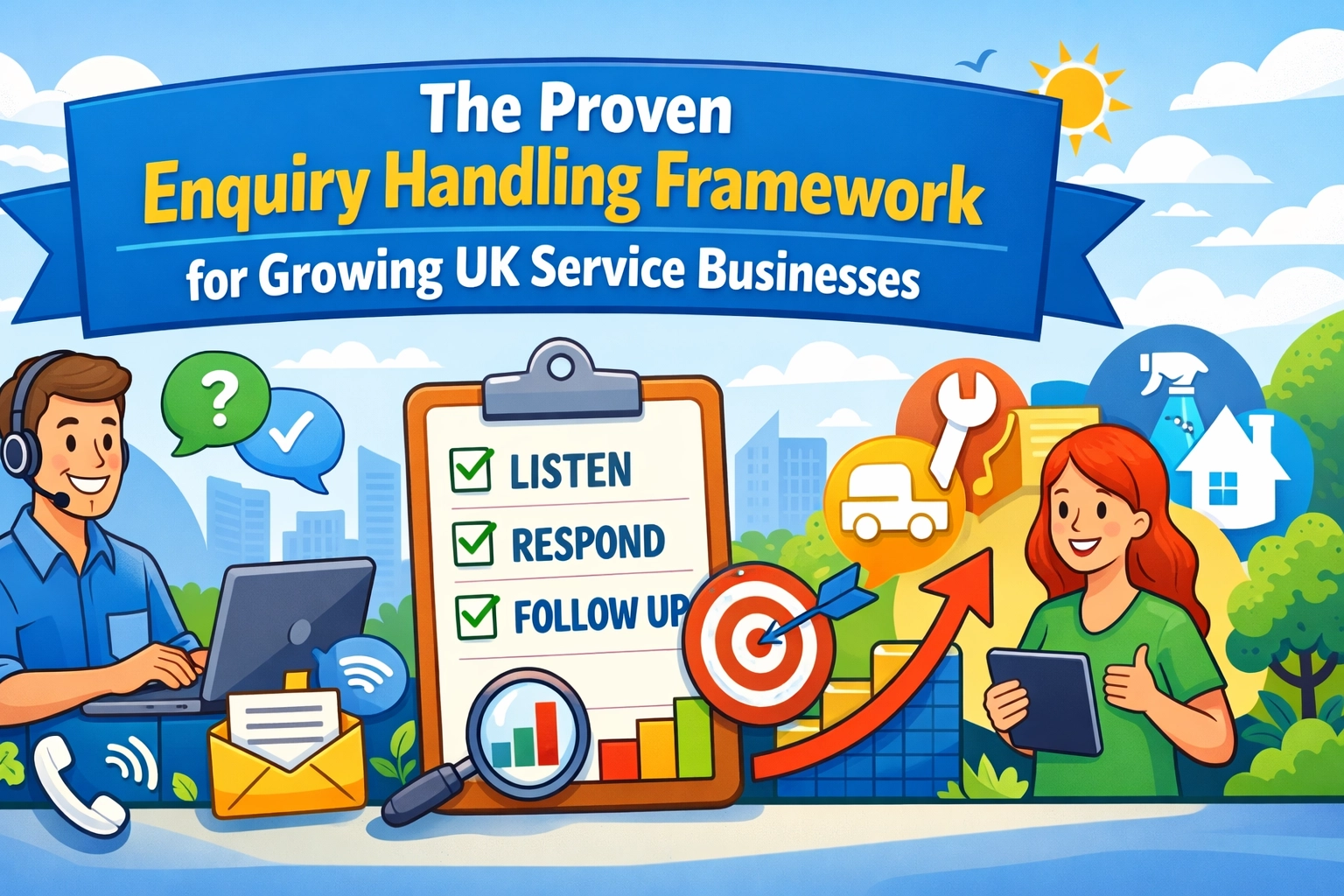
To grow, you need more than just "more leads." You need a framework to handle them. We use a three-stage methodology: Visibility, Response, and Conversion.
Phase 1: Visibility – Being Found and Building Trust
Visibility is about more than just showing up on the first page of Google. It’s about what the customer sees when they find you. According to Marcus Sheridan’s "They Ask, You Answer" principles, the modern buyer wants to do 70% of their research before they even speak to you.
If your website is just a digital brochure with a "Contact Us" page, you are losing leads. You need to be visible in a way that answers the questions your customers are actually asking.
Answer the "Big Five"
Every service business customer has the same five concerns:
- Cost: How much will it be?
- Problems: What can go wrong?
- Comparisons: How do you stack up against Joe Bloggs down the road?
- Reviews: Who else has used you?
- Best of: Who are the best providers in this area?
If you hide your pricing or refuse to talk about common pitfalls in your industry, customers will go to someone who is transparent. This transparency is the first step in website optimization. When you answer these questions on your site, you become the authority.
The "Frictionless" Entry Point
Visibility also refers to how easy it is to start an enquiry. Is your phone number clickable on mobile? Do you have a WhatsApp button? Is your contact form twenty fields long or three?

We often find that businesses are losing money because their website makes it hard to get in touch. If a customer has to search for more than five seconds to find out how to contact you, they’ll hit the "back" button. In the UK service sector, the "back" button is your biggest enemy.
Phase 2: Response – The 2-Minute Rule
Once a lead is visible and has decided to contact you, the clock starts. This is where most UK SMEs fail. We live in an era of instant gratification. If I can order a pizza in three clicks or a taxi in two, I expect a service provider to acknowledge my enquiry almost immediately.
Why Speed is Your Best Sales Tool
Research published by the Harvard Business Review shows that businesses that attempt to reach out to leads within an hour are nearly seven times more likely to have a meaningful conversation with a key decision-maker than those who wait even sixty minutes.
At Every Enquiry, we push this further. We talk about the 2-minute rule. In a competitive market, the first person to reply usually wins the job. It’s not necessarily about having the lowest price; it’s about being the most responsive and reliable.
The Role of the Digital Receptionist
As a business owner, you can’t sit by the phone all day. This is where the concept of a digital receptionist becomes essential.
A digital receptionist isn't just an automated bot; it’s a system (often a combination of smart tech and human-led processes) that ensures:
- Calls are answered 24/7.
- Enquiries from your website get an instant personalised SMS or email acknowledgement.
- Leads are qualified immediately so you don't waste time on "tyre kickers."
When you improve your response times, you stop the customer from "shopping around." If they feel looked after within two minutes, they stop looking for other options.

Phase 3: Conversion – Moving Beyond the Spreadsheet
Handling the initial enquiry is only half the battle. The final part of the framework is conversion. This is the process of nurturing that lead until they sign the quote and pay the deposit.
Many UK service businesses rely on "mental notes" or messy spreadsheets to track their leads. This is a recipe for disaster. Spreadsheets are killing your growth because they don't remind you to follow up. They don't tell you which marketing channel is actually making you money.
Structured Follow-Up Systems
Most sales are made on the fifth to twelfth contact, yet most small business owners stop after the first or second try. A conversion-focused framework uses automated follow-ups to keep your business top-of-mind.
Think about it:
- Day 1: Send the quote.
- Day 2: Automated SMS asking if they have any questions about the quote.
- Day 4: Email sharing a case study of a similar project you completed.
- Day 7: Final "checking in" call or message.
This doesn't make you "annoying", it makes you professional. It shows you want the work and that you are organised. For a customer, an organised enquiry process is a signal that you will do an organised job on their property or project.
Calculating the Real Cost
If you’re still not convinced that your current lead handling needs an overhaul, you need to do the maths. How much are missed calls really costing you? If your average job value is £1,000 and you miss five calls a week, you aren't just losing "calls", you are potentially losing £260,000 in annual turnover.
Comparing the Approaches: Traditional vs. Framework-Driven
To see where your business currently sits, look at this comparison table. Most SMEs find themselves firmly in the "Traditional" column, which is exactly why they struggle to scale beyond a certain point.
| Feature | Traditional SME Approach | Every Enquiry Framework |
|---|---|---|
| Initial Contact | Phone rings, often goes to voicemail. | Multi-channel (Call, SMS, WhatsApp, Web). |
| Response Time | "When I get a minute" (usually 4-24 hours). | Under 2 minutes (Automated or Managed). |
| Lead Qualification | Discussed during a long, unscheduled call. | Pre-qualified via digital forms or receptionist. |
| Follow-Up | Relies on the owner's memory. | Automated, multi-step nurturing sequence. |
| Data Tracking | Spreadsheets or a paper diary. | Centralised Enquiry Management System. |
| Customer Perception | "They're probably busy/unorganised." | "These guys are professional and responsive." |
| Conversion Rate | Low (losing leads to faster competitors). | High (first reply wins, consistent follow-up). |

The "They Ask, You Answer" Methodology in Action
When we apply Marcus Sheridan's principles to enquiry handling, we focus on trust. The framework works because it removes the "fear" from the customer's journey.
When a customer makes an enquiry, they are often anxious. They are worried about being ripped off, they are worried about someone coming into their home, or they are worried about making a bad investment.
Your enquiry handling framework should address these fears immediately:
- The Confirmation: "We’ve received your enquiry, John. One of our specialists will call you from this number in the next 10 minutes." (Reduces anxiety about whether the form worked).
- The Education: While they wait for the call, send them a link: "While you wait, here is a guide on what to expect during our first consultation." (Builds authority).
- The Transparency: "Just so you know, our call-out fees start at £X, and we can usually get to you within 48 hours." (Filters out the wrong customers and builds trust with the right ones).
By the time you actually speak to the lead, they are already halfway to buying. You’ve moved the conversation from "How much do you charge?" to "When can you start?"
Why Your Current Lead Conversion Isn't Working
If you feel like you're working harder but not getting more jobs, the issue is rarely your skill at the trade. It’s usually one of the 10 reasons your lead conversion isn't working.
The most common reason? The "Ghosting" Effect. A customer enquires, you respond three hours later, they don't answer, and you never call them again. You’ve just paid for a lead (via SEO, GMB, or Facebook Ads) and then thrown it in the bin.
A structured framework ensures that no lead is left behind. Even if they don't buy today, they are in your system. You can send them helpful updates, seasonal offers, or request a review if they eventually do business with you. This is how you build a sustainable business rather than just living hand-to-mouth on the next phone call.

Implementing the Framework in Your Business
Starting this might feel overwhelming, but you don't have to do it all at once.
- Audit your current speed: Have a friend enquiry through your website and time how long it takes for someone to give them a high-quality response.
- Fix the front door: Ensure your contact options are visible and mobile-friendly.
- Stop using your personal mobile for everything: Use a dedicated business line or a digital receptionist service to ensure calls are always answered professionally.
- Automate the "Receipt": Set up an auto-responder on your email and website forms. Even a simple "We've got your message and will call you in 15 minutes" sets you apart from 90% of UK businesses.
The real cost of slow follow-up is the ceiling it puts on your growth. You can only work so many hours, but a framework works 24/7.
Final Thoughts from Every Enquiry
At the end of the day, your business exists to solve a problem for your customers. But you can't solve their problem if you don't talk to them. By focusing on Visibility, Response, and Conversion, you stop being a "tradesman with a phone" and start being a service business with a growth engine.
If you’re tired of seeing potential profit slip through your fingers, it’s time to move away from the "hope and pray" method of lead handling. First reply wins. Make sure it's you.
Frequently Asked Questions (FAQ)
1. I’m a small business; do I really need a "framework" for enquiries?
Yes. In fact, small businesses need it more than large ones. A large company can afford to lose a few leads; a small business relies on every single one. A framework ensures you aren't wasting the money you spend on marketing. It levels the playing field against bigger competitors with dedicated sales teams.
2. Is this just about buying expensive CRM software?
Not at all. While software helps, a framework is about process. It's about deciding how you will handle a lead from the second it arrives. You can start with simple automations and a disciplined follow-up schedule. We advocate for enquiry management systems that simplify your life, not make it more complicated.
3. Will automated responses make my business feel impersonal?
If done poorly, yes. But if done correctly: using your voice and providing genuine value: it feels professional. Customers prefer an instant, helpful automated message over three days of silence. It shows you are organised and respect their time.
4. How much time does it take to manage this?
The goal of the framework is to save you time. By qualifying leads automatically and using a digital receptionist, you spend less time on the phone with people who aren't a good fit and more time on high-value jobs.
5. What is the "First Reply Wins" rule?
It’s a simple observation of modern buying habits: the first business to provide a helpful, human response to an enquiry is statistically the most likely to win the contract. In the UK service industry, speed is often more important than being the absolute "best" or "cheapest."
6. Can I handle this myself, or do I need Every Enquiry to do it?
You can certainly implement many of these steps yourself. However, most business owners find they are too busy "doing the work" to consistently manage the "enquiry handling." We provide the systems and management to ensure your leads are handled perfectly every time, allowing you to focus on your trade. Check out our 10 reasons why your conversion might be failing to see where you might need help.