Most SME owners in the UK are currently sitting on a goldmine. The problem is, they’ve left the gate locked and forgotten where they put the key.
Every day, businesses across the country spend thousands of pounds on SEO, Google Ads, and social media management to get their phones to ring or their inboxes to ping. But here’s the cold, hard truth: getting the lead is only 20% of the battle. The real money, the predictable growth you’re looking for, is won or lost in what happens in the sixty minutes after that enquiry lands.
At Every Enquiry, we see it all the time. A brilliant service business is doing great work, but they’re losing thousands of pounds every month because their follow-up system is essentially a sticky note and a "hope for the best" attitude.
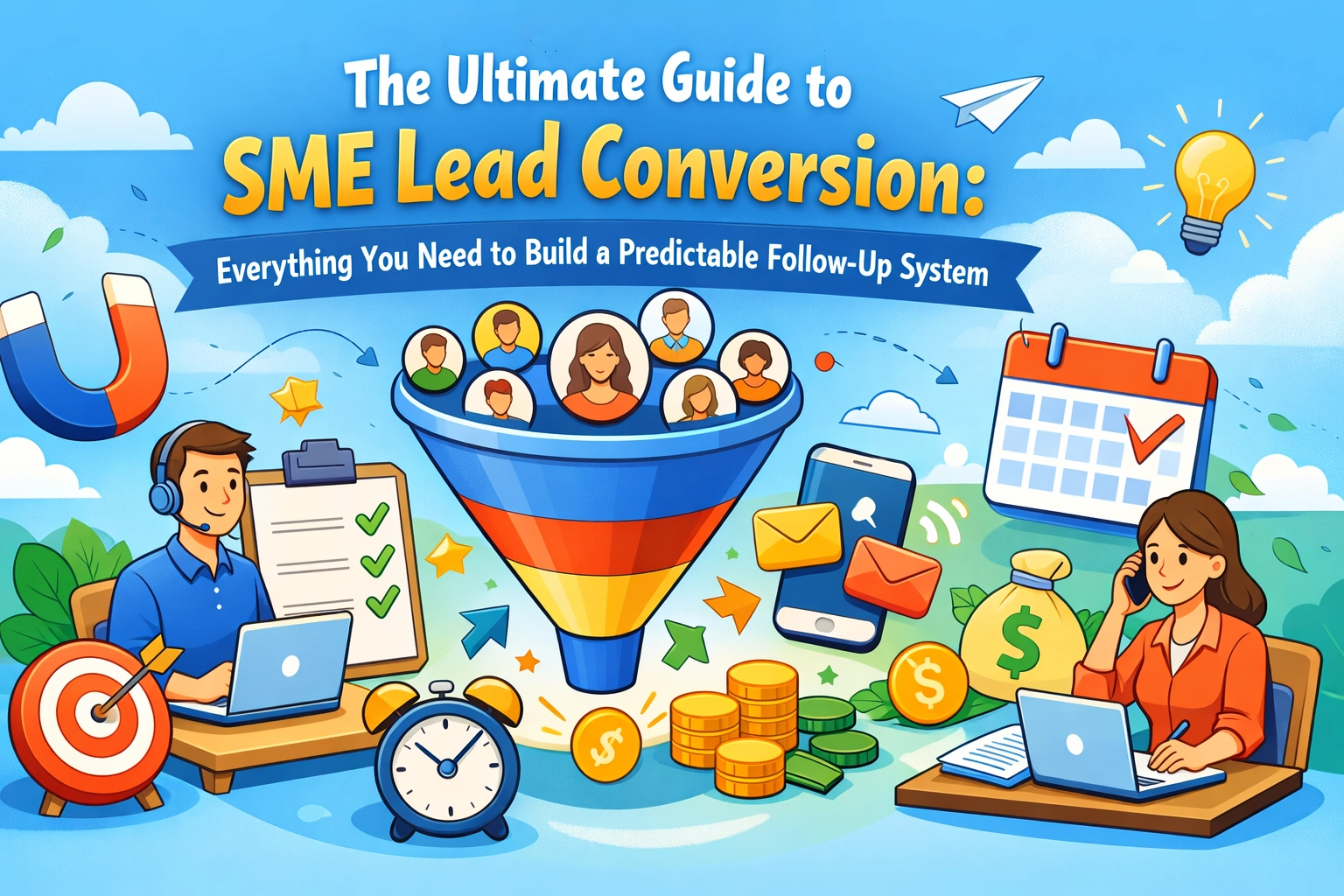
If you want to stop the "feast or famine" cycle and actually see a return on your marketing spend, you need a predictable follow-up system. This guide will show you how to build one using the principles of visibility, response, and conversion.
Visibility: Why Getting Noticed is Only the Start
You can’t convert a lead that doesn’t know you exist. In the digital age, visibility means more than just having a website; it means being where your customers are asking questions.
According to Marcus Sheridan’s They Ask, You Answer philosophy, the most visible businesses aren’t the ones with the biggest ad budgets. They’re the ones that answer the questions their customers are actually asking. When someone searches for "cost of house extensions London" or "best commercial electrician near me," they aren't looking for a sales pitch. They’re looking for an answer.
Visibility is the top of your funnel. If you’re investing in social media management, it shouldn't just be about "posting updates." It should be about building trust before they even pick up the phone.
However, many businesses mistake visibility for success. They see the "likes" and the website traffic and wonder why the bank balance isn't moving. The reason is simple: visibility brings people to your front door, but if nobody answers the bell, they’re going to walk down the street to your competitor.

Response: The 2-Minute Rule and the High Cost of Silence
This is where most UK SMEs fail. We live in an "on-demand" world. If a prospect fills out your contact form, they aren't just "testing the waters", they have a problem they want solved now.
Research shows that the odds of qualifying a lead drop by 10 times if you wait just five minutes to respond versus responding within the first minute. At Every Enquiry, we talk about the 2-minute rule. In an ideal world, you’re on the phone with that lead while they’re still on your website.
The Math of a Missed Call
Let’s be honest about the numbers. If your average job value is £1,000 and you miss five calls a week that could have been qualified leads, you aren't just "busy." You’re losing £260,000 a year in potential revenue.
When you ignore a lead or take 24 hours to reply, you’re telling the customer: "My time is more important than your problem." That isn't a great way to start a relationship. You can calculate the real cost of your missed calls to see exactly how much is leaking out of your business.
Speed is the New SEO
You could have the best website in the world, but if your response time is slow, your conversion rate will suffer. Harvard Business Review found that firms that tried to contact potential customers within an hour of receiving a query were nearly seven times as likely to have a meaningful conversation as those who waited even an hour longer.
In the UK service sector, "first reply wins" is almost a law of nature. If you’re the first person to call back, you set the standard. Everyone else who calls later is just a nuisance.
Conversion: Building Your Predictable Follow-Up System
Conversion isn't about being a "slick" salesperson. It’s about having a system that moves a person from "interested" to "invested." A predictable system removes the guesswork and ensures no lead is left behind.
Step 1: Immediate Capture and Qualification
The moment a lead comes in, it needs to be recorded. Most SMEs rely on their email inbox or, worse, a mental note. This is how leads get lost. You need a central place, a CRM (Customer Relationship Management) tool, to track every enquiry.
You also need to qualify quickly. Is this person a fit for your business? Do they have the budget? Is their problem something you solve? Lead qualification ensures your team (or you) isn't wasting time on "tyre kickers."
Step 2: The Initial Touchpoint (The "Golden Window")
As mentioned, this should happen within minutes. If you can't get to the phone, who can? This is where many businesses consider a digital receptionist. But beware: a receptionist who just takes a message is often just a "glorified voicemail." You want someone who can actually handle the enquiry.
Step 3: Education-Based Nurturing
If the lead doesn't book immediately, the follow-up doesn't stop. Most SMEs give up after one or two attempts. Research suggests that 80% of sales require five follow-up calls after the meeting, yet 44% of sales reps give up after just one.
Instead of "just checking in" (which is annoying), send them helpful content.
- "Here is a guide on how to prepare for your site visit."
- "Here are three common mistakes people make when hiring an architect."
- "Here is a video explaining our pricing."
This is the "They Ask, You Answer" approach in action. You are serving, not selling.
Step 4: The Comparison Table
To help you understand where your current system might be failing, let’s look at the different ways SMEs handle enquiries.
| Feature | The "Mental Note" / Inbox | Digital Receptionist | Professional Enquiry Management |
|---|---|---|---|
| Response Speed | Highly Variable (Hours/Days) | Immediate (Seconds) | Immediate (Seconds) |
| Data Capture | Poor / Incomplete | Basic Contact Info | Detailed Qualification & CRM Entry |
| Follow-Up | Relies on Memory | None | Systematic & Automated |
| Conversion Focus | Low (Reactive) | Low (Message Taking) | High (Proactive Booking) |
| Cost of Missed Leads | High | Medium | Low |
| Scalability | Non-existent | Limited | High |

The Spreadsheet Trap: Why Manual Systems Kill Growth
If you’re still using a spreadsheet to manage your leads, you’re essentially trying to run a marathon in wellies. It works for a bit, but it’s going to slow you down and eventually hurt.
Spreadsheets are static. They don't remind you to call someone back. They don't tell you which marketing channel is actually making you money. Most importantly, they don't scale. When your business grows from 10 enquiries a week to 50, a spreadsheet becomes a graveyard for potential revenue.
We’ve written extensively about why spreadsheets are killing your growth. To build a predictable system, you need automation. You need a system that triggers an email the moment a form is filled, notifies your sales team, and schedules a follow-up task for three days later if no progress has been made.
Implementing "They Ask, You Answer" in Your Follow-Up
Marcus Sheridan’s philosophy revolves around five core topics that most businesses are afraid to talk about:
- Pricing and Cost
- Problems and Negatives
- Comparisons
- Reviews and Ratings
- Best of Class
If you want your follow-up system to convert at a higher rate, address these head-on in your follow-up sequence.
Honesty about Cost: If a lead asks about price, don't hide it. Give them a range. Explain what factors move that price up or down. Transparency builds trust faster than any "special offer."
Addressing Problems: If there’s a common reason why people don’t hire you (e.g., "you're too expensive" or "the project takes too long"), address it in your follow-up emails. Explain why you cost more (higher quality materials, better warranties) and why the timeline is what it is.
By answering these questions before the lead even asks them, you move from being a "vendor" to being a "trusted advisor."

Stop Losing Leads Without Hiring More Staff
A common objection we hear from SME directors is: "I don't have the staff to call everyone back in two minutes."
We get it. You’re busy running the business. But hiring more staff isn't always the answer. Often, it’s about better systems. There are 5 steps to stop losing leads without hiring more staff that involve leveraging technology and refining your process.
Automation can handle the initial "thank you" and the delivery of educational content. This keeps the lead warm until you or a senior team member can have a high-value conversation. The goal is to spend your time talking to qualified prospects who are already halfway to saying "yes" because your system has educated them.
The Reality Check: What's Your Conversion Goal?
Before you can build a predictable system, you need to know what "good" looks like.
- What is your current enquiry-to-booking rate?
- What is your current booking-to-sale rate?
- How much is a single new customer worth to you over their lifetime?
If you don't know these numbers, you’re flying blind. A predictable follow-up system allows you to turn the dials. If you know that for every 10 leads you get, you convert 2 into customers worth £5,000 each, you know that 100 leads will bring in £100,000.
But if your follow-up is messy, those 10 leads might result in 0 sales one month and 4 sales the next. That’s not a business; that’s a gamble.
Closing the Loop
Building a predictable follow-up system isn't a "nice-to-have" anymore. In a competitive market where every click costs money, it is a survival requirement.
Visibility gets you in the game.
Response keeps you in the game.
Conversion wins the game.
If you’re tired of seeing leads vanish into thin air, it’s time to move beyond the spreadsheet and the "I’ll call them later" mentality. The real cost of slow follow-up is simply too high to ignore.

Frequently Asked Questions (FAQ)
1. Why is my current lead conversion rate so low?
Usually, it’s a combination of slow response times and a lack of consistent follow-up. If you take more than 30 minutes to respond to an online enquiry, the prospect has likely already moved on to the next business on Google. Additionally, if you only follow up once, you’re missing out on the 80% of sales that require multiple touchpoints.
2. Can't I just use a digital receptionist to handle my calls?
A digital receptionist is better than a missed call, but it’s often a "leaky" solution. Most reception services just take a name and number. They don't qualify the lead, they don't answer technical questions, and they don't book appointments into your calendar. To truly convert, you need enquiry management, not just message taking.
3. How many times should I follow up with a lead before giving up?
The "sweet spot" is usually between 5 and 7 touchpoints. However, these shouldn't all be phone calls. A mix of immediate calls, personalised emails, and helpful educational content (videos, guides, case studies) works best. If they haven't responded after 7 attempts over 14 days, you can move them to a long-term "nurture" list.
4. Do I need expensive software to build a follow-up system?
Not necessarily. While high-end CRMs are great, the most important thing is the process. You can start with a simple CRM like Pipedrive or HubSpot (which has a free version). The key is ensuring that every lead is entered immediately and that tasks are set for follow-up.
5. My business is "referral-only": do I still need this?
Yes! Referrals are great, but they are unpredictable. Even a referral will appreciate a fast, professional response. If a referred lead has to chase you for a quote, it reflects poorly on the person who referred you and makes it less likely they’ll do it again. A system makes your "referral-only" business more professional and scalable.
6. What's the "2-minute rule" really about?
It’s about striking while the iron is hot. When someone is on your website, they are thinking about their problem. If you call them while they are still on that page, the conversion rate is astronomically higher because you are solving their problem at the exact moment they are feeling the pain.
7. How do I handle leads that come in out of hours?
Automation is your friend here. An immediate "out of hours" email or SMS that says, "Thanks for the enquiry! We’re closed right now, but we’ve received your message and will call you at [Time] tomorrow morning," goes a long way. It stops them from continuing their search and "claims" the lead until you can speak to them.