You’ve spent weeks, maybe months, obsessing over your website. You’ve tweaked the headlines, adjusted the colours, and perhaps even spent a small fortune on Google Ads or Facebook campaigns to get the phone ringing.
And it worked. The leads are coming in.
But here’s the uncomfortable truth: if your business is like most UK SMEs, you are probably "leaking" about 40% to 60% of those leads before they ever turn into a quote, let alone a sale.
At Every Enquiry, we see it every day. Small business owners are so focused on getting more leads that they completely ignore how they handle the ones they already have. It’s like trying to fill a bucket with water while there are three massive holes in the bottom. You don’t need more water; you need to fix the bucket.
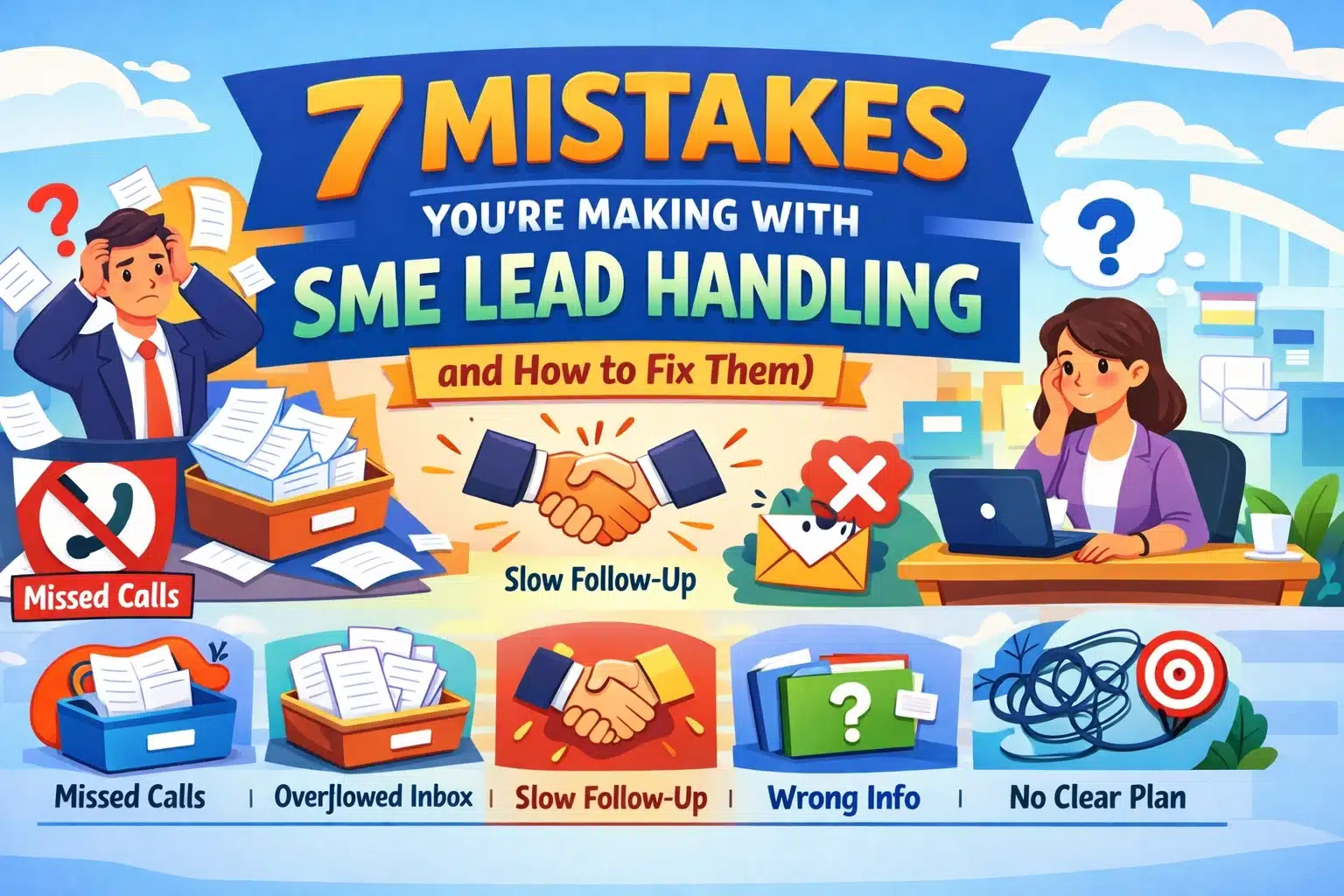
In this guide, I’m going to walk you through the seven most common mistakes I see SME service businesses making with their lead handling. More importantly, I’ll show you how to fix them using a simple framework: Visibility, Response, and Conversion.
1. The "Black Hole" of Lead Visibility
The first mistake is the most basic: not knowing exactly where your leads are coming from or where they are going.
Most SMEs rely on "gut feeling." You think most of your work comes from word of mouth, or you assume your website is doing "alright." But if I asked you right now how many enquiries you received last Tuesday, how many were from your website vs social media, and what happened to each one, could you tell me?
Without tracking, you are essentially flying blind. You might be spending £500 a month on SEO when your best leads are actually coming from a local Facebook group. Or worse, you might have a contact form on your site that’s been broken for three days and you haven’t even noticed.
The Fix: You need a single source of truth. Every enquiry: whether it’s a phone call, an email, a WhatsApp message, or a DM: must be logged in a central system immediately. This isn't about being "techy"; it's about business survival. If you can’t see the lead, you can’t manage it.

2. Letting Leads Sit in "Spreadsheet Purgatory"
I’ll be honest with you: spreadsheets are where leads go to die.
I know, I know. Excel is familiar. You’ve used it for years. But for managing enquiries, it’s a disaster. It’s manual, it doesn’t give you reminders, and it’s impossible to scale. When you rely on a spreadsheet, things get missed. You forget to call Mrs Smith back on Wednesday, and by Thursday, she’s already booked your competitor.
According to research by HubSpot, businesses that use a CRM (Customer Relationship Management) system see a significant increase in lead conversion compared to those using manual methods.
The Fix: Move away from manual logs. Use a dedicated enquiry management system. It doesn't have to be complicated. In fact, if it's too complex, your team won't use it. You want something that automatically pulls leads in and prompts you to take the next step. If you're still using "notes to self," you're losing money. Check out why spreadsheets are killing your growth to see the full impact.
3. The 5-Minute Failure (Speed of Response)
This is the big one. If you take away nothing else from this article, remember this: Speed is your greatest competitive advantage.
We live in an era of instant gratification. If a prospect fills out a form on your website, they are likely doing the same thing on three of your competitors' sites at the exact same time. The person who calls back first usually wins the job.
Studies from the Harvard Business Review show that businesses that attempt to reach out to leads within an hour are nearly seven times more likely to have a meaningful conversation than those who wait even sixty minutes. If you wait 24 hours? Forget it. You’re a ghost to them.
The Fix: Implement the "2-Minute Rule." Your goal should be to acknowledge every digital enquiry within two minutes. This doesn’t mean you have to have a full consultation, but an automated SMS or a quick "Thanks for the enquiry, I'm just on a job but will call you at 4 PM" goes a long way. It stops them from looking elsewhere. Learn more about the power of the 2-minute rule here.
4. Failing to Handle the "After Hours" Rush
Do you know when most people browse for service businesses like yours? It’s not between 9 AM and 5 PM when they’re at work. It’s at 8 PM on a Tuesday evening while they’re sitting on the sofa, or at 7 AM on a Sunday morning.
If your "lead handling" consists of you answering your mobile when you aren't busy, you are missing half your opportunities. If a potential customer calls at 7 PM and hits a voicemail, they probably won't leave a message. They’ll just click the next link on Google.
The Fix: You need a 24/7 presence. This doesn't mean you have to work all night. It means using a digital receptionist or an automated system that captures their details, qualifies what they need, and books a call-back in your diary. You wake up to a diary full of qualified leads instead of a list of missed calls.

5. The "One and Done" Follow-Up Habit
Most SMEs give up way too early. You call a lead once, they don’t answer, so you tick them off the list.
"They must not be interested," you tell yourself.
Wrong. They were probably just driving, or in a meeting, or their toddler was having a meltdown. Life happens. Research shows that it often takes between five and twelve "touches" to actually close a deal. Yet, 44% of salespeople give up after just one follow-up.
The Fix: Create a systematic follow-up process. If they don't answer the first call, send an automated text. If they don't reply, email them the next day with a helpful guide or a piece of social proof. This isn't "pestering"; it's being professional. If you stop losing leads to poor follow-up, your revenue will skyrocket without spending a penny more on marketing. See our 5-step framework to stop losing leads.
6. Unclear Lead Ownership
In many small teams, lead handling is everyone’s job: which often means it’s nobody’s job.
An enquiry comes into the info@ email address. The office manager sees it but thinks the Director is handling it. The Director sees it but assumes the salesperson has it covered. Three days later, the lead is still sitting there, cold as ice.
The Fix: Every lead must have an owner. From the moment an enquiry hits your system, it should be automatically assigned to a specific person. There should be a clear "State" for every lead: New, Contacted, Quoted, or Lost. This accountability ensures that nothing falls through the cracks. If you're wondering why your lead conversion isn't working, start by looking at who is actually responsible for them.
7. Treating All Leads the Same
Not all leads are created equal. A person asking "How much for a quick repair?" is very different from someone asking "Can you provide a quote for a full installation starting next month?"
If you treat every enquiry with the same level of priority and the same cookie-cutter response, you’re wasting your time on "tyre kickers" and neglecting your high-value prospects.
The Fix: Implement lead qualification. Use your initial contact form or an automated chatbot to ask 2-3 "qualifying" questions. This allows you to prioritise the high-intent leads that are ready to buy now. It also allows you to provide a more tailored, personal response, which significantly increases your conversion rate.
Comparison: Manual vs. Automated Lead Handling
To help you understand the difference this makes to your bottom line, let’s look at how the "old way" compares to a modern, automated system.
| Feature | The Manual Way (The "Mistake" Path) | The Every Enquiry Way (The "Fix" Path) |
|---|---|---|
| Visibility | Relying on memory and sticky notes. | 100% transparency on every lead source. |
| Response Time | 4 to 24 hours (or never). | Under 2 minutes via automated SMS/Email. |
| After-Hours | Voicemail (where leads go to die). | 24/7 capture and instant engagement. |
| Follow-Up | One phone call, then forgotten. | Systematic, multi-touch automation. |
| Data & ROI | "I think Google Ads is working…" | "I know every £1 spent returns £5." |
| Team Burden | High stress, constant interruptions. | Streamlined, predictable workflows. |
The Visibility -> Response -> Conversion Framework
Fixing these mistakes isn't about working harder; it's about building a system. At Every Enquiry, we use a three-stage methodology to help SMEs move from "Busy" to "Scalable."
Stage 1: Visibility
You cannot manage what you do not measure. We start by plugging the leaks. This involves setting up tracking so you know exactly which marketing channels are working. We move your leads out of your head and into a system where they can be seen. This is the foundation of predictable business growth.
Stage 2: Response
Once we can see the leads, we make sure they are acknowledged instantly. We implement "Speed to Lead" protocols. This includes automated "Thank You" messages that actually provide value, and setting up digital receptionists to handle the 70% of enquiries that happen outside of traditional hours.
Stage 3: Conversion
Finally, we focus on the "Fortune in the Follow-up." We build automated sequences that nurture the lead until they are ready to book. This takes the pressure off your team to remember every detail and ensures that your brand stays top-of-mind for the prospect.

They Ask, You Answer: The Transparency Factor
One of the biggest reasons SMEs fail at lead handling is a lack of transparency. Marcus Sheridan, author of They Ask, You Answer, argues that the most successful businesses are those that obsess over their customers' questions.
When a lead reaches out, they usually have three questions:
- Can you solve my problem?
- How much will it cost?
- How soon can you do it?
If your lead handling process is vague or makes them jump through hoops just to get a ballpark figure, you are creating friction. The "fix" for many of the mistakes listed above is simply to be more transparent.
Don't hide your pricing. Don't be "mysterious" about your lead times. Use your lead handling system to provide these answers immediately. An automated response that says, "Thanks for the enquiry! Most of our projects fall between £2,000 and £5,000, and we are currently booking for three weeks' time. I'll call you at 10 AM to discuss your specific needs," is infinitely more powerful than a generic "We'll be in touch."
Conclusion: Stop Burning Your Marketing Budget
If you are spending money on marketing but your lead handling is a mess, you are literally throwing money away. You don't need "more leads" to grow your business; you need to respect the leads you already have.
By fixing these seven mistakes, you’ll find that you can grow your revenue, reduce your stress, and actually spend more time doing the work you enjoy rather than chasing people who have already moved on to your competitors.
Ready to see how much your missed enquiries are actually costing you? Check out our guide on how much missed calls are really costing your business. It’s time to stop the leak and start converting.
Frequently Asked Questions (FAQ)
1. I’m a one-man band; do I really need a "system"?
Actually, you need it more than anyone else. Because you are on the tools all day, you can't answer the phone. A system acts as your virtual assistant, ensuring that while you’re working, your leads are being nurtured and your diary is being filled.
2. Isn't automation a bit impersonal?
It depends on how you do it. A cold, robotic email is impersonal. A friendly, helpful text message that arrives 30 seconds after they submit a form: acknowledging their problem and promising a callback: is actually seen as better customer service than a human calling them three days later.
3. How do I know which leads are "good" and which are "bad"?
This comes down to "Visibility." By tracking the source of every lead and using a few qualifying questions in your forms, you can quickly see that (for example) Facebook leads tend to be "tyre kickers" while Google Search leads are ready to buy. You then adjust your time and budget accordingly.
4. Is a CRM expensive?
It’s a lot less expensive than losing a £5,000 job because you forgot to call someone back. There are many affordable options designed specifically for SMEs. At Every Enquiry, we help you find the right fit that actually gets used, rather than a "suite of services" you don't need.
5. My team is already busy; won't this just give them more work?
Initially, there is a small "setup" phase. But in the long run, it saves hours of time. No more scrolling through emails to find a phone number. No more manual data entry. A good system automates the boring stuff so your team can focus on what they're good at: selling and delivering your service.
6. What is the single most important thing to change first?
Response time. If you do nothing else, find a way to contact your leads within five minutes of them reaching out. That one change alone can double your conversion rate overnight.
7. How long does it take to see results?
Usually, the results are instant. The moment you start responding faster and tracking where leads are coming from, you'll see more appointments in your diary. Most of our clients see a measurable difference within the first 14 days of fixing their lead handling "leaks."