Let’s be honest for a second: most local service businesses in the UK are flushing money down the toilet.
You spend a fortune on SEO, you might be dabbling in Google Local Services Ads, and you’ve probably got a decent-looking website. But then the phone rings while you’re on a job, or an email lands in your inbox at 7:00 PM on a Tuesday, and… nothing happens.
By the time you get back to them the next morning, that lead has already booked your competitor. They didn’t wait. Why would they? We live in an era of instant gratification. If you aren’t first, you’re last.
I’m Martyn Lenthall, and at Every Enquiry, we see this every single day. Business owners tell us they "need more leads," when in reality, they have plenty of leads, they just have a "leaky bucket" problem. Improving your response time is the single fastest way to double your conversion rate without spending an extra penny on advertising.
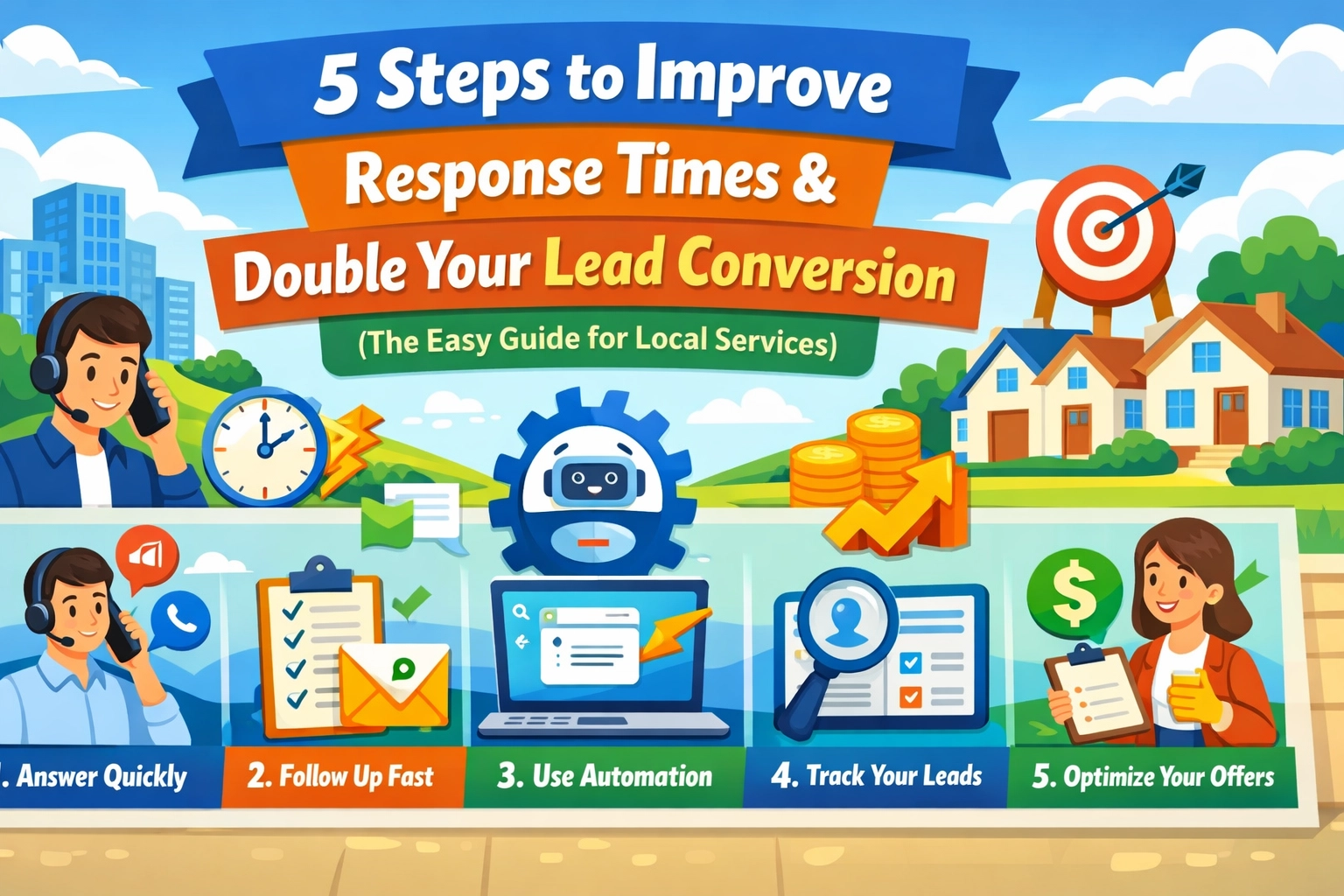
In this guide, I’m going to walk you through the five steps to stop the rot, speed up your replies, and actually turn those "enquiries" into "invoices."
Visibility is Only the Invitation
Before we dive into the steps, we need to understand the hierarchy of growth. Many SMEs focus entirely on Visibility. They want to be top of Google. They want the shiny social media posts. But visibility is just the invitation to the party. If your guests turn up and the doors are locked, they aren't coming back.
The real magic happens at the intersection of Response and Conversion.
You can have the best service in town, but if a prospective customer can’t reach you within minutes, your expertise doesn’t matter. According to research by Harvard Business Review, businesses that attempt to reach leads within an hour are nearly seven times more likely to have a meaningful conversation than those who wait even 60 minutes. If you wait 24 hours? You might as well not have the lead at all.

Step 1: Audit Your "Leaky Bucket" (The Honest Truth)
The first step isn't technical; it’s an ego check. You need to know exactly how many leads you are losing. Most business owners think they answer every call. They don't.
Go through your call logs from the last month. How many missed calls are there? Now, check your website contact form. How long, on average, does it take for someone to get a reply? If it’s more than 10 minutes, you’re losing money.
At Every Enquiry, we often talk about the hidden cost of missed enquiries. If your average job value is £500, and you miss just three calls a week, that’s over £75,000 in lost revenue every year.
What to do now:
- Track every single enquiry for one week.
- Note the time it came in and the time you (or your team) responded.
- Calculate your "Lead-to-Call" ratio. If you aren't hitting 50% or higher, your bucket is leaking.
Step 2: Implement the "2-Minute Rule"
If you take one thing away from this article, let it be this: The 2-Minute Rule.
In the world of local services, be it plumbing, legal advice, or landscaping, the "Speed to Lead" is your most powerful sales tool. When a customer searches for a service, they usually open 3 or 4 tabs on their browser. They message all of them. The business that replies first usually wins the job.
Why two minutes? Because within two minutes, the customer is still on your website or still has their phone in their hand. They are "in the zone." After five minutes, their attention shifts. After thirty minutes, they’ve forgotten who you are.
We’ve written extensively about why the 2-minute rule is your best sales tool. It creates a psychological "wow" factor. The customer thinks, "If they are this fast at replying, they must be great at their job."
How to implement it:
- Use automated SMS replies. When someone fills out a form, they should get a text immediately saying: "Hi, it’s Martyn from Every Enquiry. I’ve got your message and I’m looking at it now. Can you talk in 5 mins?"
- This stops them from calling the next person on the list.
Step 3: Stop Relying on Your Inbox (Multi-Channel Mastery)
If your primary way of handling leads is checking your "info@" email address every few hours, you are playing a losing game. Emails are where leads go to die. They get buried under newsletters, spam, and invoices.
Modern customers want to communicate via:
- Facebook Messenger
- Web Chat
- SMS
If you aren't managing these channels centrally, things will fall through the cracks. This is where most SMEs struggle because they feel overwhelmed by the number of apps. However, social media management for a service business isn't about posting "Happy Friday" memes; it’s about being available where your customers are.

The Marcus Sheridan Approach:
Answer the questions your customers are asking on the platforms they are using. If they message you on Facebook asking for a price, don't tell them to "call the office." Give them a ballpark figure or ask the clarifying questions right there in the chat.
Step 4: Use a Digital Receptionist (Human vs. Automation)
There is a massive debate in the SME world: do you use a "bot" or a human?
The truth is, you need both. You need automation for the "Instant" part (the 2-minute rule) and a human for the "Conversion" part.
Many business owners try to do it all themselves. They answer the phone while they are under a sink or in a meeting. This leads to a poor customer experience. On the flip side, a "traditional" call handling service often just takes a message and emails it to you: which doesn't actually solve the response time problem.
A digital receptionist is different. It’s a system (often backed by real people) that doesn't just "take a message," but actually qualifies the lead, books them into your calendar, or moves them through a sales pipeline.
Comparison: How You Handle Enquiries Matters
| Feature | The "DIY" Method | Traditional Call Centre | Every Enquiry System |
|---|---|---|---|
| Response Speed | Whenever you’re free | 30-60 Seconds | Under 5 Seconds (Automated) |
| Availability | Working hours only | Usually 24/7 | 24/7/365 |
| Lead Qualification | You do it on the fly | Just takes a name/number | Filters out "tyre kickers" |
| Booking | Manual back-and-forth | Rarely | Direct into your CRM/Calendar |
| Cost of Failure | High (Lost jobs) | Moderate (Paid per call) | Low (Fixed system) |
Step 5: The Fortune is in the Follow-Up
Most local businesses are "one and done." They call a lead once. If the person doesn't answer, they give up.
According to prospecting data from SalesLoft, it takes an average of 8 touchpoints to actually connect with a prospect. If you are stopping at one, you are leaving 80% of your potential revenue on the table.
You need a follow-up system that is persistent but not annoying. This is where enquiry management systems beat spreadsheets every day of the week. A spreadsheet doesn't remind you to call someone back in three days. A spreadsheet doesn't automatically send a "Checking in" text message.
Your Follow-Up Sequence should look like this:
- Minute 0: Automated SMS/Email acknowledging the enquiry.
- Minute 5: Initial phone call attempt.
- Hour 2: Follow-up SMS if no answer.
- Day 1: Second phone call attempt.
- Day 3: Value-add email (e.g., "Here is a guide on what to look for when hiring a roofer").
- Day 7: Final "break-up" message.

Moving from "Busy" to "Productive"
I get it. You're busy. You’re out on-site, you’re managing staff, and you’re trying to keep the lights on. But there is a difference between being "busy" and being "productive."
Answering the phone isn't a distraction from your work; answering the phone IS the work. Without the enquiry handling, there is no job to go to.
If you find that you're constantly missing opportunities, it’s time to stop looking for "more leads" and start looking at how to improve response times. The technology exists today to make this incredibly easy for small businesses. You don't need a call centre of 50 people; you just need a system that works while you sleep.
The "They Ask, You Answer" Principle: Addressing the Cost
One question we always get is: "Martyn, isn't this going to cost me a lot of money to set up?"
It’s the wrong question. The right question is: "How much is it costing me NOT to do this?"
If you are spending £1,000 a month on Google Ads and your conversion rate is 10%, each customer costs you £100. If you implement these five steps and double your conversion to 20% (which is very achievable with speed-to-lead), your cost per customer drops to £50.
You’ve effectively doubled your marketing budget without spending an extra penny. That is how you grow a predictable, scalable local service business.

Frequently Asked Questions (FAQ)
1. I’m a one-man band. How can I possibly respond in 2 minutes while I’m working?
This is exactly why automation is your best friend. You don't have to personally reply. An automated SMS that says "I'm on a job but I've seen your message: can I call you at 4 PM?" is infinitely better than silence. It makes the customer feel heard and stops them from calling the next business.
2. Won't automated messages annoy my customers?
Not if they are helpful. People hate being ignored. They don't mind a "holding" message as long as it’s personal and sets a clear expectation of when they will hear from a human. In fact, most customers find it professional.
3. What is the difference between a CRM and an enquiry management system?
A CRM (Customer Relationship Management) is often a complex beast used for long-term sales cycles. For local services, you need an enquiry management system: something simple that focuses entirely on the journey from "Stranger" to "Booked Job."
4. Why are spreadsheets "killing my growth"?
Spreadsheets are static. They don't ping your phone when a lead is getting "cold." They don't track the time between an enquiry and a response. If you want to scale, you need a system that gives you data, not just a list of names.
5. How do I know if my website is losing me money?
Look at your "Bounce Rate" and your "Conversion Rate" in Google Analytics. If 100 people visit your site and only 1 person contacts you, your site isn't doing its job. But more importantly, if 10 people contact you and you only book 1, your follow-up system is the problem.
6. Do I really need to be on social media for a service business?
You don't need to be an "influencer," but you do need to be responsive. Many people now use Facebook or Instagram as their primary search engine. If they message you there and you don't reply for three days, you've lost the lead. It’s about acquisition, not just posting updates.
Summary: Your 5-Step Action Plan
- Audit: Find out exactly how many calls and emails you’re missing.
- Speed: Aim for the 2-minute response using automated SMS.
- Channels: Open up WhatsApp and Web Chat to meet customers where they are.
- Systems: Invest in a Digital Receptionist or enquiry management tool to handle the heavy lifting.
- Persistence: Never stop at one follow-up. Aim for at least five touchpoints.
Stop letting your hard-earned leads slip through your fingers. The difference between a struggling business and a market leader isn't the quality of the van or the fancy logo: it's how they treat the person on the other end of the phone.
If you're ready to stop the leaks, let’s have a chat. We help UK service businesses turn their enquiries into a predictable engine for growth.