Let’s be honest for a second. You are likely spending a significant amount of money on marketing. Whether it’s Google Ads, SEO, or local flyering, you are paying to make the phone ring and the inbox ping.
But what happens when that phone rings while you’re on a job? Or when an enquiry form lands at 8:00 PM on a Sunday while you’re finally sitting down to dinner?
In many UK small businesses, those leads simply vanish. They fall into the "I’ll get to it tomorrow" pile, and by tomorrow, that potential customer has already booked with your competitor who answered the phone on the second ring.
At Every Enquiry, we see this "leaky bucket" syndrome every single day. You don't necessarily need more leads; you need a better way to catch the ones you’re already getting. Following the "They Ask, You Answer" philosophy, we aren't here to sell you a "magic button." We are here to show you the structural changes required to stop wasting your marketing budget.
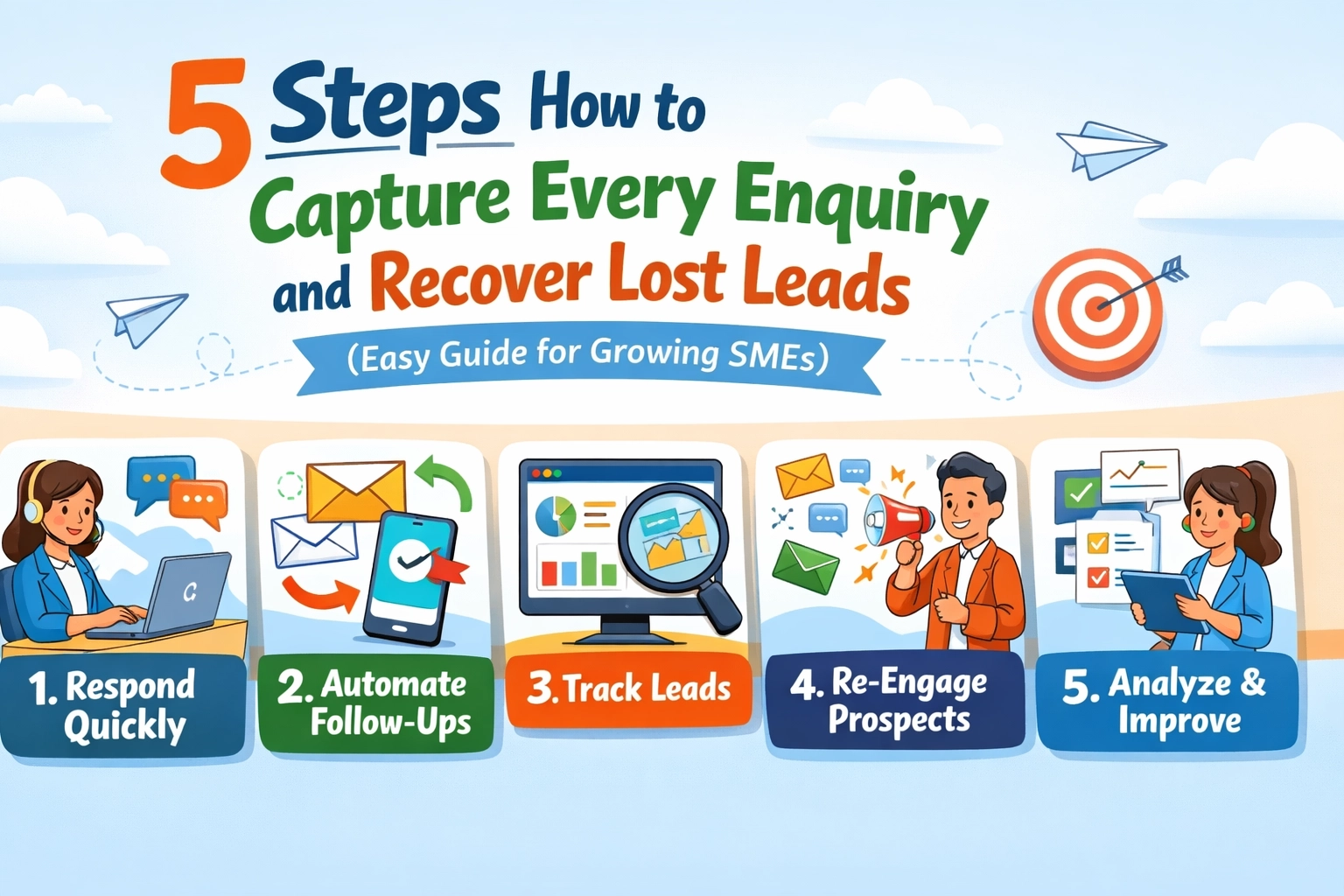
Here are the five steps to capturing every enquiry and recovering the leads you thought were lost.
Step 1: Visibility – Centralise Your Inflow
The first reason SMEs lose leads is that they don’t actually know where they are. One lead is a WhatsApp message on the Director’s personal phone. Another is an email sitting in the "info@" inbox that three different people are supposed to check (but nobody does). A third is a direct message on Instagram.
If you cannot see your leads in one place, you cannot manage them. It’s that simple.
You need to move away from the "inbox method" and towards a centralised system. This isn't just about being organised; it's about business intelligence. When all your enquiries land in one dashboard, you can suddenly see the patterns. You might realise that your Facebook leads are mostly tyre-kickers, while your web visibility efforts are bringing in high-value contracts.
Stop Using Spreadsheets
We’ve said it before: spreadsheets are killing your growth. They are static, they don't send alerts, and they rely on manual entry which, let’s face it, doesn't happen when things get busy.
What to do now:
- Audit your channels: List every way a customer can contact you.
- Connect them: Use a basic CRM or an enquiry management tool to funnel every single one of these into a single list.
- Acknowledge immediately: The moment a lead enters the system, an automated, friendly SMS or email should go out. This tells the customer, "We’ve got you," and stops them from clicking the next link on Google.

Step 2: Response – The 2-Minute Rule
If you take only one thing away from this guide, let it be this: Speed is your best sales tool.
According to research published by Harvard Business Review, businesses that attempt to reach an online lead within an hour are seven times more likely to have a meaningful conversation than those who wait even sixty minutes.
At Every Enquiry, we push this even further. We talk about the 2-minute rule. In the modern world, consumers have the attention span of a goldfish. If they don't get a response almost instantly, they assume you're too busy or simply don't care.
Why Speed Trumps Price
Service businesses often worry about being the cheapest. However, for many customers, especially in the trades or professional services, the "winner" is often just the person who showed up first. By responding in under two minutes, you aren't just a service provider; you are the solution to their immediate problem.
How to master your response:
- Digital Receptionists: If you can't answer the phone, have a service that does. A missed call is a missed invoice. You can calculate how much missed calls are really costing you here.
- Automated "Next Steps": Don't just say "Thanks for your email." Say, "Thanks for your email, we’ve received your request for a boiler quote. One of our engineers, Dave, will call you from a mobile number in the next 15 minutes."
- The Human Touch: Automation gets you through the door, but a prompt human response closes the deal.
Step 3: Ownership – Assign Clear Responsibility
A common problem in growing SMEs is the "I thought you were doing it" trap. When a lead comes in, and the whole team sees it, often nobody takes ownership.
Every enquiry must have a name attached to it. If a lead isn't assigned, it doesn't exist. This is where many businesses fail during the conversion phase. They have the visibility and the initial response, but then the lead sits in limbo because no one knows who is responsible for the follow-up call or the quote.
The Accountability Framework
In the "They Ask, You Answer" methodology, transparency is key. You should be transparent with your team about who is handling what.
- Lead Routing: Use software to automatically assign leads based on the type of enquiry. For example, all "New Installation" enquiries go to Sarah, and all "Maintenance" enquiries go to Tom.
- Deadlines: Set a "Kill Clock." If a lead hasn't been contacted within 4 hours, it gets escalated to a manager. This ensures nothing slips through the cracks.

Step 4: The Process – Structure Your Follow-Up
Most SMEs stop after one or two attempts to contact a lead. They call once, leave a voicemail, and then decide the lead "wasn't serious."
This is a massive mistake. The real cost of slow follow-up isn't just the missed initial job; it's the lifetime value of that customer.
Data from HubSpot suggests that it takes an average of 8 attempts to reach a prospect. If you’re stopping at two, you are leaving 75% of your potential revenue on the table.
A Typical SME Follow-Up Cadence:
- Minute 1: Automated SMS acknowledgement.
- Minute 5: Initial phone call attempt.
- Hour 2: Personalised email referencing their specific problem.
- Day 1: Second phone call attempt + WhatsApp message.
- Day 3: Follow-up email with a helpful resource (e.g., "5 things to check before hiring a roofer").
- Day 7: The "Break-up" email. "I haven't heard back, so I'll assume you’ve sorted this elsewhere. If you still need help, we're here."
This structured approach moves the lead through the response framework effectively, turning cold enquiries into warm conversations.
Step 5: Recovery – How to Win Back "Lost" Leads
What about the leads that genuinely went cold? The ones from six months ago who said they didn't have the budget or decided to "wait until next year"?
Most businesses treat these as dead. But "No" often just means "Not now."
The Art of Re-engagement
Recovering lost leads is the most cost-effective way to grow your business because you've already paid to acquire them.
- The Cooling-Off Period: Wait 6 months, then reach out with a non-salesy message. "Hi [Name], you spoke to us back in March about your garden project. We're just checking in to see if that's still on your radar or if you managed to get it finished?"
- Segmented Re-engagement: If they didn't buy because of price, send them an update when you have a seasonal offer. If they didn't buy because of timing, ask if their circumstances have changed.
- Address the "Why": Use the "They Ask, You Answer" principle. If people aren't converting, ask yourself why. Is your pricing unclear? Do they have fears you haven't addressed? Create content that answers these questions and send it to your cold leads.
Comparison: The Old Way vs. The Every Enquiry Way
To help you see the difference these steps make, we’ve put together this comparison table.
| Feature | The "Ad-Hoc" Way (Status Quo) | The Every Enquiry Way |
|---|---|---|
| Lead Capture | Scattered across emails, texts, and post-it notes. | All leads in one central, secure dashboard. |
| Response Time | "When I get a minute" (usually 4–24 hours). | Under 2 minutes via automated SMS/Email. |
| Accountability | "I thought Dave was calling them." | Clear ownership assigned to every lead. |
| Follow-up | One call, then forgotten. | Structured 5-7 step sequence over 7 days. |
| Lead Recovery | Zero strategy for old leads. | Automated re-engagement campaigns. |
| Outcome | High stress, wasted spend, lost revenue. | Predictable growth and higher ROI. |

Why "They Ask, You Answer" Matters for Lead Conversion
Marcus Sheridan’s philosophy is built on trust. When an enquiry comes in, the customer has a question. They are asking, "Can you help me? Are you reliable? What will it cost?"
If you fail to respond quickly, you are answering those questions with a resounding "No." You are telling them you aren't reliable and you aren't ready to help.
By implementing these five steps, you are demonstrating your expertise and your commitment to service before you’ve even spoken to them. You are providing the best sales tool possible: a professional, prompt experience.
Common Pitfalls to Avoid
- Over-complicating the Tech: You don't need an enterprise-level Salesforce setup. You need something simple that your team will actually use.
- Being Too "Salesy": In your follow-ups, focus on being helpful. If you’re a plumber, send them a guide on how to prevent burst pipes in winter. Education builds more trust than a discount code.
- Ignoring the Data: If you see that 80% of your leads are dropping off at Step 3, you know exactly where the "hole" in your bucket is. Fix the ownership, and you fix the revenue.
Conclusion: Start Plugging the Holes
Capturing every enquiry isn't about working 24/7. It's about having a system that works while you are on the tools, in a meeting, or asleep.
If you are tired of seeing your marketing budget go down the drain, it’s time to look at your conversion process. Start with Step 1: get everything in one place. Once you have visibility, the rest of the steps become much easier to manage.
Ready to see how we can help you automate this entire process? Check out our services or have a look at our pricing to see how we can help your SME scale without the headache of missed leads.
Frequently Asked Questions (FAQ)
1. I’m a one-man band; how can I respond in 2 minutes?
You can't do it manually, and you shouldn't try. This is where automation and digital receptionists come in. You can set up an automated SMS that triggers the second a form is filled out. It buys you time by letting the customer know you’ve seen their enquiry and will call them at a specific time.
2. Isn't automated follow-up a bit "spammy"?
Only if it’s irrelevant. If you send five emails saying "Buy from me!", people will be annoyed. If you send one email acknowledging the enquiry, one text to arrange a call, and one helpful guide related to their problem, that’s not spam: that’s excellent customer service.
3. We get a lot of "bad" leads. Why should I chase them?
Not all leads are created equal. However, many "bad" leads are actually just "early" leads. They might not be ready to buy today, but by handling them professionally and adding them to a recovery sequence, you'll be the first person they call when they are ready.
4. How much does it cost to set up an enquiry management system?
The cost is almost always less than the value of one or two lost jobs. You can view our pricing here, but generally, for most SMEs, the return on investment is seen within the first month by simply closing the leads that would have otherwise been missed.
5. Can I just use WhatsApp for my business leads?
WhatsApp is great for communication, but it’s terrible for lead management. You can't easily assign leads to staff, you can't see a "big picture" of your sales pipeline, and it’s very easy for messages to get buried. Use a system that integrates with WhatsApp so you get the best of both worlds.
6. What if my team resists using a new system?
Resistance usually comes from systems being too complex. This is why we advocate for simple, direct tools. When your team sees that they are no longer getting shouted at for missing leads: and that their sales commissions are going up: they usually become the biggest advocates for the system.
For more information on how to improve your business processes, visit our blog section or contact us today.