Let’s be honest for a second. You’re likely spending a fair bit of your hard-earned budget on marketing. Whether it’s Google Ads, a bit of SEO, or keeping your social media channels ticking over, the goal is always the same: make the phone ring and the inbox fill up.
But here’s the kicker. Most small to medium-sized businesses (SMEs) in the UK are actually throwing money away. Not because their marketing is bad, but because their "catchment" system is full of holes. You work hard to get a lead, then life gets in the way. You’re on a job, you’re in a meeting, or you’re simply exhausted, and that enquiry sits there. By the time you call back, they’ve already booked with the bloke down the road who answered on the second ring.
It’s frustrating, isn't it?
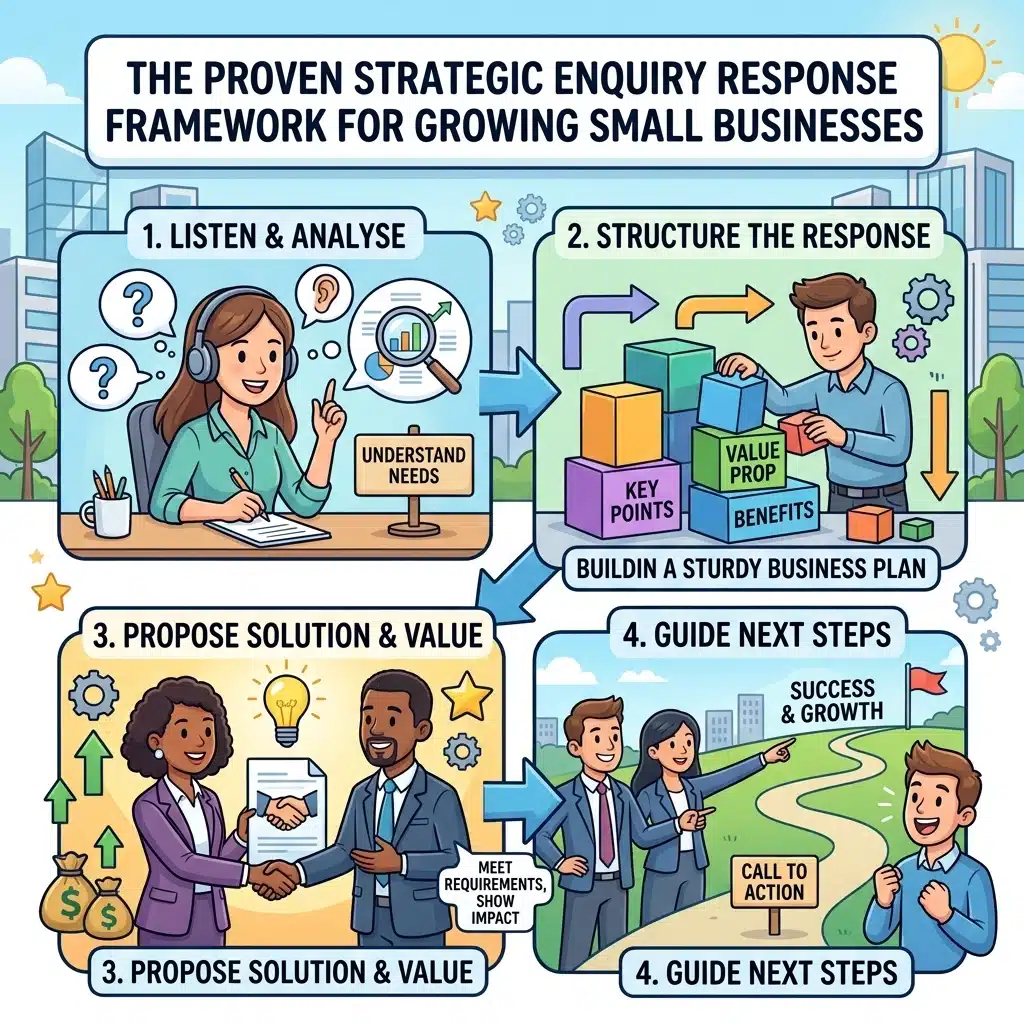
At Every Enquiry, we’ve seen this play out hundreds of times. That’s why we’ve developed a Strategic Enquiry Response Framework designed specifically for service-based businesses. It’s not about fancy software or jargon; it’s about a logical flow from being seen to getting paid.
In this guide, we’re going to break down the three pillars of growth: Visibility, Response, and Conversion.
Pillar 1: Visibility – Being Found Where It Matters
Visibility is more than just "having a website." It’s about being present when a potential customer has a problem they need solving right now. According to Google’s own insights, the "messy middle" of the customer journey is where people search, explore, and evaluate. If you aren't visible during that evaluation, you don't even get a chance to compete.
For a UK trade or professional firm, visibility usually means appearing in local search results or having a strong social presence. But here is the "They Ask, You Answer" truth: if your website doesn't answer the basic questions your customers have (like pricing, "how it works", and "who this isn't for"), you might be visible, but you aren't helpful.
The Transparency Trap
Most businesses are terrified of putting their prices online. They think, "If I show my price, the competition will undercut me." The reality is that your customers are already looking for pricing. If you don't give it to them, they’ll go to someone who will. Being visible is about being transparent.
We often talk about how Social media management is more than just posting updates. It’s about creating a gateway to your business. If your social media looks like a ghost town, people won't trust you enough to enquire.

Pillar 2: Response – The "Make or Break" Window
This is where the magic (or the tragedy) happens. You’ve got the visibility, the lead has come through, and now the clock is ticking.
We talk a lot about The 2-minute rule. Research, including a famous study cited by Harvard Business Review, shows that businesses that try to contact potential customers within an hour of receiving a query are nearly seven times as likely to have a meaningful conversation with a key decision-maker as those who wait even sixty minutes.
In the world of SME service businesses, an hour is an eternity. If someone needs a plumber, a locksmith, or an accountant, they want an answer now.
Why Speed is a Sales Tool
When you respond instantly, you aren't just being efficient; you’re demonstrating how you do business. You’re telling the customer, "You are a priority."
Many businesses rely on spreadsheets to track these leads. We’ve said it before and we’ll say it again: enquiry management via spreadsheets is killing your growth. Things get missed. Rows get deleted. Leads go cold.
A proper framework requires a digital receptionist UK or a structured automated system that ensures no call or email goes unacknowledged. It’s about creating a "Safety Net" for your business.
The Real Cost of "I'll Call Them Later"
Have you ever sat down and worked out how much missed calls are really costing you? If your average job is worth £500 and you miss three calls a week, that’s £78,000 in lost revenue a year. That’s a lot of money to leave on the table just because you were "busy."

Pillar 3: Conversion – Turning "Just Asking" into "Where Do I Pay?"
Conversion is the final hurdle. This isn't about "hard selling" or using pushy tactics. In fact, if you’ve handled Pillar 1 (Visibility/Trust) and Pillar 2 (Response/Speed) correctly, conversion should feel like a natural next step.
However, many SMEs fall down here because they don't have a follow-up system. They call once, the person doesn't pick up, and they give up.
The Art of the Follow-Up
Conversion requires persistence. Not annoying persistence, but helpful persistence.
- The First Touch: Immediate acknowledgement (SMS or Email).
- The Second Touch: A personal call within 15 minutes.
- The Third Touch: A follow-up email with value (e.g., "Here is a guide on what to expect during our service").
- The Fourth Touch: A "break-up" email or a final check-in.
If you’re wondering why your leads aren’t turning into customers, check out our guide on 10 reasons your lead conversion isn't working. Usually, it’s a lack of structure.
Stop Losing Money on Your Website
Your website should be a conversion machine. If it’s just a digital brochure, it’s failing you. Is your website losing you money? The hidden cost of missed enquiries is massive. Every "Contact Us" form that doesn't lead to an immediate response is a potential lost customer.

Comparing the Approaches: Manual vs. Strategic Framework
To understand why a framework is necessary, let's look at how most SMEs currently operate versus how a strategic enquiry response framework looks.
| Feature | The "Busy Business" Method (Manual) | The Every Enquiry Framework (Strategic) |
|---|---|---|
| Response Time | 2 to 24 hours (or more) | Under 2 minutes |
| Tracking | Post-it notes, spreadsheets, or memory | Centralised Dashboard & CRM |
| Consistency | Depends on how busy the owner is | Automated and guaranteed 24/7 |
| Customer Perception | "They might be too busy for me" | "They are professional and proactive" |
| Follow-up | Rare or inconsistent | Systematic (minimum 5 touchpoints) |
| Conversion Rate | Low (10-20% of leads) | High (40-70% of leads) |
| Scalability | Impossible without hiring more staff | Easily scales as lead volume grows |

Implementing the Framework: A Step-by-Step Guide
So, how do you actually put this into practice? You don't need a degree in marketing, but you do need a bit of discipline. Following the principles of They Ask, You Answer, you should focus on being the most helpful teacher in your industry.
1. Audit Your Visibility
Look at your business from a customer’s perspective. If you search for your service in your town, do you appear? Is your phone number clickable? Can someone message you on Facebook and get a reply? If the answer is "no" or "sometimes," you have a visibility gap. Visit our Visibility page to see how we help businesses bridge this.
2. Set Up a Response Protocol
Decide right now: who answers the phone? What happens if they are busy? You might want to look into a response system that acts as a digital front desk. You need a system that triggers an SMS the moment an enquiry hits your inbox. "Hi [Name], thanks for reaching out! We've received your message and Martyn will call you in 10 minutes." This simple step stops them from calling the next person on Google.
3. Use the "5-Step Framework" for Improved Response
We have a specific 5-step framework to stop losing leads. It involves:
- Immediate Notification: Knowing a lead exists the second it's born.
- The Rapid Call: Beating the competition to the punch.
- Qualification: Asking the right questions to ensure they are a good fit.
- Booking: Getting a date in the diary immediately.
- Nurture: Keeping them warm until the job starts.
4. Calculate Your ROI
Don't just guess if it's working. Look at your pricing and compare it to the revenue you are currently losing. The real cost of slow follow-up is usually much higher than the cost of implementing a professional system.
The SME Growth Mindset
Growing a small business in the UK is tough. The economy is up and down, and competition is fierce. But most of your competitors are lazy with their lead handling. They think getting the lead is the hard part. It isn't. The hard part is the "last mile", the gap between someone saying "I'm interested" and someone saying "Here is my credit card."
By adopting a strategic enquiry response framework, you aren't just "fixing your sales." You are building a reputation. You become the company that actually picks up. The company that cares. The company that is professional.
In the long run, that reputation is worth more than any individual lead. It leads to referrals, repeat business, and a brand that stands the test of time.
If you’re ready to stop the leak in your bucket, contact us today. We don't do fluff, and we don't do "marketing speak." We just help you handle your enquiries better so you can grow your business.
Check out our blog section for more deep dives into lead handling and SME growth.
Frequently Asked Questions
Why is speed of response so important?
In the digital age, customers have zero patience. If you don't respond quickly, they assume you are either out of business or too busy to help them. By the time you call them back three hours later, they've likely already spoken to a competitor who gave them a quote. Speed equals trust.
I’m a one-person band; how can I respond in 2 minutes?
This is the biggest challenge for SMEs. You can't be on the tools and on the phone at the same time. This is where automation and digital receptionists come in. A system can send an immediate text or take a message so the customer feels "heard" while you finish the task at hand.
Isn't automated follow-up a bit impersonal?
Not if it's done right. An automated message should feel like it's coming from a real person. "Hi, it's Martyn from Every Enquiry. I've just seen your message. I'm with a client right now but I'll call you at 4 pm. Does that work?" This is helpful, not robotic.
How much does an enquiry response system cost?
The real question is: how much is it costing you not to have one? Most businesses find that saving just one or two leads a month more than pays for the entire system. You can view our pricing options here.
Do I really need a CRM?
If you have more than five leads a week, yes. Trying to remember who you called, who said "call me back on Friday," and who needs a quote sent is a recipe for disaster. A simple CRM (Customer Relationship Management) tool keeps everything in one place.
Can Every Enquiry help with my social media too?
Yes. Visibility is the first pillar of our framework. If your social media isn't generating leads, it’s not working hard enough. We focus on social media management that actually drives enquiries, not just likes.
What is the most common mistake SMEs make with leads?
Giving up too soon. Most people stop after one missed call. Research shows it often takes 5 to 7 "touches" to convert a lead. A strategic framework automates these touches so you don't have to remember to do them manually.
Ready to transform your enquiry handling?
Visit Every Enquiry and let’s get your business growing. No more missed calls, no more lost revenue. Just a solid, strategic approach to growth.
Cheers,
Martyn Lenthall
Director, Every Enquiry