You’ve probably been there. You spend thousands on Google Ads, you’re posting on Instagram every day, and you finally see the enquiries start to trickle: or hopefully pour: in. But at the end of the month, when you look at the bank balance, something doesn’t quite add up. The "busy-ness" isn't translating into "business".
Most SME owners in the UK think their problem is a marketing problem. They think they need more leads. But in our experience at Every Enquiry, the problem is rarely the quantity of leads. It’s almost always how those leads are handled once they land in your inbox or hit your phone.
In the spirit of Marcus Sheridan’s "They Ask, You Answer" philosophy, let’s be brutally honest: if you aren't closing deals, you’re likely dropping the ball during the "handover" from marketing to sales. You’re making mistakes that are invisible to you but blindingly obvious to your potential customers.
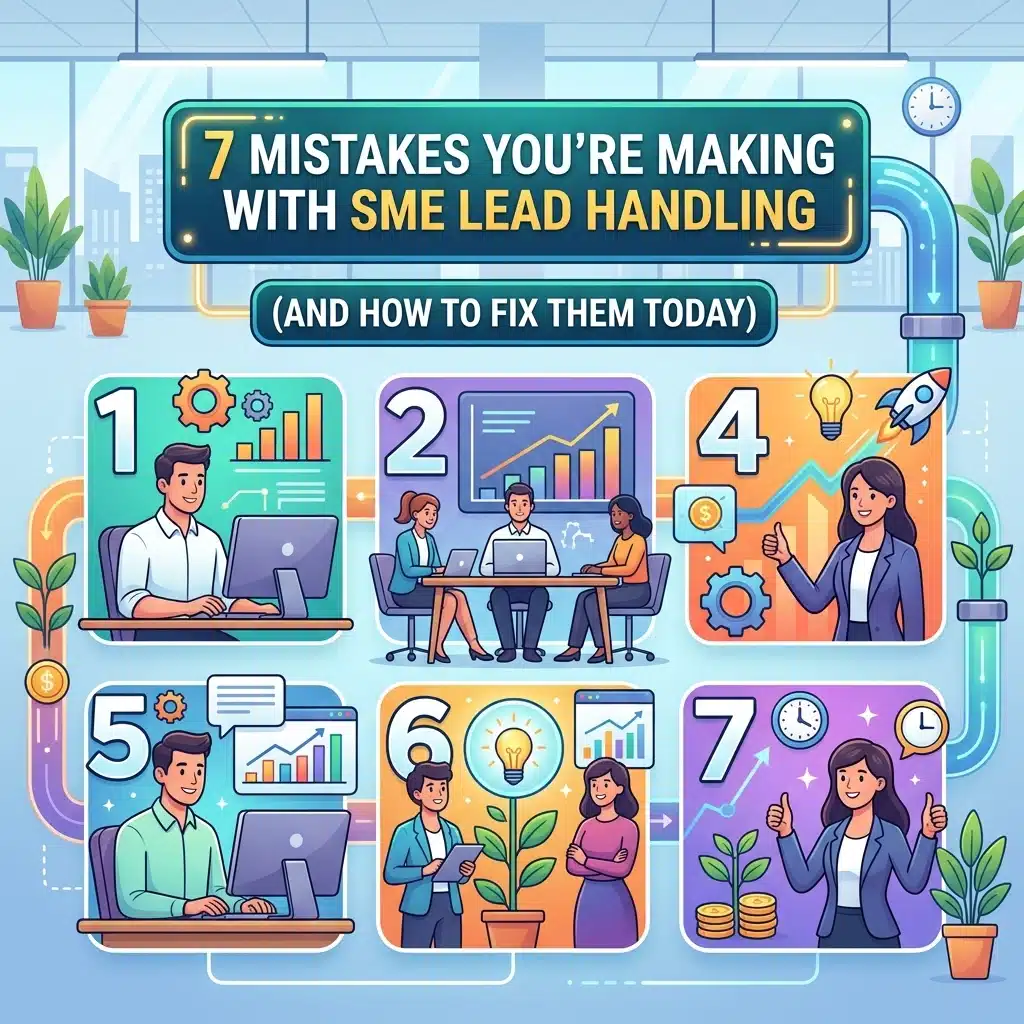
Let’s look at the seven most common mistakes SMEs make with lead handling and, more importantly, how you can fix them before the end of the day.
Visibility: You Can’t Fix What You Can’t See
Before we get into the nitty-gritty of how you talk to people, we have to talk about how you see them. If your lead handling is a black box where enquiries go in and "maybe" come out as sales, you have a visibility problem.
1. Not Tracking Lead Sources (The Blind Spend)
If I asked you right now which marketing channel gave you your last three customers, could you tell me? Most small business owners can’t. They know they have a website, a Facebook page, and maybe some local flyers, but they don't know which one is actually paying the bills.
When you don’t track where a lead comes from, you’re essentially gambling with your marketing budget. You might be pouring £500 a month into a social media strategy that generates "likes" but zero enquiries, while your SEO is quietly doing all the heavy lifting.
The Fix: You need a system that tags every enquiry with its source. Whether it’s a specific phone number for an ad or a tracking code on a web form, visibility is key. This allows you to calculate your customer acquisition cost by source. Stop guessing and start measuring.
2. Buying Low-Quality, "Shared" Leads
We see this all the time in the service industry. A business signs up for a lead generation platform that sells the same enquiry to five different companies. It becomes a race to the bottom on price.
The mistake isn't just buying the leads; it’s the lack of vetting. If you’re spending your morning chasing "leads" who didn't realise they were asking for a quote or who are purely looking for the cheapest possible price, you’re wasting your most valuable resource: time.
The Fix: Pivot your strategy toward exclusive lead generation. It’s better to have five high-quality, exclusive enquiries than 50 shared ones. Focus on your own website optimization to capture leads that are looking for you, not just any provider.

Response: The "Speed to Lead" Game
Visibility is the foundation, but response is the engine. In the UK service sector, the first person to call back usually wins the job. If you’re slow, you’re invisible.
3. The Slow Response (The 2-Minute Rule)
Did you know that your chances of qualifying a lead drop by 10x if you wait longer than five minutes to respond? Most SMEs take hours, if not days, to get back to an email enquiry. By that time, the customer has already called three of your competitors, and one of them has already booked the site visit.
We call this "The 2-Minute Rule." In a world of instant gratification, a prompt response isn't just "good service": it’s a competitive advantage. According to research by Harvard Business Review, businesses that attempt to reach leads within an hour are nearly seven times more likely to have meaningful conversations than those who wait even 60 minutes.
The Fix: Implement an automated "first response." This doesn't have to be a full quote, but an immediate acknowledgement that tells the lead, "We’ve got your message, and we’re on it." Better yet, use a system that alerts your team instantly so a human can make that 2-minute call.
4. Relying on "Leaky" Systems (Spreadsheets and Post-its)
If your "system" for managing enquiries involves a spreadsheet that only you have the password for, or: heaven forbid: a stack of sticky notes on the edge of a desk, you are losing money.
Leads fall through the cracks. You forget to follow up. You lose the phone number. Spreadsheets are where leads go to die. They don't remind you to call someone back in three days, and they don't show you the history of the conversation.
The Fix: You need a simple, dedicated enquiry management system. It doesn't have to be a complex enterprise CRM, but it must be a central hub where every team member can see the status of a lead. This is how you move from busy to scalable.
Conversion: Turning Interest into Income
You’ve seen the lead, and you’ve responded quickly. Now comes the hard part: making sure they actually buy from you. This is where most SMEs stop, thinking their job is done once the quote is sent.
5. Not Segmenting Your Audience
Not all leads are created equal. Someone who downloads a "Price Guide" from your website is at a very different stage of the buyer's journey than someone who fills out a "Book an Emergency Callout" form.
Treating them the same is a massive mistake. If you send a "Buy Now" pitch to someone who is just researching, you'll scare them off. If you send a "Research Guide" to someone with a leaking pipe, they’ll call someone else.
The Fix: Segment your leads based on intent and source. Tailor your messaging to where they are in the journey. This is a core principle of enquiry handling. Personalisation doesn't mean writing every email from scratch; it means sending the right automated message to the right person.
6. Skipping the Lead Nurture (The "One-and-Done" Approach)
Most SMEs follow up once. If the prospect doesn't reply or says "not right now," the lead is deleted or forgotten. This is a tragedy for your ROI.
Statistically, most sales happen between the 5th and 12th contact point. If you stop at one, you’re leaving 80% of your potential revenue on the table. A "No" today isn't necessarily a "No" forever; it’s often just a "Not right now."
The Fix: Create a 12-month nurture sequence. Use email marketing to provide value, share case studies, and answer common questions. By the time they are ready to buy, you’ll be the only company they think of. This is how you turn enquiries into sales without spending more on marketing.
7. Relying on a Single Lead Source
If 90% of your business comes from word-of-mouth or a single lead provider, you don't have a business; you have a vulnerability. What happens when that lead provider triples their prices? Or when the local Facebook group you rely on changes its rules?
Feast-and-famine cycles are almost always caused by a lack of diversity in lead generation.
The Fix: Build a "Marketing Haystack." Combine organic SEO, paid ads, social media, and local networking. This ensures a predictable flow of enquiries even if one channel dries up.

Manual vs. Systematic Lead Handling: A Comparison
To see why these mistakes are so costly, let’s compare the traditional "Manual" way of handling leads versus a "Systematic" approach.
| Feature | Manual Lead Handling | Systematic (Every Enquiry) Approach |
|---|---|---|
| Response Time | 2 – 24 hours (or never) | Under 2 minutes (Automated + Human) |
| Tracking | "I think they saw us on Google" | Precise source tracking for every lead |
| Follow-up | Once or twice, then forgotten | Structured 12-month nurture sequence |
| Data Storage | Spreadsheets, paper, or email inbox | Centralised, searchable Enquiry Hub |
| Lead Quality | Chasing everyone (and no one) | Automatic lead scoring and segmentation |
| Scalability | Relies on the owner's memory | Works perfectly without the owner |
| Cost | High (due to missed opportunities) | Fixed, predictable, and high ROI |
Why "They Ask, You Answer" Matters for Lead Handling
Marcus Sheridan’s philosophy is simple: obsess over your customers' questions and answer them transparently. When it comes to lead handling, this means your very first response should address their biggest concerns.
If a lead asks for a price, don't hide behind "it depends." Give them a range. If they ask how long a job takes, tell them. By being the most transparent business in your local area, you build trust before you even meet them in person.
This transparency should be baked into your enquiry management system. When you respond fast and provide the information they actually want, you become the obvious choice.
The Role of a Digital Receptionist
If you’re a small team, answering every call and email within two minutes is impossible. You’re busy on-site or in meetings. This is where the concept of a digital receptionist comes in.
A digital receptionist isn't just an answering service. It’s an integrated system that captures the lead, logs it in your CRM, sends an immediate SMS to the customer, and notifies you to call back. It bridges the gap between a "missed call" and a "missed opportunity."

How to Start Fixing Your Lead Handling Today
You don't need to overhaul your entire business by Monday. You just need to stop the leaks. Here are three steps you can take right now:
- Mystery Shop Yourself: Send an enquiry through your own website or call your business number. How long does it take to get a response? Is the experience friendly and professional?
- Audit Your Last 20 Leads: Go back through your emails. How many of those 20 became customers? For the ones that didn't, do you know why? Did you follow up more than once?
- Calculate the Cost of Silence: Use our guide on how much missed calls are costing your business. Often, just saving two "lost" leads a month pays for a professional enquiry handling system ten times over.
Final Thoughts from Every Enquiry
At Every Enquiry, we believe that British service businesses deserve better than "winging it." You work too hard for your leads to let them vanish into an unorganised inbox.
By fixing these seven mistakes, you aren't just improving your sales; you’re building a professional brand that people trust. You’re moving from a business that is "always busy" to a business that is "always growing."
If you’re ready to stop losing leads and start converting, it’s time to look at your systems. Whether it’s improving your response times or diversifying your social media strategy, every small change adds up to massive growth.
Frequently Asked Questions (FAQ)
What is the ideal response time for a new enquiry?
While "as soon as possible" is the standard, aim for under five minutes. Research shows that responding within five minutes increases the likelihood of a successful conversion by nearly 100% compared to waiting 30 minutes.
I’m too busy to answer the phone while I’m working. What should I do?
This is a common struggle. Consider an automated enquiry handling system or a digital receptionist service. These tools ensure every caller gets an immediate response (via text or email) even when you are hands-on with a job.
Why shouldn't I use a spreadsheet to track my leads?
Spreadsheets are static. They don't send you reminders, they don't integrate with your marketing tools, and they are prone to human error. A dedicated enquiry management system automates the "boring" stuff so you can focus on the sale.
How many times should I follow up with a lead?
The "sweet spot" is usually between 5 and 7 touches. Most SMEs give up after one. A structured follow-up process, including emails, SMS, and calls, ensures you stay top-of-mind without being a nuisance.
Are shared leads from sites like Checkatrade or Bark worth it?
They can be, but they are often a race to the bottom on price. If you use them, your "Speed to Lead" must be lightning-fast. In the long run, generating exclusive leads through your own website is more profitable and sustainable.
What is a "Lead Service Level Agreement" (SLA)?
It’s a simple agreement (even if you’re a team of two) that defines how quickly a lead should be contacted and what the follow-up process looks like. It ensures consistency and prevents leads from being ignored.
How much does it cost to fix my lead handling?
The real question is: how much is it costing you not to fix it? If you lose just one £1,000 job a month due to a slow response, you’ve lost £12,000 a year. Professional systems often cost a fraction of that lost revenue.