You’ve done the hard part. You’ve put in the hours, built a website, and invested your hard-earned cash into marketing. Whether it’s SEO, local Google Ads, or a bit of social media graft, the goal was the same: make the phone ring and the inbox fill up.
But here’s the cold, hard truth: for most UK small and medium enterprises (SMEs), getting the enquiry is only 20% of the battle. The real money, the actual profit that pays your mortgage and grows your business, is made in how you handle that lead once it lands.
At Every Enquiry, we see it every day. Brilliant service businesses (plumbers, solicitors, accountants, builders) are literally throwing money down the drain because their lead handling is, frankly, a bit of a mess.
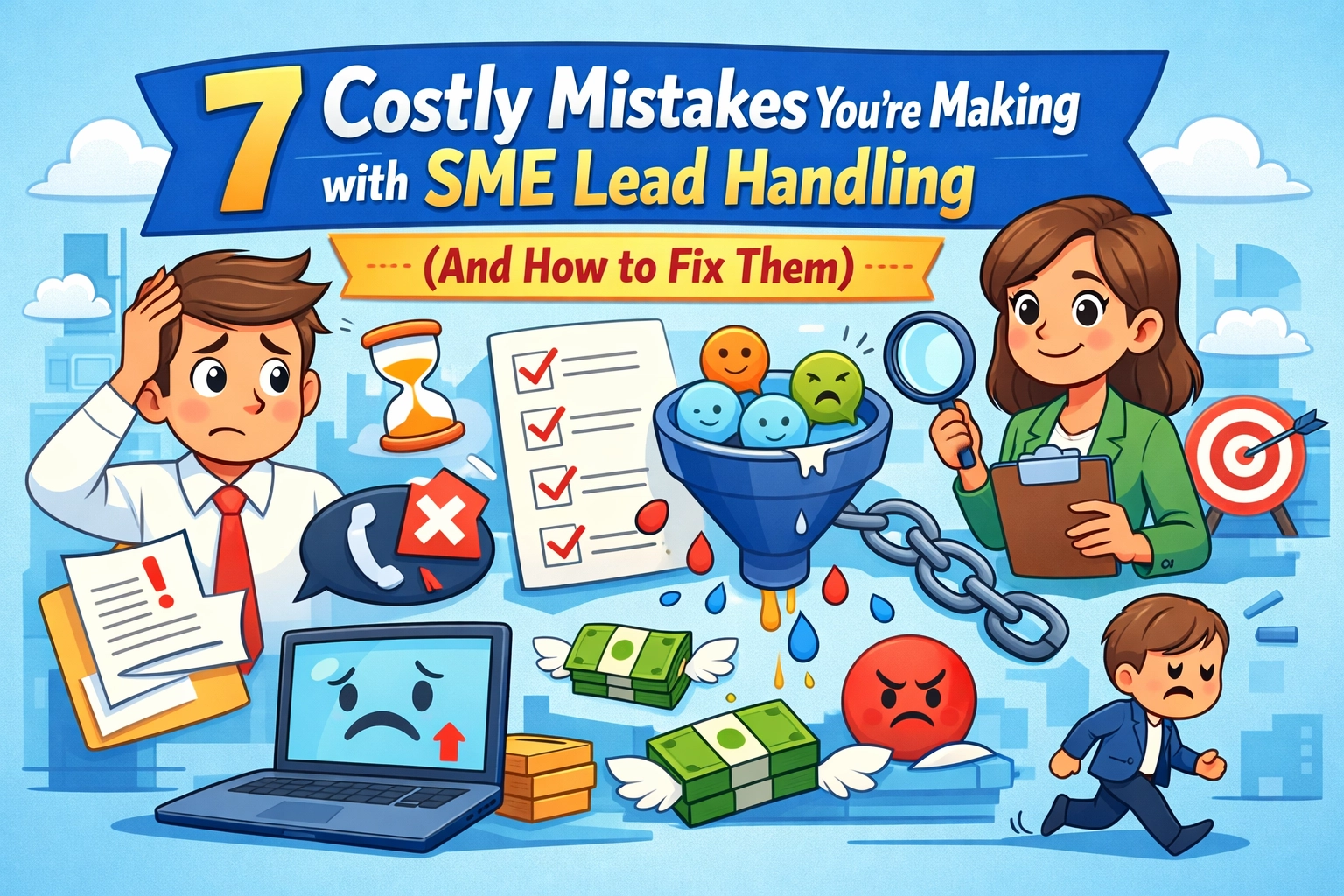
If you feel like you’re busy but your bank balance isn't reflecting the effort, or if you’re frustrated that "leads are rubbish" these days, you’re likely making one of these seven mistakes. Let’s look at what they are and, more importantly, how you can fix them using our Visibility -> Response -> Conversion framework.
The Framework: Visibility, Response, and Conversion
Before we dive into the mistakes, you need to understand the three pillars of a successful business.
- Visibility: Being found by the right people.
- Response: How fast and how well you acknowledge the enquiry.
- Conversion: The process of turning that "hello" into a "yes."
Most business owners obsess over Visibility. They want more traffic. But if your Response and Conversion systems are broken, more visibility just means more wasted money.
1. The "I’ll Do It Later" Response (The 2-Minute Rule)
The single biggest mistake we see is a lack of urgency. In the age of Amazon Prime and instant gratification, your potential customers aren't going to wait 24 hours for you to finish on-site or get out of a meeting to call them back.
According to a study by Harvard Business Review, businesses that try to contact potential customers within an hour are nearly seven times as likely to have a meaningful conversation with a key decision-maker than those who wait even 60 minutes.
If you wait until the end of the day to check your emails, you’ve already lost. The lead has already called your competitor, and they’ve likely already booked them in.
The Fix: You need to implement the 2-minute rule. This doesn't mean you have to have a full hour-long consultation in two minutes. It means you acknowledge the lead instantly. Whether it’s an automated (but personal-sounding) text message or a quick "I’ve seen your enquiry, I’m on a job, I’ll call you at 4 PM," that immediate touchpoint stops them from looking elsewhere.

2. The "One and Done" Follow-Up
Many SMEs receive a lead, call once, and if the person doesn't pick up, they move on. They assume the lead wasn't serious or was just "tyre kicking."
This is a massive error. Life happens. People are at work, they’re picking up the kids, or they’re simply busy. Most sales require between five and twelve touchpoints before a conversion happens. If you stop after one missed call, you are leaving about 80% of your potential revenue on the table.
The Fix: Build a lead follow-up system. This isn't about being annoying; it’s about being persistent. A mix of phone calls, emails, and WhatsApp messages over a 7-to-10-day period is the sweet spot. If you don't have time for this, you need an enquiry management system that automates the reminders for you.
3. Ignoring the "Elephant in the Room" (Pricing)
Inspired by Marcus Sheridan’s They Ask, You Answer philosophy, one of the biggest mistakes SMEs make is hiding their prices. You might think, "I can't give a price until I see the job," or "I don't want to scare them off."
The reality? Customers hate it when you hide the price. They feel like you’re going to "size them up" before giving a quote. By not being transparent, you’re actually creating friction in the conversion process.
The Fix: You don't have to give a fixed quote for every bespoke job, but you must talk about what influences the price. Create content on your site that explains "How much does [Service] cost?" and "Why some companies are cheaper than others." This builds massive trust before you’ve even spoken to them. When they do enquire, they are already "pre-qualified" because they know roughly what to expect.
4. Letting Leads Fall into the "Spreadsheet Abyss"
Are you still tracking your leads in a notebook or a messy Excel spreadsheet? Or worse, just leaving them in your email inbox?
Spreadsheets are where leads go to die. There’s no reminder to follow up, no way to see the "big picture" of your marketing spend, and it’s impossible to scale. When you’re relying on your memory to follow up with "Dave from last Tuesday," things get missed. And missed calls are costing you more than you think.
The Fix: Move to a simple, visual CRM (Customer Relationship Management) tool. It doesn't have to be complicated. You just need a way to see who is at the "new enquiry" stage, who has a "quote sent," and who needs a "follow-up." This ensures no lead is left behind.
5. Treating All Leads as "Ready to Buy Now"
Not every lead is ready to pull out their credit card today. Some people are in the "research" phase. They’re just trying to understand their options.
If you treat a researcher like they should be ready to book a site visit tomorrow, you’ll scare them off. Conversely, if you treat a "ready to buy" lead with a slow, educational nurture sequence, they’ll get frustrated and go to someone faster.
The Fix: Segment your audience. When someone fills out a form on your site, ask a qualifying question like "When are you looking to start this project?"
- Response for "ASAP": Phone call immediately.
- Response for "Just researching": Send them an educational guide or a link to your blog section and put them on a weekly email nurture.
6. The "Disconnected Receptionist" Syndrome
If you have someone answering your phones, whether it’s a virtual assistant or a receptionist, are they just taking a message?
"He’s out at the moment, can I take your name and number?" is the most common phrase in British business. It’s also a conversion killer. By the time you call them back, the "buying heat" has cooled down.
The Fix: Empower your "gatekeeper" to be a "bridge." Instead of just taking a message, they should be trained to ask 2-3 qualifying questions and, ideally, book a slot directly into your calendar. This moves the lead from "enquiry" to "appointment" in one step. Check out our thoughts on digital receptionists vs. enquiry management to see the difference.

7. Not Tracking the ROI of Every Enquiry
Do you know exactly which marketing channel produced your last five customers? Was it the Google Ad? The Facebook post? Or the sign on your van?
Most SME owners "think" they know where their leads come from, but gut feeling is often wrong. You might be spending £500 a month on SEO that’s bringing in "tyre kickers," while a £100 local sponsorship is bringing in high-value clients. Without data, you can't optimize your visibility.
The Fix: Use lead tracking. Whether it’s a dedicated phone number for different ads or a simple "How did you hear about us?" on every form, you must track the source. This allows you to stop wasting money on what doesn't work and double down on what does.
Comparison: The DIY Approach vs. The Every Enquiry Way
| Feature | The "Busy Boss" DIY Approach | The Every Enquiry Managed System |
|---|---|---|
| Response Time | 4-24 hours (whenever free) | Under 2 minutes (automated & human) |
| Follow-up Frequency | 1 call, maybe a text | Structured 7-10 day multi-channel sequence |
| Data Management | Inbox, sticky notes, or memory | Centralised CRM with real-time tracking |
| Lead Qualification | None – talk to everyone | Pre-qualified via smart forms & questions |
| Transparency | "Call for a quote" | Upfront pricing guides & educational content |
| Conversion Rate | Low (losing leads to speed) | High (predictable & consistent) |
Why Speed of Response is Your Best Sales Tool
Let’s talk about the "Speed to Lead" concept. It’s not just a buzzword. When a lead arrives, it’s like a hot coal. If you hold it and act on it immediately, you can start a fire (a sale). If you leave it on the floor for three hours, it goes cold.
The psychology of a customer is simple: they have a problem, and they want it solved. The first person who responds professionally and competently usually gets the job. You don't even have to be the cheapest; you just have to be the most responsive.
In fact, responding promptly is one of the 10 reasons your lead conversion isn't working. When you respond fast, you signal to the customer that you are organised, reliable, and that you value their business. If you’re slow to respond to an enquiry, they’ll assume you’ll be slow to do the work.
How to Improve Response Times Without Working More Hours
You’re probably thinking, "Martyn, I’m on a roof/in a courtroom/fixing a boiler. I can't answer the phone in two minutes."
I get it. That’s why you shouldn't rely on you being the one to do it. You need a framework.
- Automation: Set up an immediate auto-reply on your website forms. Not a boring "We have received your enquiry," but something like "Hi, I’m Martyn. I’ve got your details. I’m currently on-site but I’ve looked at your request and I’ll give you a shout at [Time]. In the meantime, here is our [Pricing Guide]."
- External Support: Use an enquiry management service that handles the first touch for you.
- The 2-Minute Rule Framework: Read our 5-step framework to see how to delegate this without losing the personal touch.
The "They Ask, You Answer" Connection
If you want to truly master lead handling, you have to stop selling and start teaching. Marcus Sheridan, author of They Ask, You Answer, discovered that by answering every question a customer had, even the uncomfortable ones about cost and competitors, his business exploded.
When a lead comes in, they usually have three fears:
- How much is this going to cost me?
- Can I trust this person to do a good job?
- Are they going to rip me off or disappear?
Your lead handling process should address these fears immediately. Send them a video of your team. Send them a PDF of your "What to expect" process. Send them a link to your privacy policy and terms so they know you’re a legitimate, professional outfit.
This is how you move from being a "commodity" (where people only care about price) to a "trusted authority" (where people are happy to pay a premium for your expertise).
Final Thoughts: The Cost of Doing Nothing
Every missed call, every ignored email, and every "I’ll do it later" follow-up is a dent in your business growth. If you’re currently converting 10% of your leads and you could move that to 20% just by answering the phone faster, you’ve effectively doubled your business without spending an extra penny on marketing.
Is your website losing you money? It might be. But the fix isn't always a new website; it's a better system for when the website does its job.
If you’re ready to stop the "leaky bucket" in your business, it’s time to look at your pricing and see how a professional enquiry management system could pay for itself within the first month.
Frequently Asked Questions
1. Is it really that important to respond within minutes?
Yes. Data shows that the odds of qualifying a lead drop by 10 times if you wait more than 5 minutes. In the UK service market, if you don't answer, they simply click the next result on Google.
2. I'm a one-person band, how can I possibly handle leads this fast?
You don't have to do it yourself. Use automation for the initial "touch" or hire an enquiry management service that acts as your front office. The goal is to acknowledge the customer so they stop searching.
3. Why should I put my prices on my website? Won't my competitors see them?
Your competitors likely already know what you charge. By hiding your prices, you aren't protecting yourself from competitors; you're annoying your customers. Transparency builds trust faster than anything else.
4. What is the difference between a digital receptionist and enquiry management?
A digital receptionist or answering service usually just takes a message. Enquiry management is more proactive: we qualify the lead, answer their basic questions, and move them further down your sales funnel.
5. How many times should I follow up with a lead before giving up?
We recommend at least 5 to 7 attempts across different channels (phone, email, text) over a period of two weeks. Many people don't buy on the first touch, but they appreciate the persistence when they are finally ready.
6. Do I need a complicated CRM to manage my leads?
Not at all. For most SMEs, a simple "Kanban" style board (like Trello or a basic CRM) is enough. The key is having one central place where every enquiry lives, so nothing gets forgotten.
7. How can I track where my leads are coming from?
You can use tools like Google Analytics, dedicated tracking numbers (like Ruler Analytics or CallRail), or simply build a mandatory "How did you find us?" field into your contact forms. Knowing your source is vital for predictable growth.