Let’s be honest for a second. You are likely spending a small fortune on marketing. Whether it’s SEO, Google Ads, or a social media manager, you are pumping money into the front end of your business to get the phone to ring or the inbox to ping. But what happens when it actually does?
For most SME service businesses in the UK, from tradespeople to law firms, this is where the wheels fall off. You’ve done the hard work of being visible, but the lead falls into a black hole. Maybe you’re on a job and can’t answer. Maybe your admin person is overwhelmed. Or maybe you just forget to follow up because life gets in the way.
At Every Enquiry, we call this the "Leaky Bucket Syndrome." You keep pouring water (leads) into the top, but the holes in your response process mean you’re losing money every single day.
In this guide, we’re going to show you how to plug those holes using a structured approach: Visibility -> Response -> Conversion. We’ll be using the "They Ask, You Answer" principles pioneered by Marcus Sheridan, focusing on radical transparency and education. If you want to stop losing leads for good, keep reading.
Phase 1: Visibility – The Foundation of the Enquiry
Before we even talk about responding to a lead, we have to look at how that lead found you. Many business owners think visibility is just about "being on page one of Google." It isn't. Visibility is about being found by the right people for the right reasons.
In the world of Visibility, quality beats quantity every time. If you attract 1,000 visitors who are just "tyre-kickers," your response team will be exhausted and your conversion rate will plummet.
Addressing the "Big 5"
To ensure your visibility leads to high-quality enquiries, your website and content must address what Marcus Sheridan calls "The Big 5." These are the things buyers are searching for but most businesses are too scared to talk about:
- Pricing and Cost: If you don't tell them what it costs, they’ll go to someone who will.
- Problems: Talk about the issues with your service or industry. It builds massive trust.
- Comparisons: How do you stack up against the competition?
- Reviews: What are people actually saying?
- The Best: Who are the best in your area (even if it’s not just you)?
When you are transparent about these things, the leads that do come through are "pre-qualified." They already know your ballpark pricing and they trust your honesty. This makes the website optimization process much more effective.

Phase 2: Strategic Response – Where the Magic Happens
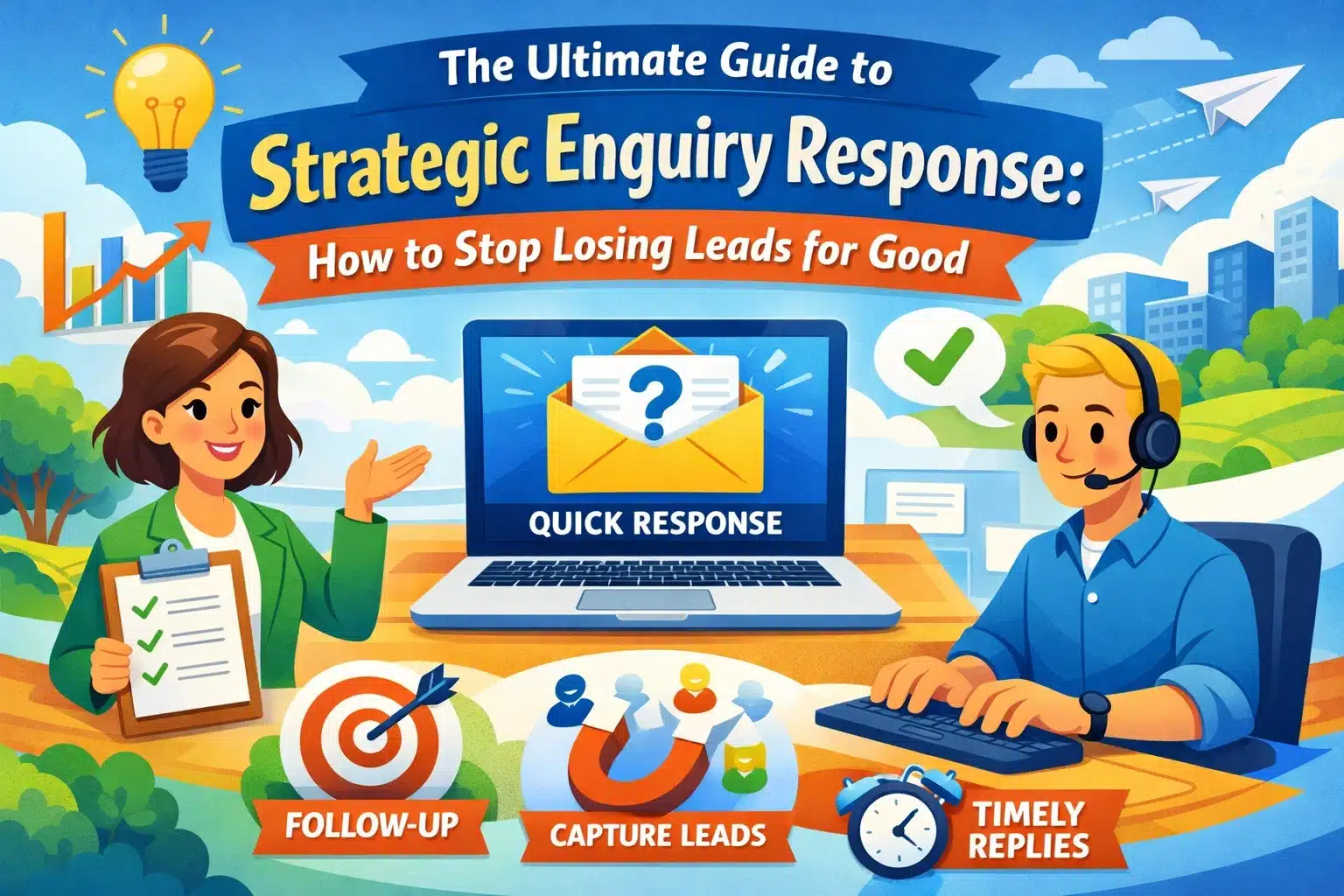
This is the "Response" phase, and it is the most critical part of the entire journey. You can have the best service in the world, but if you take three days to reply to an email, you’ve already lost.
According to research by Harvard Business Review, firms that tried to contact potential customers within an hour of receiving a query were nearly seven times as likely to have a meaningful conversation with a key decision-maker than those who waited even sixty minutes.
The "Five-Minute" Rule
In the modern world, five minutes is the new gold standard. If a lead fills out a form on your site and you call them back while they are still on your page, you aren't just a service provider, you're a mind reader. You are professional, prompt, and clearly on top of your game.
But how does a busy SME achieve this? You can't sit by the phone all day. This is where enquiry handling systems come into play.
Categorisation and Prioritisation
Not all leads are created equal. A strategic response system involves categorising enquiries as they arrive:
- High Priority: "My boiler has exploded," or "I need a solicitor for a hearing tomorrow." These need an immediate human response.
- Medium Priority: "I’m looking for a quote for a kitchen renovation next month." These need a response within the hour.
- Low Priority: "Do you have a brochure?" These can be handled by automated workflows.
By using a digital receptionist or an automated enquiry management system, you ensure that no lead is left behind, regardless of its priority.
The Power of Acknowledgment
If you can't give a full answer immediately, an "immediate acknowledgment" is the next best thing. An automated email or SMS that says, "Hi [Name], thanks for your enquiry about [Service]. Martyn here: I've received your message and I'm just finishing up a meeting. I'll give you a call at 2 PM today to discuss," goes a long way. It stops the prospect from clicking back to Google and calling your competitor.

Phase 3: Conversion – Turning Conversations into Cash
The final piece of the puzzle is Conversion. You’ve been seen, you’ve responded quickly, and now you need to close the deal.
Conversion isn't about "hard selling." It’s about continuing the educational journey you started in the Visibility phase. If you use the "They Ask, You Answer" method, your sales process should feel like a consultation, not a pitch.
Structured Follow-Up Systems
Most leads die in the follow-up. A salesperson (or business owner) calls once, doesn't get an answer, and gives up. This is a massive waste of resources.
A structured follow-up system looks like this:
- Immediate Call/SMS acknowledgment.
- Follow-up call 2 hours later if no contact was made.
- Value-add email on Day 1 (e.g., "Here is a guide on how to prepare for your renovation").
- Check-in call on Day 3.
- "Break-up" email on Day 7.
This persistence, when done politely and with a focus on being helpful, is what separates the top 1% of SMEs from the rest.
Why SMEs Struggle (and the Solution)
Most small businesses struggle with this because they try to do it all manually. They use post-it notes, their memory, or a messy inbox. This is why 10 reasons your lead conversion isn't working usually boils down to a lack of a structured system.
Let’s look at the difference between the "Old Way" and the "Strategic Way."
Comparison: Manual Handling vs. Strategic Enquiry Management
| Feature | Manual Handling (The Old Way) | Strategic Management (Every Enquiry Way) |
|---|---|---|
| Response Time | 4 to 48 hours | Under 5 minutes (Automated/Human) |
| Follow-up | When you remember | Structured 5-touch sequence |
| Lead Tracking | "I think we got some leads" | Full dashboard with ROI tracking |
| Trust Building | Generic sales pitch | Educational content & transparency |
| Availability | 9-to-5 (if you're lucky) | 24/7 Enquiry capture |
| Cost of Lost Leads | Thousands in wasted ad spend | Maximised ROI on every penny spent |

Implementing "They Ask, You Answer" in Your Response
To truly stop losing leads, your response must mirror the honesty of your marketing. When a lead asks a difficult question during the enquiry phase: usually about price or "what could go wrong": don't dodge it.
If a potential client asks, "Why are you more expensive than the guy down the road?", a strategic response isn't to get defensive. It’s to say: "That's a great question. We are more expensive because we include [X, Y, and Z] which ensures [Benefit]. Here is a blog post we wrote that compares our service level to 'budget' providers so you can decide which is right for you."
This level of honesty is disarming. It builds a level of trust that no "slick" salesperson can match. You can find more about our approach on our blog section.
The Role of Technology: Digital Receptionists and CRMs
You might be thinking, "Martyn, this sounds like a lot of work."
You're right. Doing this manually is a lot of work. That’s why we use technology to bridge the gap. A Digital Receptionist UK service isn't just about someone answering the phone; it’s about a system that integrates with your CRM (Customer Relationship Management) software.
When a call comes in, the system should:
- Capture the lead details.
- Identify which marketing channel they came from.
- Send an automated "Thank You" with a link to helpful content.
- Task a team member to call them back within a specific timeframe.
By automating the "Response" and "Follow-up" parts of the journey, you free yourself up to do what you do best: providing your expert service. You can check out our pricing to see how we make this accessible for SMEs.

Stop the Leak: Your 30-Day Action Plan
If you want to stop losing leads by the end of this month, here is what you need to do:
- Audit Your Response Time: Have a friend "secret shop" your business. Fill out a form or call the number. How long did it take to get a reply? Was the reply helpful or generic?
- Fix Your "Contact Us" Page: Ensure your form only asks for essential info. Long forms kill conversions. Add a note saying exactly when they should expect a call back.
- Create a "Common Questions" Document: Write down the top 10 questions your leads ask. Turn these into a PDF or a series of emails that get sent automatically the moment an enquiry is made.
- Invest in a System: Whether it's Every Enquiry's services or a dedicated CRM, get your leads out of your inbox and into a system.
Summary: It’s All About Trust
At the end of the day, people buy from people they trust. Trust isn't built by having a flashy logo; it’s built by being there when they need you.
When you align your Visibility (marketing) with a lightning-fast Response and a helpful Conversion process, you create a seamless experience for your customers. You stop being a "service provider" and start being a trusted partner.
If you are tired of watching leads slip through your fingers, contact us today. Let's talk about how we can plug the holes in your bucket and start growing your business properly.
Frequently Asked Questions (FAQ)
1. How fast do I actually need to respond to a lead?
In an ideal world, under five minutes. If you can’t manage that, aim for under an hour. Anything over 24 hours and you are effectively throwing that lead in the bin. Most modern consumers will have contacted 3-4 other businesses by the time you reply the next day.
2. Can automated responses feel too "robotic"?
Only if you write them that way. We recommend a casual, British tone (just like this blog!). Use the recipient's name and be honest about the fact that it's an automated message designed to help them quickly. People value speed over "fake" personality every time.
3. We are a very small team: how can we handle enquiries 24/7?
This is where technology and external services come in. You don't need a full-time receptionist. A mix of automated SMS workflows and a dedicated enquiry management service can give you a 24/7 presence for a fraction of the cost of a new hire.
4. What if my leads are just asking for the "lowest price"?
This is a visibility problem. If your marketing only talks about what you do and not how or why you do it, the only thing left to compare is price. By using the "They Ask, You Answer" method, you educate leads on the value of your service before they even talk to you.
5. Does Every Enquiry only work with certain industries?
We specialise in SME service businesses. This includes trades (plumbers, electricians, builders) and professional firms (solicitors, accountants, consultants). If you rely on enquiries to generate business, we can help.
6. Is it worth following up with a lead more than twice?
Absolutely. Research shows that 80% of sales require five follow-up calls after the initial contact. Most businesses stop at one or two. By simply having a structured follow-up system, you will outperform almost all of your competitors.
7. How do I know if my enquiry management is actually working?
You need data. You should be tracking your "Lead-to-Appointment" rate and your "Appointment-to-Sale" rate. If you don't have a dashboard showing you these numbers, you’re flying blind. Our systems provide this visibility automatically.