If you’re running a small to medium-sized business (SME) in the UK, you’ve likely felt the sting of a missed opportunity. You spend money on Google Ads, you perfect your website, and you work hard on your social media presence. But then, the phone rings while you’re on a job, or an email lands in your inbox at 8:00 PM on a Tuesday. By the time you get back to them on Wednesday morning, they’ve already booked with your competitor.
It’s frustrating. It feels like throwing money down the drain. At Every Enquiry, we’ve seen this pattern repeat across trades, legal firms, and professional services. The gap isn't usually in the quality of the work; it’s in the strategic enquiry response.
In this guide, we’re going to break down how to stop losing leads and start scaling your business using a structured approach: Visibility -> Response -> Conversion. We’ll be using the "They Ask, You Answer" philosophy made famous by Marcus Sheridan, focusing on transparency, honesty, and answering the questions your customers are actually asking.
Pillar 1: Visibility – Why Being Seen Isn't Enough
Visibility is the first step in any marketing funnel. If people can’t find you, they can’t enquire. However, most SMEs make the mistake of thinking visibility is the only goal. They pour thousands into SEO and PPC without a plan for what happens when a lead actually arrives.
To succeed in the UK market today, your visibility needs to be strategic. It’s not about ranking for every keyword under the sun; it’s about being present when someone has a problem they need solving right now.
Local SEO and Trust Signals
For a local plumber in Manchester or a solicitor in Bristol, local visibility is king. This means a fully optimised Google Business Profile, plenty of 5-star reviews, and a website that loads fast on mobile. According to Forbes, 97% of people learn more about a local company online than anywhere else.
But here is the "They Ask, You Answer" truth: visibility also means being honest about what you do and what you don't do. If you only take on large commercial projects, don’t try to rank for "small home repairs." You’ll get enquiries, sure, but they’ll be the wrong ones.
The Cost of Wasted Visibility
When your visibility is high but your response is low, you are effectively paying to send customers to your competitors. Every click you pay for that doesn’t turn into a conversation is a loss. You can check if your current setup is bleeding cash by looking at the hidden cost of missed enquiries.

Pillar 2: Response – The Battleground of the 2-Minute Rule
Once you are visible, the clock starts ticking. This is where most SMEs fail. We call it the "Response Gap."
In the modern world, patience is a dead virtue. If I search for "emergency glazier" and call the first three results, I’m going to book the person who answers the phone first. I’m not going to leave a voicemail and wait four hours.
The 2-Minute Rule
Research from Harvard Business Review suggests that if you respond to an enquiry within five minutes, you are 100 times more likely to connect with them than if you wait 30 minutes. At Every Enquiry, we push for the 2-minute rule.
Speed of response is your greatest sales tool. It signals professionalism, reliability, and respect for the customer’s time.
What is Strategic Enquiry Response?
Strategic enquiry isn’t just about barking "Hello?" into a mobile phone while you’re on a building site. It’s a process of understanding complex issues through intentional questioning.
As our research into strategic inquiry suggests, the best responses involve:
- Active Listening: Genuinely seeking to understand the prospect’s problem before offering a quote.
- Open-Ended Questions: Instead of "Do you want a quote?", try "What are you looking to achieve with this project?"
- Creating Space for Emergence: Sometimes a customer doesn't know exactly what they need. A strategic response helps them discover the solution through your expertise.
Human vs. Automation
Many businesses try to solve the response problem with chatbots. While bots have their place, they often frustrate customers who have complex needs. A digital receptionist provides the best of both worlds: the speed of automation with the empathy and nuance of a human being.

Pillar 3: Conversion – Turning "How Much?" into "When Can You Start?"
The final pillar is conversion. If you’ve answered the phone and handled the enquiry well, you still need to close the deal.
Qualifying the Lead
Not every enquiry is a good enquiry. A major part of lead handling for SMEs is filtering out the "tyre-kickers." This is where the Marcus Sheridan principles come in. Be clear about your pricing on your website. Be clear about your lead times. If you are the most expensive in town, don't hide it. Explain why you are the most expensive.
By the time someone calls you, they should already know if they can afford you. This saves your time and theirs, leading to a much higher conversion rate for the enquiries that do come through.
The Power of Follow-Up
Most sales are made in the follow-up, yet most SMEs never follow up more than once. A structured follow-up system ensures that no one falls through the cracks. Whether it’s a text message 24 hours after a quote or a phone call three days later, consistency is key.
Comparing Enquiry Handling Methods
To help you decide which approach is right for your business, we’ve put together this comparison table.
| Feature | DIY (Handling it yourself) | Automated Chatbots | Every Enquiry (Managed) |
|---|---|---|---|
| Response Speed | Variable (often slow) | Instant | Under 2 Minutes |
| Empathy & Nuance | High | Low | High |
| Cost | "Free" (but high opportunity cost) | Low | Mid-range |
| Lead Qualification | High | Basic | High |
| Availability | Only when you're free | 24/7 | 24/7 or Extended Hours |
| Conversion Rate | Moderate (if you answer) | Low | High |
Scaling Your Business with a Structured System
If you want to scale from a "one-man band" or a small team to a multi-crew operation, you cannot be the person answering every call. You are the bottleneck.
Scaling requires moving from problem-solving to inquiry-oriented thinking. Instead of you solving every customer problem personally, you need a system, a digital receptionist or a dedicated response team, that asks the right questions to qualify the lead and book the job into your calendar.
Connecting Daily Work to Strategy
Every enquiry handled is a data point. If you find that 50% of your enquiries are for a service you don’t find profitable, you need to change your visibility strategy. If people are calling but not booking, you need to look at your response quality.

Addressing the "Elephant in the Room": Pricing and Trust
In the spirit of "They Ask, You Answer," let's talk about the things most agencies avoid.
"Isn't it cheaper to just answer my own phone?"
In the short term, yes. In the long term, no. If your hourly rate is £50 and you spend 3 hours a day dealing with basic enquiries, that's £150 a day. If you miss just one £1,000 job a month because you were busy, the service has already paid for itself.
"Will a digital receptionist know my business as well as I do?"
No, they won't. And they shouldn't try to. Their job is to be the professional front door, to welcome the guest, answer the "Big 5" questions (Cost, Problems, Comparisons, Reviews, Best-of), and get them to the next stage of your sales process.
The "Big 5" Questions You Must Answer
According to the "They Ask, You Answer" methodology, there are five topics that all buyers research, but most businesses avoid. If you want your enquiry response to be truly strategic, your website and your initial response should address these:
- Pricing and Cost: Don't hide your prices. If you can't give an exact price, give a range or explain the factors that move the price up or down.
- Problems: Be honest about what could go wrong or who your service isn't for.
- Comparisons: How do you stack up against the competition?
- Reviews: What are people saying? (The good and the bad).
- Best-in-class: Who are the best providers in your area? (Yes, even mentioning competitors builds trust).
When you address these openly, the enquiries you receive are much higher quality. You move from "selling" to "educating."

Summary: Your Path to Growth
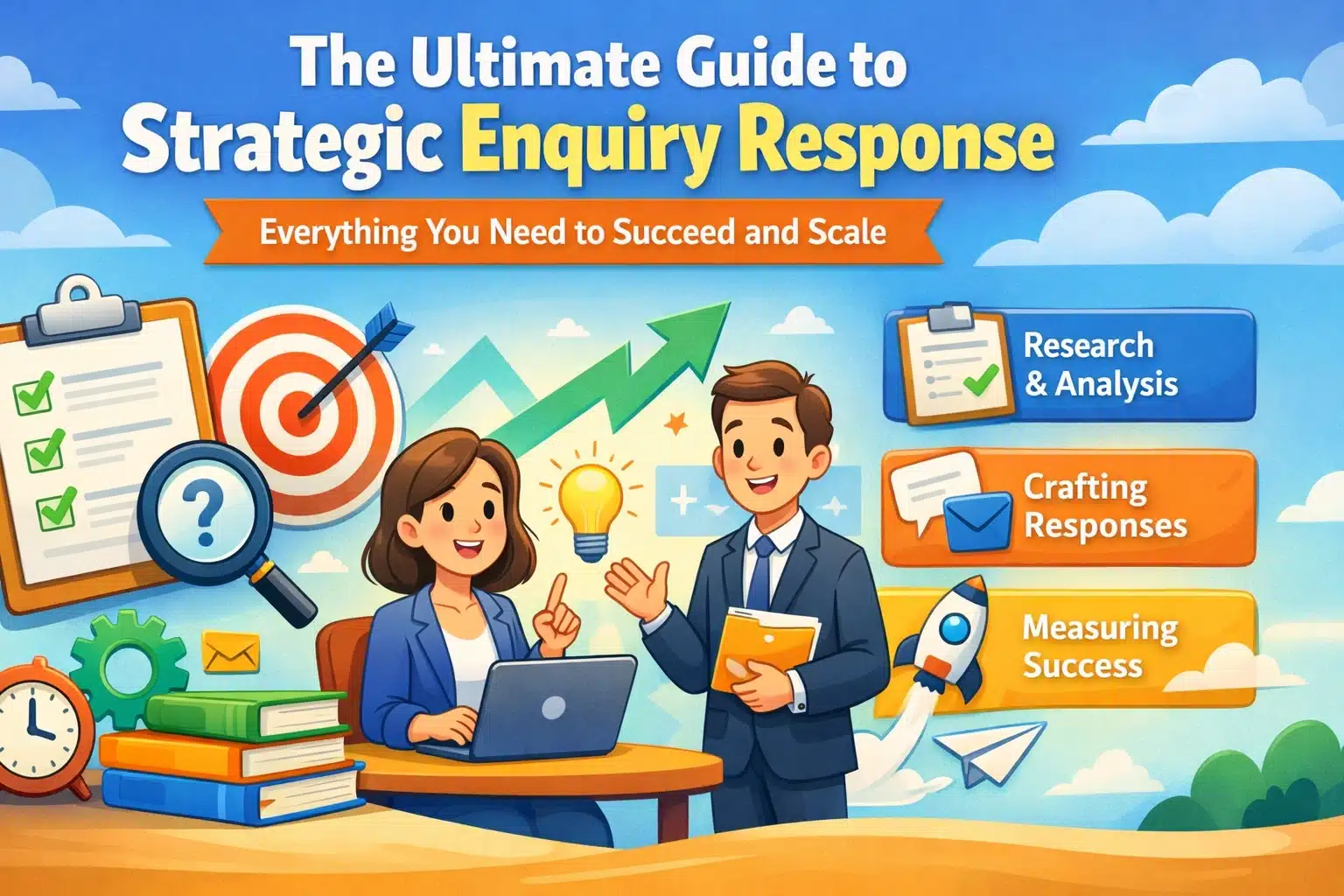
Strategic enquiry response isn't a "nice to have": it's the difference between a business that plateaus and one that scales. By focusing on the three pillars:
- Visibility: Ensuring the right people find you and trust you.
- Response: Answering every enquiry in under two minutes with a human touch.
- Conversion: Qualifying leads and following up with military precision.
…you create a machine that works even when you don't.
If you're tired of seeing potential profit slip through your fingers, it’s time to look at your services and decide how you’re going to bridge the gap. Whether you hire a dedicated team or use a service like ours, the key is to stop being the bottleneck and start being the CEO.
Frequently Asked Questions (FAQ)
1. Why is speed of response so important for an SME?
Because your customers are likely looking at your competitors at the same time. In the UK service sector, the first person to answer the phone or respond to the email usually wins the job. If you wait more than 5-10 minutes, your chances of conversion drop by over 80%.
2. Can't I just use an AI chatbot for my enquiries?
You can, but proceed with caution. While AI is great for basic "What are your hours?" questions, it lacks the empathy required for high-ticket service enquiries. A potential customer looking for a divorce solicitor or a new roof wants to talk to a human who understands their stress.
3. How do I know if I’m losing leads?
Check your "missed call" log on your phone and compare your website traffic to your actual enquiry numbers. If you have 500 visitors a month but only 5 enquiries, your website is losing you money. If you have 20 missed calls a week, you're literally handing money to your competitors.
4. What is a "Digital Receptionist"?
A digital receptionist is a professional service (like Every Enquiry) that handles your incoming calls, live chats, and emails. Unlike a traditional call centre, they are trained to understand your business and qualify leads as if they were sitting in your office.
5. Is it expensive to outsource enquiry handling?
It’s usually much cheaper than hiring a full-time employee and significantly cheaper than the cost of the jobs you are currently missing. Most businesses find that if the service saves just one or two mid-sized jobs a month, it has completely paid for itself. You can see our pricing for more details.
6. Does this work for all industries?
It works best for service-based businesses where the "lead" is a phone call or an email. This includes trades (plumbers, electricians, builders), professional services (lawyers, accountants), and healthcare (dentists, physios).
7. What's the first step to improving my response?
Start tracking. For one week, log every enquiry that comes in and how long it took to respond. You might be surprised (and slightly horrified) at the reality. Once you have the data, you can look at solutions to speed things up.
Ready to take the next step? Explore our blog section for more tips on lead handling, or contact us today to see how we can help you capture every enquiry.