Let’s be honest for a second. You’re likely spending a fair bit of your hard-earned revenue on marketing. Whether it’s Google Ads, SEO, or just keeping your social media ticking over, you’re paying to make the phone ring.
But what happens when that phone actually rings?
If you’re like most SME owners in the UK, you’re busy. You’re on-site, you’re in a meeting, or you’re elbows-deep in a project. The call goes to voicemail. You think, "I'll call them back in an hour." By the time you do, that prospect has already called three of your competitors. One of them picked up. You just lost a lead, and more importantly, you just threw your marketing budget down the drain.
This isn't just a minor inconvenience; it's a silent killer for small businesses. At Every Enquiry, we call this the "Leaky Bucket Syndrome." You keep pouring more water (leads) into the top, but because there are holes in the bottom (poor lead handling), the bucket never stays full.
In this guide, we’re going to show you how to plug those holes using a three-stage framework: Visibility, Response, and Conversion. This isn't about fancy software or complex jargon; it’s about simple, effective systems that turn "maybe" into "money."
Phase 1: Visibility – If You Can’t See It, You Can’t Fix It
The first step in lead recovery is admitting you have a problem. Most SMEs have no idea how many leads they are actually losing. They see the jobs they win, but they are completely blind to the ones they never even spoke to.
The Hidden Cost of Missed Calls
When a potential customer calls a service business, whether it’s a plumber, a solicitor, or an accountant, they usually have a problem that needs solving now. If you don't answer, they don't leave a voicemail and wait patiently. They go back to Google.
Research from the Harvard Business Review shows that businesses that try to contact potential customers within an hour are nearly seven times as likely to have a meaningful conversation as those who wait even 60 minutes. Wait longer, and the lead is essentially dead.
To gain visibility, you need to track:
- Total Enquiries: How many calls, emails, and messages are coming in?
- Missed Call Rate: What percentage of those calls go unanswered?
- Lead Source: Which marketing channel produced the lead that you missed?

Stop Flying Blind
You wouldn’t run your accounts without a spreadsheet, so why run your lead generation without tracking? You need to know exactly where the leaks are. Is it your website contact form that's broken? Is your phone line tied up during peak hours?
Using a structured approach to visibility allows you to see the true ROI of your marketing. If you’re spending £1,000 a month on ads and missing 50% of the calls, your cost-per-lead is actually double what you think it is.
At Every Enquiry, we advocate for the "They Ask, You Answer" philosophy. One of the biggest questions customers have is: "Will you actually show up?" If you can’t even answer the phone, you’ve already failed the first test of reliability.
Phase 2: Response – The Five-Minute Rule
Once you can see the leads coming in, the next step is the response. In the modern economy, speed is a competitive advantage. According to Forbes, speed is now the ultimate customer experience weapon.
For an SME, "Response" doesn't just mean picking up the phone; it means how you handle the enquiry from the second it arrives.
The Digital Receptionist Revolution
Many small businesses think they need to hire a full-time receptionist to solve this. But for most, that’s an overhead they can’t justify. This is where enquiry handling services and digital receptionists come in.
A digital receptionist ensures that every call is answered by a real person, in your company name, 24/7. It’s not just a call answering service; it’s a lead recovery system. They can qualify the lead, book an appointment directly into your calendar, or escalate urgent issues.
Why Voicemail is Where Leads Go to Die
Let’s be blunt: nobody likes leaving voicemails. In fact, most people will hang up as soon as they hear the beep. They feel like they’re shouting into a void. By providing an immediate human response, you build instant trust.
You need a 5-step framework to ensure no lead is left behind:
- Immediate Acknowledgement: Answering the call or sending an automated "we’ve got your message" text.
- Qualification: Asking the right questions to see if they are a fit.
- Value Proposition: Briefly explaining why you are the right choice.
- Call to Action: Booking the next step (quote, visit, or call).
- Data Capture: Ensuring their details are in your system for follow-up.

Phase 3: Conversion – Turning "Checking Prices" into "Signed Contract"
Visibility and Response get you to the table. Conversion is how you win the game. This is where many SMEs struggle because they treat every enquiry like a transaction rather than the start of a relationship.
Building Trust Through Education
Using the "They Ask, You Answer" principles, your conversion process should be focused on education. If a lead asks about price, don't hide it. If they ask about your competitors, be honest.
Most lost leads can be recovered through a structured follow-up system. Just because someone didn't buy today doesn't mean they won't buy next week. But if you don't have a system to nurture those "lost" enquiries, they will eventually wander off to someone else.
The Power of the "Lost Lead" Call-Back
One of the most effective lead recovery strategies is the "Second Chance" call. If you missed a call earlier in the day, don't just call back and say "Sorry I missed you." Instead, try:
"Hi, it's Martyn from Every Enquiry. I saw I missed a call from you earlier: my apologies, I was helping another client. I wanted to make sure you got the help you needed even if it wasn't from us. How can I help?"
This disarms the prospect and shows a level of care that 99% of your competitors lack. You can read more about why lead conversion isn't working for most businesses and how to fix it on our blog.

Comparing Your Options: How Should You Handle Enquiries?
Not every SME needs a full-blown managed service, but every SME needs something. Here is a breakdown of how different methods stack up when it comes to lead recovery.
| Feature | DIY / Voicemail | Traditional Call Centre | Every Enquiry (Lead Recovery) |
|---|---|---|---|
| Response Time | Slow (Hours/Days) | Fast (Seconds) | Instant |
| Lead Qualification | None | Scripted/Basic | Deep & Tailored |
| Data Tracking | Manual/Non-existent | Basic Reporting | Full CRM Integration |
| Conversion Focus | Low | Low (Just taking messages) | High (Closing the next step) |
| Customer Experience | Poor | Average | Excellent |
| Cost | "Free" (But huge lost revenue) | Low Monthly Fee | Performance Based / High ROI |
As you can see, pricing shouldn't be your only consideration. The cheapest option (doing it yourself) is often the most expensive when you factor in the value of the jobs you lose because you were too busy to pick up the phone.
Implementation: How to Start Recovering Leads Today
You don't need to change everything overnight. Lead recovery is a process of marginal gains. Here is how you can start:
1. Audit Your Current Website
Is your website making it easy for people to enquire? Or is it losing you money? Check your contact forms, ensure your phone number is clickable on mobile, and make sure your "Thank You" page tells people exactly when they should expect to hear from you. Check out our website optimisation tips for more.
2. Set Up Basic Tracking
If you don't have a CRM (Customer Relationship Management) system, get a simple one. Even a shared Trello board or a Google Sheet is better than nothing. Every time the phone rings, it goes on the list. If it isn't "Closed" or "Lost," it stays on the list.
3. Consider Social Media Enquiries
Don't forget that leads don't just come through the phone. Many people will message you on Facebook or Instagram. Social media management is more than just posting pretty pictures; it’s about being present when a customer asks a question in your DMs.
4. Professionalise Your Response
If you can't answer the phone, get someone who can. Whether it's a dedicated service or a smart call-routing system, ensure that the first impression of your business isn't a recorded "mailbox full" message.
The "They Ask, You Answer" Approach to Lead Recovery
Marcus Sheridan’s philosophy revolves around being the most trusted voice in your industry. In terms of lead recovery, this means:
- Address the "Elephants in the Room": If you missed a call because you're a small team, tell them. "We're a small, expert team and sometimes we're all on-site, but your enquiry is vital to us."
- Focus on the "Big 5": Cost, problems, comparisons, reviews, and best-in-class. Use these topics in your follow-up emails to keep leads engaged.
- Video Follow-ups: Send a quick 30-second video via WhatsApp or email to a lead you missed. It puts a face to the name and builds massive rapport.
Summary: Turning the Tap Off vs. Fixing the Leaks
Most marketing agencies will tell you that you need more traffic. They’ll want you to increase your ad spend. But if your lead handling process is broken, more traffic just means more missed calls and more frustration.
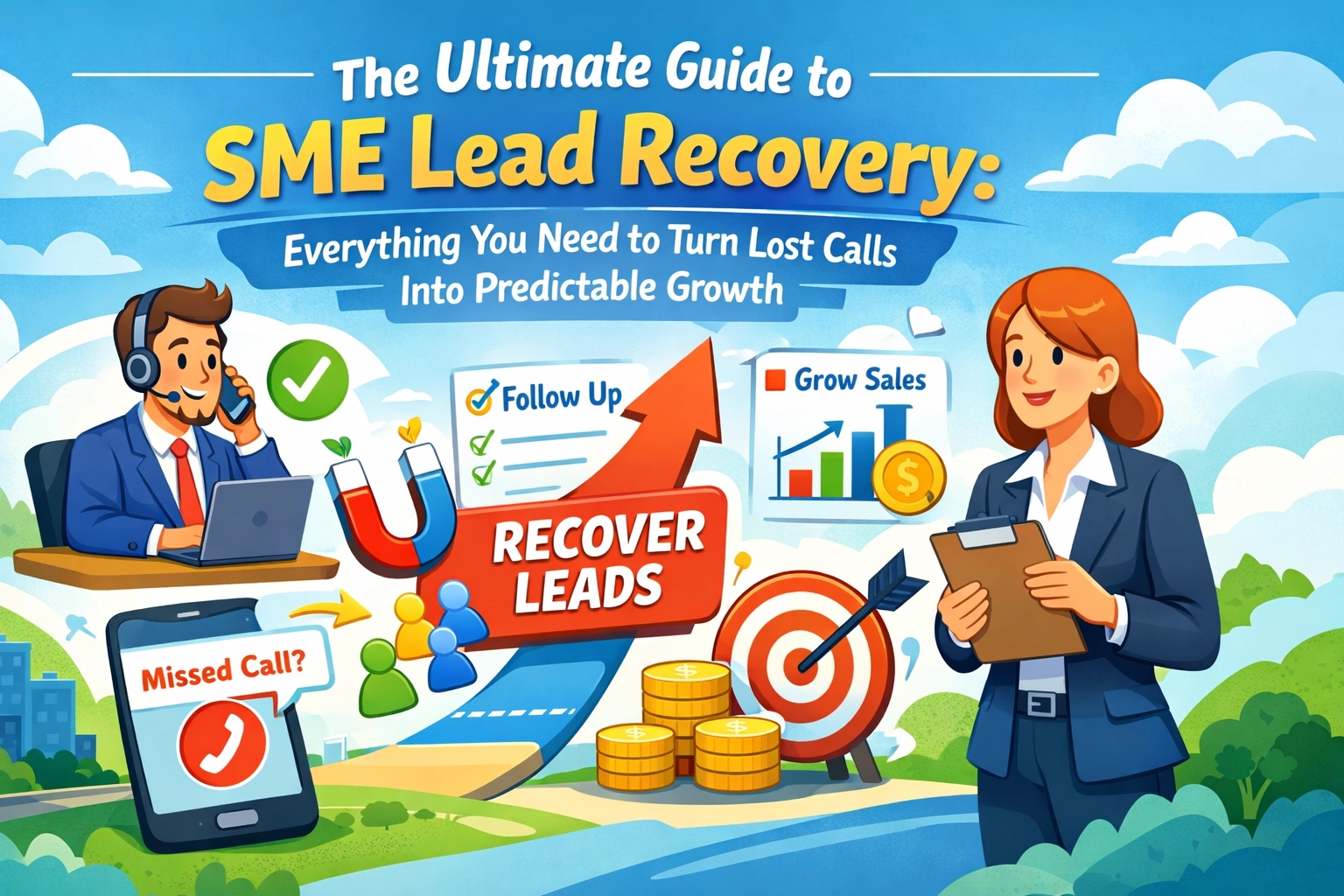
By focusing on Visibility (knowing what you're missing), Response (answering fast and professionally), and Conversion (nurturing the relationship), you can turn lost calls into a predictable growth engine.
Every Enquiry was built to help SMEs stop the bleed. We believe that the power of prompt response is the single biggest growth lever available to a small firm today.
Ready to see how many leads you're actually losing? Contact us today for a lead recovery audit. Let's plug the holes in your bucket.
Frequently Asked Questions (FAQ)
1. Why shouldn't I just use an answering machine?
Answering machines are passive. Most modern consumers, especially those looking for immediate services, will not leave a message. They want a conversation, not a recording. A live response or an interactive digital receptionist converts at a much higher rate.
2. Is lead recovery expensive for a small business?
It’s actually more expensive not to do it. If one missed contract is worth £500 and you miss four a month, you're losing £2,000 in revenue. A lead recovery system usually costs a fraction of that, meaning it pays for itself almost instantly.
3. Can't my admin person just handle all the enquiries?
They can, until they get busy, go on lunch, or take a holiday. Human-only systems have single points of failure. A structured lead recovery system provides 24/7 coverage that doesn't get sick or overwhelmed.
4. What if I don't have enough leads to justify a service?
If you have "too few leads," every single one is precious. You can't afford to lose even one. Starting with better visibility and response systems often reveals that you actually had more leads than you thought: you were just losing them before they reached your radar.
5. How long does it take to see results?
Usually, you’ll see the impact within the first 30 days. Once you start capturing the calls that previously went to voicemail, you’ll notice an immediate uptick in booked quotes and enquiries.
6. Does this work for trades like plumbers and electricians?
Absolutely. In fact, trades see some of the highest ROIs from lead recovery because customers in these sectors are usually in a hurry. Being the first one to answer the phone often guarantees you the job.