Let’s be honest for a second. Most small business owners are great at what they do, whether that’s plumbing, legal advice, or bespoke landscaping, but they are often terrible at handling the very thing that keeps their business alive: leads.
You spend a small fortune on Google Ads, you’ve paid a "guru" to sort your SEO, and your social media looks the part. Then, the phone rings while you’re on-site or in a meeting. You don’t pick up. Or an email lands in your inbox at 2:00 PM on a Tuesday, and you don’t reply until Thursday morning.
By then, that lead is gone. They’ve already called the next person on the list who did answer the phone.
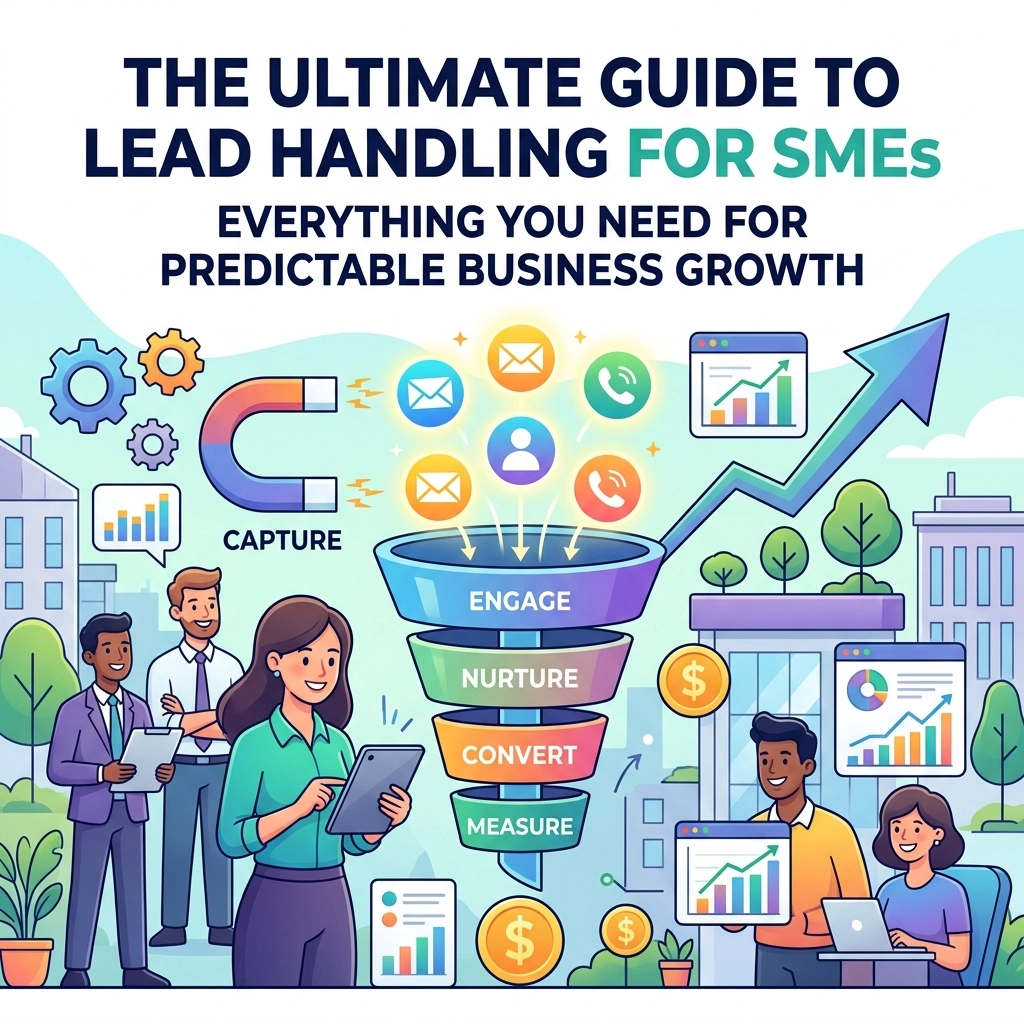
At Every Enquiry, we see this every single day. We call it the "Leaky Bucket" syndrome. You’re pouring expensive water (leads) into a bucket full of holes (your process). This guide is here to help you plug those holes. We’re going to walk through the three pillars of growth: Visibility, Response, and Conversion.
The Hard Truth About Lead Handling
Before we dive into the "how-to," we need to address the "why." According to Harvard Business Review, businesses that try to contact potential customers within an hour of receiving a query are nearly seven times as likely to have a meaningful conversation with a key decision-maker as those who wait even sixty minutes.
For an SME, "meaningful conversation" usually translates to "money in the bank."
If you want predictable growth, you can't rely on luck. You need a system. Following the principles of Marcus Sheridan’s They Ask, You Answer, we’re going to be transparent about what works, what doesn't, and why your current setup might be costing you a house deposit every single month.
Pillar 1: Visibility – Making Sure the Right People Find You
Visibility is the top of your funnel. If nobody knows you exist, you have no leads to handle. However, visibility isn't just about being "seen"; it’s about being seen by the right people at the right time.
Stop Chasing Every Click
Many SMEs make the mistake of thinking more traffic equals more profit. It doesn't. If you’re a high-end kitchen fitter in London, 10,000 visitors from Scotland won’t help you. You need targeted visibility that attracts people ready to buy.
This involves:
- Search Engine Optimisation (SEO): Making sure you appear when people search for your specific services in your specific area.
- Paid Advertising: Using Google or Meta ads to jump to the front of the queue.
- Social Media Presence: Not just posting for the sake of it, but showing your expertise. Have a look at how social media management is more than just updates.
The Trust Factor
Visibility without trust is a waste of time. When a lead lands on your site, they are asking themselves: “Are these people experts? Can I trust them with my money?” You answer this by being transparent. Talk about your pricing (yes, even if it varies), talk about the problems you solve, and show your face.

Pillar 2: Response – The "Speed to Lead" Revolution
This is where 90% of SMEs fail. You’ve done the hard work of getting the lead, but your response time is killing your conversion rate.
The Five-Minute Rule
In the digital age, a lead’s attention span is shorter than ever. If you don't respond within five minutes, your chances of converting that lead drop by 80%. This isn't just a statistic; it’s a reality of modern consumer behaviour. People want solutions now. If you don't provide them, your competitor will.
The Problem with "I'll Do It Later"
Most SME owners wear too many hats. You’re the technician, the accountant, and the salesperson. When a lead comes in, you think, "I’ll call them back when I finish this job."
By the time you finish, three hours have passed. The lead has already spoken to two other firms and booked a site visit with one of them. You’re now fighting an uphill battle. To fix this, you need a framework. We’ve actually put together a 5-step framework to stop losing leads that goes into the nitty-gritty of how to automate or delegate this.
Human vs. Machine
While automation is great for acknowledging a lead, nothing beats a human response. A "Digital Receptionist" or a dedicated lead handler can qualify a lead on the spot. They can ask:
- What is your budget?
- What is your timeline?
- Are you the decision-maker?
This filters out the "tyre-kickers" and ensures that when you do step in, you're talking to someone who is ready to spend money. For more on this, check out why enquiry handling is key to customer acquisition.
Pillar 3: Conversion – Turning "Maybe" into "Yes"
Conversion is the final hurdle. It’s the process of taking a qualified lead and turning them into a paying client.
Structured Follow-Up Systems
Did you know that 80% of sales require at least five follow-up calls, yet 44% of sales reps give up after just one?
In an SME, that "sales rep" is often you. If you call once, they don't answer, and you never call back, you’ve just thrown money away. A structured follow-up system looks like this:
- Immediate Call/Email: Within 5 minutes.
- Day 1 Follow-up: If no answer, a polite text or email.
- Day 3 Value Add: Send them a guide or a case study relevant to their enquiry.
- Day 7 Check-in: A final "are you still looking for help?" message.
Using a CRM (Stop Using Sticky Notes!)
If your "lead management system" is a pile of Post-it notes on your dashboard or a scattered Excel sheet, you are losing money. A CRM (Customer Relationship Management) system allows you to track every interaction. You’ll know exactly when you last spoke to a lead and what their concerns were.
This level of organisation is what separates a "small business" from a "growing company." If you're struggling with this, read our post on 10 reasons your lead conversion isn't working.

Comparing Your Lead Handling Options
Every business is different, but the options for handling leads generally fall into three categories. We’ve broken them down so you can see which fits your current stage of growth.
| Feature | DIY (The "Solo" Approach) | Traditional Call Centre | Every Enquiry |
|---|---|---|---|
| Response Time | Erratic (depends if you're busy) | Fast, but often robotic | Fast & Personalised |
| Lead Qualification | High (you know your stuff) | Low (they just take messages) | High (structured scripts) |
| Cost | "Free" (but costs you time) | Medium | Scalable based on results |
| Follow-up | Rare | None | Automated & Manual |
| Data Tracking | Manual/Non-existent | Basic | Full CRM Integration |
| Best For | Brand new start-ups | High-volume, low-value queries | SMEs looking for growth |
Addressing the "Elephant in the Room": Why Do Leads Fail?
At Every Enquiry, we believe in radical honesty. If we're going to follow the They Ask, You Answer philosophy, we have to talk about why leads actually fail to convert.
1. Price Shock
You haven't been transparent about your pricing. The lead gets to the end of the process, hears the number, and runs. You can avoid this by having a pricing page or discussing "ballpark" figures early on.
2. Lack of Specialisation
If you try to be everything to everyone, you’re nothing to nobody. Leads convert better when they feel you are an expert in their specific problem.
3. Friction
If your contact form has 15 fields, people won't fill it out. If your phone number is buried on your site, they won't call. Make it as easy as possible for people to give you their information.

Lead Handling Methodology: The "Every Enquiry" Way
We don't just "handle leads"; we manage an ecosystem. Our methodology is built on the belief that every enquiry is a potential long-term relationship.
Phase 1: Lead Organization & Qualification
We move you away from spreadsheets and into a centralised system. We use sales intelligence to understand who is calling. Is it a big firm with a huge budget, or a one-man band? We prioritise the leads that will move the needle for your business.
Phase 2: Prioritisation & Scoring
Not all leads are created equal. A lead who has downloaded three of your guides and visited your pricing page is "hotter" than someone who just liked a photo on Instagram. We help you score these leads so you know who to call first.
Phase 3: Automation with a Human Touch
We use technology to do the heavy lifting: automated emails, SMS reminders, and CRM updates: but we keep the communication human. People buy from people, not from bots.
Is Your Business Ready for Predictable Growth?
Predictable growth isn't about a "lucky" month where the phone doesn't stop ringing. It’s about knowing that for every £1,000 you spend on marketing, you have a system in place to capture, qualify, and convert the resulting enquiries.
If you’re tired of checking your voicemail at 6:00 PM only to find out you missed three potential jobs, it’s time to change your approach.
The Cost of Doing Nothing
Let’s do some quick maths.
- Average Lead Value: £1,000
- Leads Missed per Month: 5
- Total Lost Revenue: £5,000 per month / £60,000 per year.
That is the price of poor lead handling. It’s not just a missed call; it’s a missed opportunity to grow your team, upgrade your equipment, or finally take a proper holiday.

Frequently Asked Questions (FAQ)
1. "I'm a small business. Do I really need a lead handling system?"
Actually, you need it more than a large corporation. A large firm can afford to lose a few leads. For an SME, every single enquiry is a significant percentage of your monthly revenue. A system ensures you don't waste the hard-earned money you spend on marketing.
2. "Won't a lead handling service make me lose touch with my customers?"
Quite the opposite. By having someone else handle the initial "filtering" and administrative follow-up, you are freed up to have more meaningful, high-quality conversations with leads who are actually ready to buy. You step in when the relationship is already "warm."
3. "Is this just an expensive answering service?"
No. An answering service takes a message. A lead handling system qualifies the lead, enters them into a CRM, schedules follow-ups, and provides you with data on where your best leads are coming from. One is reactive; the other is proactive.
4. "How long does it take to see results?"
You’ll see an improvement in response times immediately. In terms of revenue, most SMEs see a noticeable shift in their conversion rates within the first 30 to 60 days as the "backlog" of leads starts being managed correctly.
5. "What if I don't have a CRM?"
Don't worry. Part of what we do at Every Enquiry is helping you set up the right tools for your business size. You don't need a complex enterprise system; you need something that works for you.
Your Next Steps
If you’re ready to stop the leak in your bucket, start with these three actions:
- Audit your response time: Send a test enquiry through your own website right now. How long does it take for you to get a human response?
- Review your "dead" leads: Go back through your emails from last month. How many people did you never follow up with after the first interaction?
- Get in touch: If you want us to look at your current setup and show you where the gaps are, visit our contact page.
Growing an SME is hard enough. Don't make it harder by ignoring the people who are literally knocking on your door asking to give you money.
Martyn Lenthall, Director at Every Enquiry