Let’s be honest for a second. Most small business owners in the UK are currently setting fire to their marketing budget.
You spend a fortune on SEO, you pay Google handsomely for every click on your ads, and you spend your evenings trying to figure out why your social media isn’t "popping." But then, when the lead finally arrives, the phone rings or an email drops into the inbox, something breaks.
Maybe you’re on a job site and can’t answer. Maybe you’re in a meeting and figure you’ll call them back "later." By the time you do, that prospect has already booked with your competitor because they answered their phone first.
At Every Enquiry, we see this every single day. We’ve worked with plumbers, solicitors, consultants, and landscapers who all have the same problem: they don't have a lead problem; they have a lead handling problem.
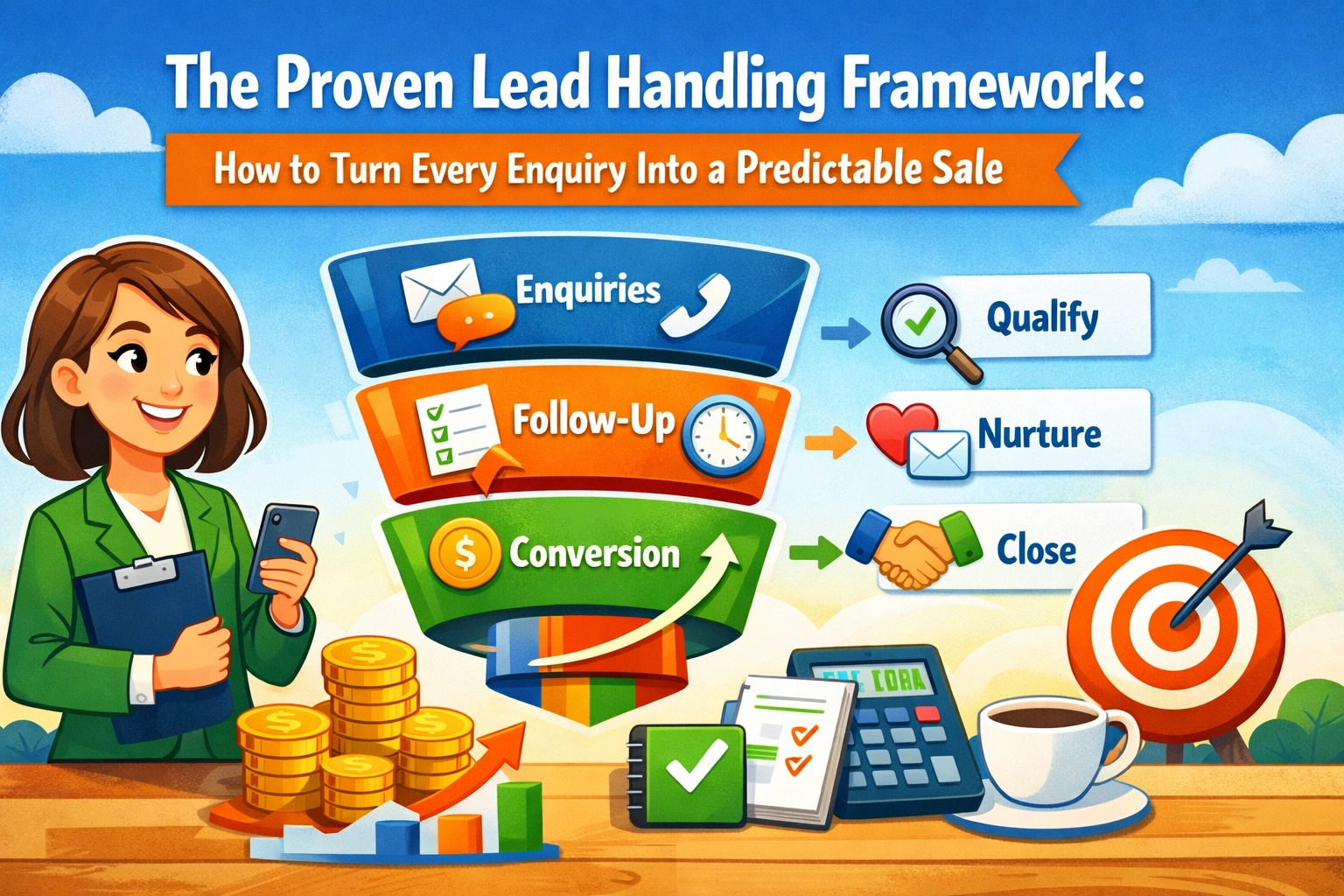
If you want to stop the leak and start turning those enquiries into predictable sales, you need a framework. Not a "wing it and hope" approach, but a structured system. This post will walk you through our proven Lead Handling Framework, built on the principles of visibility, response, and conversion.
The Foundation: They Ask, You Answer
Before we dive into the nuts and bolts, we need to talk about the philosophy that drives everything we do. It’s called "They Ask, You Answer" (TAYA), a concept pioneered by Marcus Sheridan.
The core idea is simple: if a customer has a question, you must answer it. Honestly, transparently, and thoroughly. Most businesses hide their prices, avoid talking about their flaws, and dance around the "awkward" questions. We do the opposite. By being the most transparent voice in your industry, you build more trust than any fancy advert ever could.
This trust is the fuel for our framework. Without it, your lead handling will always feel like a pushy sales pitch. With it, you’re just helping someone make an informed decision.

Pillar 1: Visibility (Attracting the Right Enquiry)
Visibility isn’t just about being seen by everyone; it’s about being seen by the right people. In the SME world, "more leads" often just means more time wasted on people who can’t afford you or aren't a good fit.
Address the Elephant in the Room: Price
One of the biggest hurdles to conversion happens before the enquiry is even made. People want to know what things cost. If your website says "Contact us for a quote" and your competitor has a starting price or a calculator, they’re getting the click.
By being transparent about your pricing, you filter out the bargain hunters and attract people who value your expertise. This makes the lead handling process significantly easier because the "price shock" is already gone.
Focus on "The Big 5"
To gain the right kind of visibility, your content should focus on what Marcus Sheridan calls "The Big 5" topics that drive sales:
- Pricing and Cost: How much does it cost? What factors make it more expensive?
- Problems: What can go wrong? Why might this solution not be right for them?
- Comparisons: How do you stack up against the other options?
- Reviews: What do people actually think?
- Best of: Who are the best providers in the area (even if it’s not you)?
When you create content around these topics, you aren't just getting traffic; you’re building a visibility strategy that prepares the lead for a sale before they even speak to you. You can learn more about how this impacts your bottom line in our article on is your website losing you money?.
Pillar 2: Response (The 5-Minute Rule)
This is where most UK SMEs fail. We live in an era of instant gratification. If I’m looking for a boiler repair or a conveyancing solicitor at 7:00 PM on a Tuesday, I want an answer now.
According to research published by Harvard Business Review, firms that try to contact potential customers within an hour of receiving a query are nearly seven times as likely to have a meaningful conversation as those who wait even 60 minutes.
At Every Enquiry, we go further. We aim for the 5-minute rule.
Why Speed is Your Greatest Competitive Advantage
If you respond within five minutes, you catch the prospect while they are still on your website or still thinking about the problem. If you wait two hours, they’ve moved on. They’re making dinner, they’re in another meeting, or worse, they’ve already booked a site visit with a competitor who was faster than you.
The "Digital Receptionist" Concept
We know what you’re thinking: "Martyn, I’m a busy Director. I can’t sit on my phone all day."
You’re right. You shouldn't. This is where a structured response system or a digital receptionist comes in. You need a way to ensure that every enquiry is acknowledged immediately.
- Automated SMS: "Hi [Name], thanks for reaching out to Every Enquiry! We've received your request and Martyn will call you back within 15 minutes. In the meantime, have you seen our pricing guide?"
- Instant Booking: Let them book a slot on your calendar immediately after they fill out a form.
- Live Chat: Real people (or very smart bots) answering basic questions in real-time.
Stop thinking of lead handling as a "manual task" and start thinking of it as a customer acquisition system.

Pillar 3: Conversion (The Educational Sales Process)
Once you’ve got their attention and responded quickly, how do you close the deal? This is the conversion stage. For many SMEs, "conversion" is just a fancy word for "hoping they say yes to the quote."
In our framework, conversion is a predictable outcome of a structured follow-up system.
Stop "Checking In"
The worst thing you can do is call a lead and say, "Hi, I'm just checking in to see if you got my quote." It adds zero value. It’s annoying.
Instead, use educational follow-ups.
- "Hi [Name], I sent that quote over yesterday. I also wanted to send you this quick video explaining the three different types of materials we discussed, so you can see the difference in durability."
- "Hi [Name], following our call, I thought you might find this guide on 'What to expect during your installation' helpful."
By continuing to teach, you continue to build trust. This is the "They Ask, You Answer" philosophy in action within the sales funnel.
Lead Scoring and Prioritisation
Not all leads are created equal. A "predictable sale" comes from knowing which leads to spend your time on.
- MQL (Marketing Qualified Lead): Someone who has downloaded a guide or watched a video. They are interested but maybe not ready to buy today.
- SQL (Sales Qualified Lead): Someone who has asked for a quote or a call-back.
Your conversion strategy should treat these differently. Don't waste your best sales energy on someone who is just "looking for ideas." Nurture them with automated emails until they become an SQL. If you’re struggling with this, check out our 10 reasons your lead conversion isn't working.
Comparison: The Chaos vs. The Framework
To illustrate the difference this framework makes, let's look at how a typical "Trade" or "Professional Service" firm handles a lead versus how we do it at Every Enquiry.
| Feature | The "Chaotic" SME Approach | The Every Enquiry Framework |
|---|---|---|
| Response Time | 4 to 24 hours (or never) | Under 5 minutes (Automated/Human mix) |
| Transparency | "Contact for price" / Hiding flaws | Public pricing / Addressing problems head-on |
| Follow-up | One "checking in" phone call | 5-7 touchpoints with educational content |
| Lead Quality | High volume of "tyre kickers" | Highly qualified prospects who trust you |
| Predictability | "Hope" is the primary strategy | Data-driven forecasting and CRM tracking |
| First Impression | Disorganised and hard to reach | Professional, fast, and helpful |
Implementing the Framework: Step-by-Step
Ready to change how your business handles enquiries? Here is how to start implementing this today.
Step 1: Audit Your Current Response Time
Have a friend or family member submit an enquiry on your website right now. Don't tell your staff. See how long it takes to get a response. Is it 10 minutes? 10 hours? This is your starting point. You can't fix what you don't measure.
Step 2: Create Your "Big 5" Content
Look at your sent folder in your email. What are the 10 questions you answer every single week? Write them down. These are your first 10 blog posts. When a lead asks one of these questions, instead of typing a long email, you say: "That's a great question, I actually wrote a detailed guide on that here [Link]. Have a read and let me know if it makes sense."
This saves you time and positions you as the expert. This is exactly what we discuss in our social media management strategy, it’s about more than just updates; it’s about answering the customer’s needs.
Step 3: Map Your Follow-up Sequence
What happens after the first call? Don't leave it to memory. Create a simple 3-step sequence:
- Immediate: Thank you email + link to "What to expect" guide.
- Day 2: Educational video or case study relevant to their problem.
- Day 4: The "closing" follow-up, addressing any remaining fears or barriers.

The Hidden Cost of Doing Nothing
Most business owners look at a lead handling framework and see "work." They see more content to write and systems to set up. But what they should be looking at is the cost of the status quo.
If you spend £1,000 on ads and get 20 leads, each lead costs you £50. If you only close 2 of those because your follow-up is poor, your cost per customer is £500.
If you implement this framework and close 6 of those leads, your cost per customer drops to £166. You’ve just tripled your marketing efficiency without spending a single extra penny on advertising.
That is the power of a structured follow-up system. It turns the "gambling" of marketing into the "investment" of a predictable sales machine.
Final Thoughts from Martyn
At the end of the day, your customers are just like you. They are busy, they have problems they need solving, and they want to work with someone they can trust.
By focusing on visibility (honesty), response (speed), and conversion (education), you aren't just "handling leads." You are building a reputation. In a world of "cowboy" contractors and unresponsive professional firms, being the one who actually answers the phone and provides honest information is a superpower.
If you’re tired of losing leads to the "other guy" and you want to see how Every Enquiry can help you build this framework into your business, check out our services or get in touch for a contact today.
Frequently Asked Questions (FAQ)
1. Is a 5-minute response really necessary?
Yes. In the digital age, the "winner" is often the person who answers first. By the time you call back an hour later, the customer has often already committed to another firm or has moved on to something else, making it much harder to re-engage them.
2. Should I really put my prices on my website? What if my competitors see them?
Your competitors likely already know what you charge. The only people you are keeping in the dark are your potential customers. By being transparent, you build immediate trust and stop wasting time on leads that can't afford you.
3. What is a "Digital Receptionist"?
It’s a combination of technology and systems (like AI chat, automated SMS, and smart routing) that ensures your business "answers" every enquiry instantly, even if you are personally busy on a job or in a meeting.
4. How many times should I follow up with a lead?
Studies show it often takes 5 to 7 touchpoints to close a sale. Most SMEs stop after one or two. The key is to make those touchpoints educational and helpful, not just "salesy."
5. Does this framework work for all industries?
While we specialise in SME service businesses (trades and professional firms), the principles of speed, honesty, and education are universal in any B2C or B2B environment.
6. Is this going to require a lot of expensive software?
Not necessarily. While a good CRM helps, the framework is a process. You can start with simple email templates and a commitment to faster response times before scaling up to more advanced automation. Find more info on our pricing page.