Let’s be honest for a second. You’re likely spending a fair chunk of your monthly budget on marketing. Whether it’s Google Ads, SEO, or social media management, you’re paying to get the phone to ring and the inbox to ping.
But what happens when that notification pops up?
If you’re like many SME owners I speak to, the answer is a bit of a mixed bag. Sometimes you’re on it immediately. Other times, you’re in a meeting, on a job site, or just plain exhausted, and that enquiry sits there. And sits. And sits.
At Every Enquiry, we see this every day. Businesses think they have a "lead generation" problem. They want more traffic. More clicks. More "visibility." But in reality, they have a "lead handling" problem. They are pouring water into a leaky bucket, and instead of fixing the holes, they’re just turning the tap on harder.
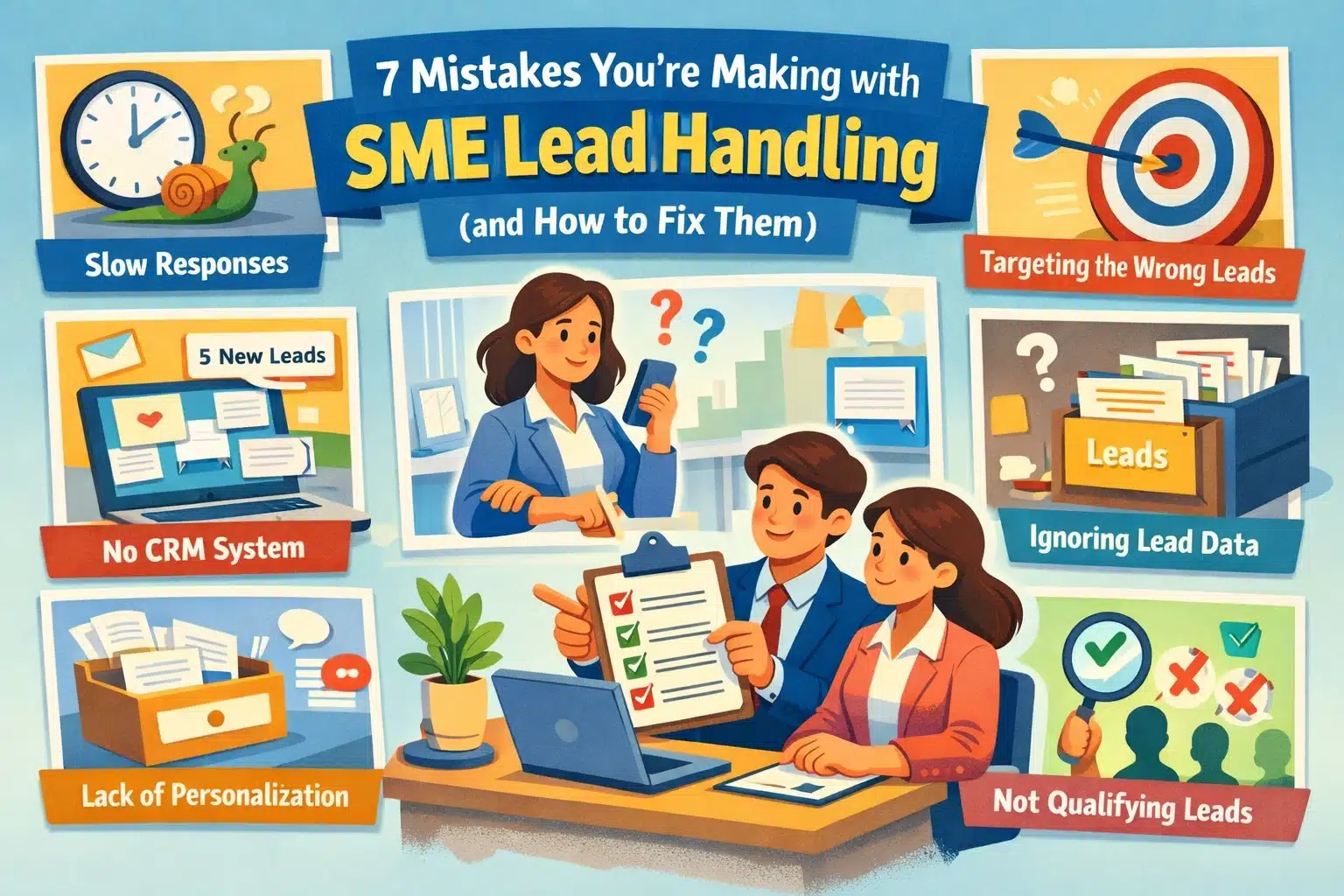
In this guide, I’m going to walk you through the seven most common mistakes small and medium-sized businesses make with their lead handling. We’ll look at why these mistakes are costing you a fortune and, more importantly, how to fix them using our core framework: Visibility, Response, and Conversion.
1. Treating Every Lead Like They’re All the Same
Not all leads are created equal. This is the first hurdle where most SMEs stumble. You might get a lead from a "Contact Us" form that says, "I need a quote for a £10,000 project today," and another from a Facebook ad that just wants a free PDF guide.
If your team treats these with the same level of urgency and the same script, you’re wasting time and losing money.
The Fix: Implement Lead Scoring
You need to differentiate between a "tyre kicker" and a "high-intent buyer." Lead scoring allows you to prioritise your time.
- Marketing Qualified Leads (MQLs): People who have shown interest (e.g., downloaded a guide) but aren't ready to buy. These need nurturing via email or social media.
- Sales Qualified Leads (SQLs): People who are ready for a conversation right now. These need an immediate phone call.
By categorising your leads, you ensure your best sales talent is focused on the enquiries most likely to result in revenue. You can learn more about how we help with this on our conversion services page.

2. The "I'll Get Back to Them Later" Mentality (Slow Response Times)
This is the biggest killer of SME growth. We live in an era of instant gratification. If I’m looking for a plumber or a solicitor and I fill out three forms, the person who calls me back first almost always wins the job.
According to a famous study shared by the Harvard Business Review, businesses that try to contact potential customers within an hour are nearly seven times more likely to have a meaningful conversation than those who wait even 60 minutes. If you wait 24 hours? The lead is basically dead.
The Fix: The 5-Minute Rule
Your goal should be to respond to every high-intent enquiry within five minutes. I know that sounds impossible when you’re running a business, but it’s the gold standard.
If you can't do it yourself, you need a system. This might be an automated SMS that says, "Hi [Name], I’ve received your enquiry and I’m looking at it now. Can I call you in 10 minutes?" Or, it might be partnering with an enquiry handling service that manages the front line for you.
3. The Great Divide: Sales and Marketing Aren't Talking
In many SMEs, "marketing" is what happens on the website, and "sales" is what happens on the phone. They often feel like two different departments that don't share a map.
Marketing complains that "the leads are rubbish." Sales complains that "marketing isn't sending enough leads." Meanwhile, the business owner is stuck in the middle, paying for both and seeing neither work effectively.
The Fix: Create a Service Level Agreement (SLA)
You don’t need a 50-page legal document. You just need a simple agreement on what constitutes a good lead and what the follow-up process looks like.
- Marketing agrees to provide leads with a valid phone number and specific project interest.
- Sales agrees to call every lead at least three times within 48 hours.
When these two sides align, conversion rates skyrocket. For a deeper dive into this, check out our post on why your lead conversion isn’t working.
4. Poor Data Hygiene (The "Scraps of Paper" Problem)
I’ve walked into offices where leads are written on Post-it notes, tucked into Excel spreadsheets that haven't been updated since 2022, or buried in a "Leads" folder in an inbox that has 4,000 unread emails.
If you don't have a single source of truth for your data, you have no visibility. You can't see which marketing channels are actually making you money and which are just costing you clicks.
The Fix: Use a CRM (and actually use it)
A Customer Relationship Management (CRM) tool is non-negotiable. Whether it’s HubSpot, Pipedrive, or something else, every single enquiry must go into the CRM automatically. This allows you to track the journey from the first click to the final invoice.
At Every Enquiry, we advocate for the "They Ask, You Answer" approach. Your CRM should help you track which questions your customers are asking so you can create content that answers them. This builds trust before you’ve even picked up the phone.

5. Inconsistent Lead Routing
Who handles the leads in your business? Is it just whoever is closest to the phone?
If your lead routing is "whoever isn't busy," you’re making a mistake. Some people are great at "cold" follow-ups. Others are brilliant at technical consultations. If a high-value enquiry goes to the wrong person, it’s likely to stall.
The Fix: Automated Routing Based on Expertise
Set up your systems so that enquiries are routed based on the prospect's needs. If someone enquires about a specific service, they should go to the person who knows that service inside out. This isn't just about efficiency; it's about providing the best possible customer experience from the very first touchpoint.
6. Robotic, One-Size-Fits-All Follow-ups
We’ve all received those automated emails: "Dear Customer, thank you for your enquiry. A member of our team will be in touch shortly."
It’s boring. It’s impersonal. And it doesn't solve the customer's problem. By the time your team "gets in touch shortly," the customer has already forgotten they filled out your form.
The Fix: Personalisation at Scale
Use the data you have. If they enquired about "Kitchen Extensions," your automated response should mention kitchen extensions. Even better, include a link to a helpful resource, like a blog post on website optimisation or a price guide.
The goal is to move the conversation forward even when you aren't there. Address their fears, their budget concerns, and their timelines immediately.
7. Giving Up Too Soon (The "One and Done" Error)
Most SMEs call a lead once. If they don't pick up, they leave a voicemail and move on.
The reality is that it often takes 6 to 8 touchpoints to actually reach a prospect. If you stop after one try, you are leaving money on the table for your competitors to pick up.
The Fix: The Persistence Plan
Create a multi-channel follow-up sequence.
- Day 1: Phone call, followed by an SMS, followed by an email.
- Day 2: Phone call.
- Day 4: Email with a helpful case study.
- Day 7: Final "break-up" email.
Don’t be afraid of being "annoying." If someone has asked for your help, they usually appreciate the persistence: as long as you are being helpful, not just hounding them for a sale.
Comparison: Call Answering vs. Managed Enquiry Handling
Many SMEs think a basic call answering service is the solution to their lead handling problems. While it's better than nothing, it’s often just a "digital receptionist." Here is how it compares to a full Enquiry Management system.
| Feature | Basic Call Answering | Every Enquiry Management |
|---|---|---|
| Response Time | High (if they pick up) | Instant (Omnichannel) |
| Lead Qualification | None (just takes a message) | Full (MQL vs SQL filtering) |
| CRM Integration | Rare/Manual | Automatic & Real-time |
| Follow-up | None | Multi-touch persistence plan |
| Visibility | Low (who called?) | High (ROI per channel) |
| Outcome Focus | Message taking | Booking & Conversion |
As you can see, simply answering the phone isn't enough. You need a system that bridges the gap between visibility and conversion.

How to Fix Your Lead Handling Today
If you’ve recognised your business in any of the mistakes above, don’t panic. Most SMEs are in the same boat. The good news is that fixing these issues usually provides a much faster ROI than spending more money on advertising.
Step 1: Audit Your Current Process
Go to your own website right now. Fill out your enquiry form. See how long it takes for someone to contact you. See what the email looks like. Is it professional? Is it fast? Is it helpful?
Step 2: Implement "Response" Systems
Focus on speed. Whether you use auto-responders or a dedicated team, make sure no lead waits more than 15 minutes for some form of acknowledgement. Check out our response framework for a step-by-step guide.
Step 3: Track Everything
If you aren't using a CRM, start today. Stop using your inbox as a to-do list for sales. You need to know exactly where your leads are in the pipeline.
Step 4: Educate Your Leads
Stop "selling" and start "teaching." Use your blog and social media to answer the questions your leads are asking. This makes the eventual sales call much easier because the prospect already trusts you. This is the heart of social media management that actually works.
Summary: Stop Losing Leads
At Every Enquiry, we believe that your business growth shouldn't be a guessing game. By moving from a chaotic, "hope-for-the-best" approach to a structured lead handling system, you can turn more of your existing traffic into paying customers.
It’s about being visible, responding at lightning speed, and focusing on the conversion.
If you’re tired of seeing leads slip through the cracks and want to see how a professional enquiry management system could work for your business, take a look at our pricing and packages. We don't just answer phones; we help you grow.
Frequently Asked Questions (FAQ)
1. Why is lead handling more important than lead generation?
Lead generation gets people to your door, but lead handling is what gets them inside. You can spend thousands on ads, but if your response time is slow or your follow-up is poor, that money is wasted. Optimising your handling process often yields a higher ROI than increasing your ad spend.
2. How quickly do I really need to respond to an enquiry?
The "golden window" is 5 minutes. After 30 minutes, the chance of qualifying the lead drops by 21 times compared to a 5-minute response. Even an automated, personalised response is better than silence.
3. We are a small team; how can we possibly handle leads 24/7?
You don't necessarily have to be awake 24/7, but your systems do. Using automated SMS, intelligent chatbots, or a managed enquiry service like Every Enquiry ensures that leads are acknowledged and qualified even when you are off the clock.
4. What is the biggest mistake SMEs make with their website forms?
Asking for too much information too early (friction) or having a broken form that doesn't send notifications reliably. Also, failing to provide a "Thank You" page that tells the customer exactly when they will hear from you.
5. Do I really need a CRM?
Yes. Without a CRM, you have no visibility into your sales pipeline. You can't track which marketing efforts are working, and you will inevitably lose leads in your inbox. A CRM is the backbone of any scalable SME.
6. What should I do with "dead" leads?
Don't delete them! Implement lead recycling. A lead that wasn't ready to buy six months ago might be ready now. Periodically re-engage them with helpful content or a special offer.
7. How does Every Enquiry differ from a virtual assistant?
A virtual assistant handles general tasks. Every Enquiry is a specialist digital marketing and enquiry management firm. We focus specifically on the mechanics of turning an enquiry into a conversion using data, speed, and proven sales psychology.
Ready to stop the leak in your business bucket? Contact us today to discuss how we can help you manage your enquiries more effectively.