Let’s be honest for a second. Most SME owners I talk to are brilliant at what they do, whether that’s fitting kitchens, providing legal advice, or running a landscaping empire. But when it comes to the "boring" stuff, the lead handling, the follow-ups, and the data entry, things start to get a bit messy.
You spend a small fortune on Google Ads or SEO to get the phone ringing. Then, when a lead actually arrives, it sits in an inbox for three hours, or worse, it gets "handled" by a busy staff member who forgets to take a name.
At Every Enquiry, we see this every single day. We call it the "Leaky Bucket Syndrome." You’re pouring more water (leads) into the top, but because the bucket is full of holes, your profit is just draining away onto the floor.
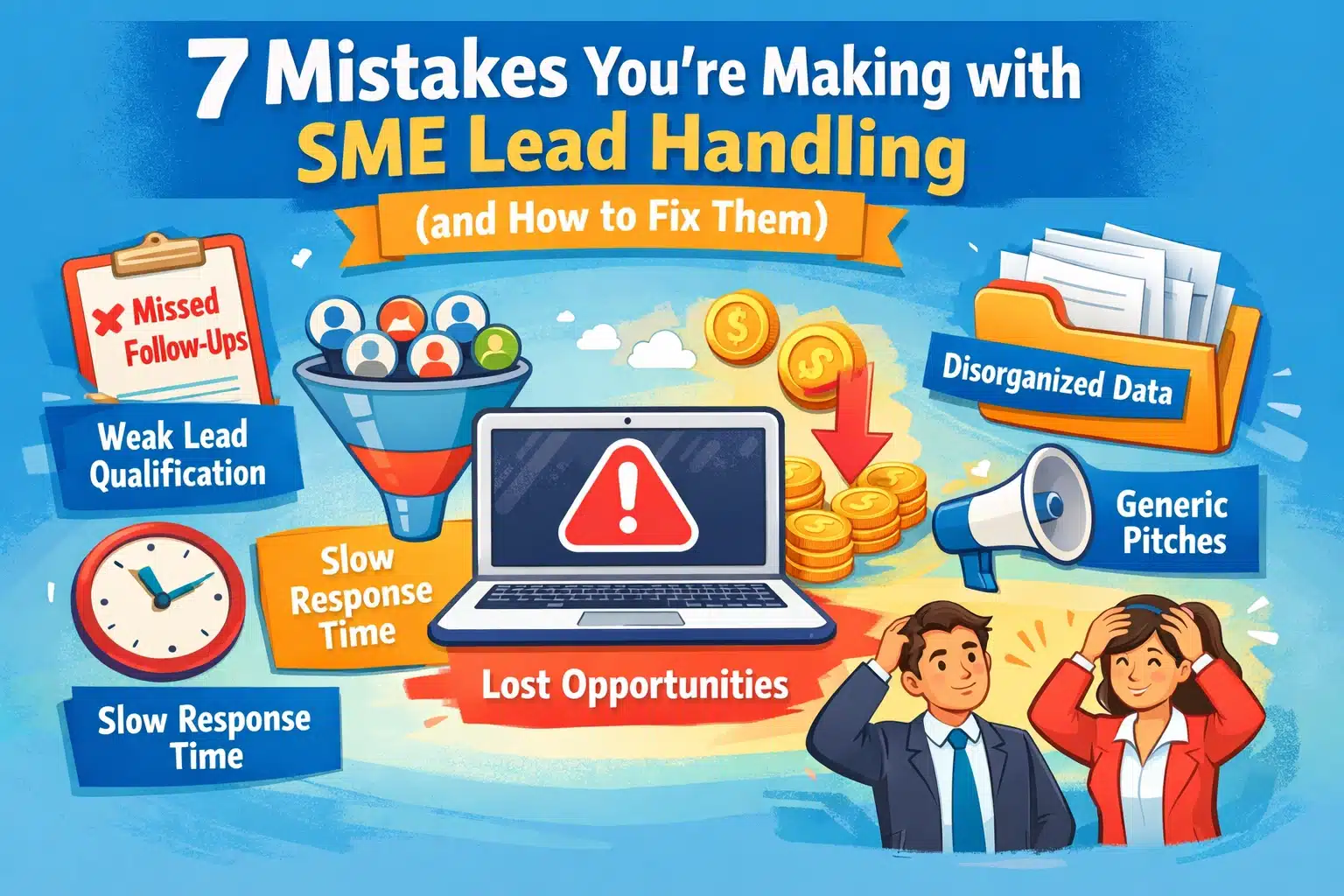
I’m Martyn Lenthall, and today I’m going to walk you through the seven most common mistakes SMEs make with their lead handling, and, more importantly, exactly how you can fix them using the same principles we use here at Every Enquiry.
1. Treating Every Lead Like It’s the Same
This is the biggest mistake in the book. If you treat a "tyre-kicker" who’s just looking for a rough price the same way you treat a "ready-to-buy" customer who needs a quote yesterday, you are wasting your most valuable resource: time.
In the world of Visibility, not all traffic is equal. Some people are just browsing, while others are in "pain" and need a solution now.
The Fix: Implement Lead Scoring and Qualification
You need to distinguish between a Marketing Qualified Lead (MQL) and a Sales Qualified Lead (SQL).
- MQL: Someone who has downloaded a guide or signed up for a newsletter. They aren't ready to buy yet; they need education.
- SQL: Someone who has filled out a "Get a Quote" form or called your office. They need a human response now.
Stop trying to sell to the browsers and start prioritising the buyers. According to HubSpot, companies that automate lead qualification see a significant jump in sales productivity because their team isn't chasing ghosts.

2. The "I’ll Call Them Back Later" Mentality
We live in an era of instant gratification. If I’m looking for a plumber and you don’t answer, I’m not going to leave a voicemail and wait by the phone like it’s 1995. I’m going to click the next link on Google.
If you take more than 30 minutes to respond to a web enquiry, you’ve basically set your marketing budget on fire. Research published by the Harvard Business Review shows that firms that tried to contact potential customers within an hour of receiving a query were nearly seven times as likely to have a meaningful conversation as those who waited even an hour longer.
The Fix: Focus on Instant Response
At Every Enquiry, we preach the "5-Minute Rule." If you can respond within five minutes, your Response rates will skyrocket.
You don’t need to be chained to your desk to do this. Use automated SMS acknowledgements. As soon as a form is submitted, the lead should get a text saying: "Hi [Name], thanks for reaching out to [Business Name]. We’ve got your enquiry and Martyn will give you a buzz in the next 10 minutes. In the meantime, check out our pricing guide here: [Link]."
This "stops the clock" for the customer. They feel looked after, and they stop searching for your competitors.
3. Relying on Manual Lead Routing (The "Who’s Got This?" Problem)
In many SMEs, lead handling is a bit of a free-for-all. An email comes into a generic info@ account, and everyone hopes someone else is dealing with it. Or, worse, the Director is trying to manage all the leads from their personal mobile while on-site.
This leads to "cherry-picking," where staff only call the "easy" leads, and the ones that require a bit of work get left behind.
The Fix: Automate Your Routing
Use a CRM (Customer Relationship Management) system to instantly assign leads. You can set up "Round Robin" distribution so every salesperson gets a fair share, or you can route leads based on expertise.
If you want predictable growth, you need a system that doesn't rely on human memory. Systems don’t have bad days; people do.
4. Sales and Marketing Living in Different Worlds
Marketing says: "We sent you 50 leads this month!"
Sales says: "Yeah, but they were all rubbish."
This disconnect is a profit killer. If your marketing team (or agency) is focused on "clicks" but your sales team is focused on "conversions," you have a massive misalignment.
The Fix: Create a Service Level Agreement (SLA)
You need a formal agreement between "the people getting the leads" and "the people closing the leads." This should define:
- What a "good" lead actually looks like.
- How quickly Sales must contact a lead.
- How many times a lead should be followed up before it’s marked as "lost."
When these two sides talk to each other, Conversion rates improve because the marketing reflects what the customers are actually asking. This is a core pillar of Marcus Sheridan’s "They Ask, You Answer" philosophy, if your customers are asking about price, your marketing should answer it before they even talk to a salesperson.
Comparison: Manual vs. Automated Lead Handling
| Feature | Manual Handling (The Old Way) | Every Enquiry Method (The New Way) |
|---|---|---|
| Initial Response Time | 2 – 24 Hours | Under 5 Minutes (Automated) |
| Data Entry | Scribbled notes / Post-its | Automated CRM Sync |
| Lead Accountability | "I thought you called them?" | Clear ownership & tracking |
| Follow-up Consistency | Sporadic (when time permits) | Scheduled and Automated |
| Qualification | Guesswork | Pre-defined criteria (MQL/SQL) |
| Visibility | None (The "Black Box") | Full dashboard reporting |
5. Using Generic, "Robotic" Communication
While automation is great, SMEs often make the mistake of sounding like a cold, heartless corporation. If your first response to a lead is a boring, "Your enquiry is important to us, please wait for a representative," you’ve already lost the emotional connection.
People buy from people. They especially buy from experts who seem like they actually give a toss about their problem.
The Fix: Personalise Every Touchpoint
Even an automated email can feel personal. Use their name. Mention the specific service they asked about.
Instead of: "We have received your enquiry regarding landscaping."
Try: "Hi Sarah, I saw you were looking to get your garden sorted before the summer. I’ve helped a few people in [Your Town] with similar projects recently. I’m just finishing up a job, but I'll give you a call at 2 pm to discuss your ideas. Cheers, Martyn."
It takes 30 seconds longer to set up a template like that, but the Conversion rate difference is massive. For more tips on this, check out our post on 10 reasons your lead conversion isn't working.

6. Poor Segmentation (The "One Bucket" Mistake)
If you’re a building firm that does both £500 repairs and £100,000 extensions, you cannot send them the same follow-up emails. The "pain points" for a leaky tap are not the same as the pain points for a year-long construction project.
Many SMEs dump every lead into one giant email list and send everyone the same monthly newsletter. It’s irrelevant, and people just hit "unsubscribe."
The Fix: Segment by Intent and Interest
Your CRM should automatically tag leads based on what they clicked on.
- Segment A: Interested in New Builds.
- Segment B: Interested in Renovations.
- Segment C: Past Customers (Great for referrals!).
By segmenting, you can send targeted advice that actually helps them. If someone is looking at an extension, send them a guide on "How to survive a home renovation without losing your mind." That’s how you build authority.
7. Giving Up Too Early (The "One and Done" Failure)
Most SMEs call a lead once. If they don’t answer, they maybe try once more the next day. If they still don’t answer? "Oh well, they weren't serious."
Rubbish.
Life happens. People get busy. They’re in the middle of a school run, or a meeting, or they just forgot. According to Salesforce, it takes an average of 6 to 8 touches to even generate a viable sales lead. If you’re stopping at two, you’re leaving 70% of your potential revenue on the table.
The Fix: The "Lead Recycling" System
You need a multi-channel follow-up sequence.
- Day 1: Call within 5 mins + SMS.
- Day 2: Follow-up Email with a helpful case study.
- Day 4: Second phone call at a different time of day.
- Day 7: The "Break-up" email. "Hi [Name], I haven't heard back so I assume your project is on hold. I’ll close your file for now, but feel free to reach out if things change."
Surprisingly, that "break-up" email often gets the highest response rate because it triggers a "fear of loss" in the prospect.

How Every Enquiry Solves the Visibility -> Response -> Conversion Gap
At Every Enquiry, we don't just give you a bit of software and wish you luck. we look at the entire journey of a customer.
Visibility
We ensure you can see exactly where your leads are coming from. No more "I think the radio ad worked." We track the source so you can put your money where the profit is. We help you dominate your Visibility so the right people find you.
Response
We implement the systems that ensure no lead is ever ignored. Whether it's an automated digital receptionist or a lightning-fast SMS trigger, we make sure your business is the first one to respond. Check out our Response services to see how we handle the "speed to lead" problem.
Conversion
Finally, we help you turn those conversations into cash. Through better tracking, better follow-ups, and a "They Ask, You Answer" approach to content, we increase your Conversion rates without you having to hire more expensive sales staff.
Frequently Asked Questions (FAQ)
1. "I'm a small business. Is this lead automation too expensive for me?"
Actually, it’s more expensive not to do it. If you lose just one £1,000 job a month because you were too slow to call back, the system would have paid for itself ten times over. We have pricing options tailored for SMEs, not just big corporations.
2. "Will my customers hate getting automated texts?"
Not if they’re helpful. People hate "spam." They love "service." If a text says, "I’ve got your message and I’m calling you at 2 pm," that is helpful service. It saves them time and gives them peace of mind.
3. "Do I need to be a tech genius to set this up?"
Nope. That’s what we’re here for. We handle the "pipes and wires" of the CRM and the automation. You just need to be ready to answer the phone when it rings.
4. "What if I already have a CRM?"
Great! Most SMEs have a CRM but only use it as a digital Rolodex. We can usually plug into your existing system and make it work much harder for you by adding the automation and tracking layers it’s currently missing.
5. "How quickly will I see results?"
In terms of Response times, you’ll see an improvement on day one. In terms of revenue, most of our clients see a noticeable lift in conversions within the first 30 to 60 days as the "leaky holes" in their bucket get plugged.
Final Thoughts from Martyn
Lead handling isn't about being "salesy." It’s about being organised and showing your potential customers that you respect their time. If you can fix these seven mistakes, you will instantly be ahead of 90% of your competitors who are still scribbling phone numbers on the back of cigarette packets.
Ready to stop losing leads and start growing predictably? Let’s have a chat. You can contact us here to find out how we can help your SME turn every enquiry into an opportunity.
Cheers for reading!
Martyn Lenthall
Director, Every Enquiry