Let’s be honest for a second. You spend a small fortune on marketing. You’ve got the website looking sharp, your SEO is ticking along, and maybe you’re even dabbling in some paid ads. The enquiries are coming in. But then, things go quiet. That "hot lead" who filled out your contact form yesterday? They aren't answering their phone today. The person who messaged you on Facebook? They’ve gone to a competitor.
Most SMEs in the UK think they have a "lead generation" problem. Usually, they actually have a "lead follow-up" problem.
At Every Enquiry, we see it every day. Businesses work incredibly hard on Visibility, getting seen by the right people, but they fall down at the Response and Conversion stages. If you aren't converting the leads you already have, buying more leads is just like pouring water into a leaky bucket. It’s expensive, frustrating, and ultimately, unsustainable.
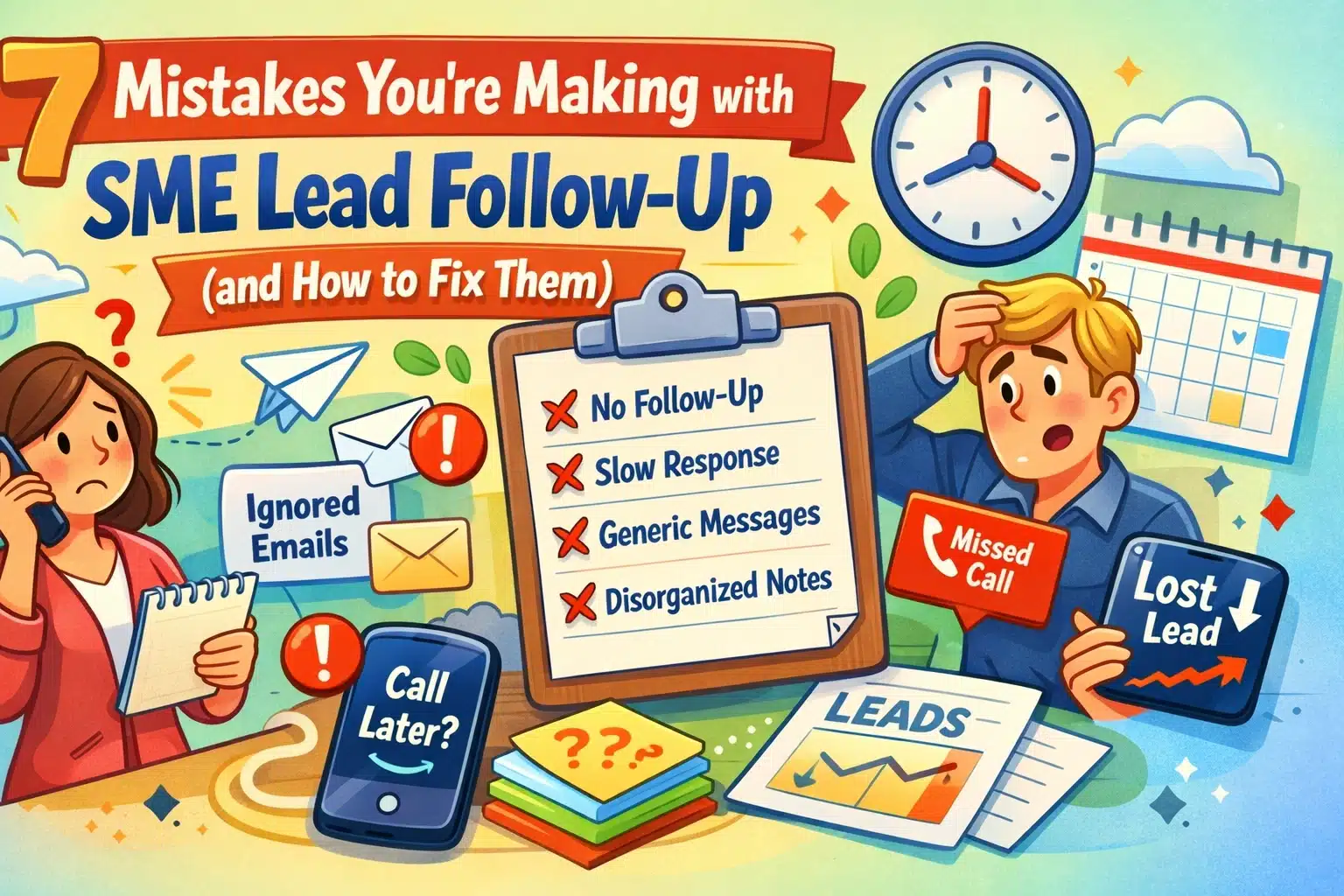
If you want to stop the leak, you need to fix your follow-up. Here are the seven most common mistakes British service businesses make with their lead follow-up and, more importantly, how you can fix them right now.
1. The "I’ll Do It Later" Lag (Speed to Lead)
The biggest mistake is also the simplest: taking too long to reply. We live in an era of instant gratification. If I want a plumber, a solicitor, or a landscape gardener, I’m not going to wait three days for a callback. I’m going to go down the list on Google until someone picks up the phone.
Research from the Harvard Business Review shows that businesses that try to contact potential customers within an hour of receiving an enquiry are nearly seven times as likely to have a meaningful conversation as those who wait even sixty minutes. If you wait 24 hours? Your chances of ever speaking to that person drop off a cliff.
How to fix it:
Aim for the "5-minute rule." If an enquiry comes in during business hours, someone should be on the phone within five minutes. If you can't do that because you're out on a job or in meetings, you need a system in place. This is where a managed enquiry handling system becomes your best friend. It ensures that every lead is greeted by a human being immediately, not an answerphone.

2. The "One and Done" Approach
Most SMEs give up far too early. A lead comes in, you call them once, they don’t answer, so you leave a voicemail and move on. You figure, "If they were serious, they’d call me back."
Wrong. People are busy. They might be at work, driving, or putting the kids to bed when you call. According to Salesforce, it takes an average of six to eight touches to generate a viable sales lead. If you stop after one call, you are literally handing your hard-earned money to your competitors.
How to fix it:
Build a "Sales Cadence." This is a structured schedule for following up. A typical cadence might look like this:
- Day 1: Immediate call + follow-up email/text.
- Day 2: Another call at a different time of day.
- Day 3: A value-led email (answering a common question).
- Day 5: Another call + SMS.
- Day 10: The "Break-up" email (politely asking if they still need help).
Consistency is what separates the top 1% of businesses from the rest. You can read more about building these frameworks in our guide on how to improve response times.
3. Relying Solely on Email
In the digital age, many business owners have become "phone-shy." It’s easier to fire off an email than it is to pick up the phone. The problem? Emails get buried. They go to spam. They get "read" but not "processed."
If you are only using one contact channel, you are missing out on everyone who prefers a different method. Some people love a phone call. Others want a quick WhatsApp. Some want a detailed email they can read in the evening.
How to fix it:
Go multi-channel. Your follow-up should be a blend of phone calls, emails, and SMS. If your lead came from social media, you should even consider following up there. Our approach to social media management goes beyond just posting updates; it's about engaging with the people who are actually talking to you. Don't be afraid to use SMS, it has an open rate of nearly 98%, which crushes email every day of the week.
4. The "Check-In" Email (Lacking Value)
We’ve all received them. "Hi, just checking in to see if you’ve had a chance to look at my quote."
These emails are boring, they put the work on the customer, and they offer zero value. Following Marcus Sheridan’s "They Ask, You Answer" principles, every interaction should be an opportunity to educate and build trust.
How to fix it:
Instead of "checking in," provide something useful. Send them a link to a blog post you wrote about "What to look for when hiring a [Your Profession]." Send them a video of a recent project similar to theirs. Answer a question they didn’t even know they had yet. This positions you as the expert, not just another salesperson pestering them for a cheque. Check out our blog section for examples of how we use content to drive conversion.

5. Falling Into the "Spreadsheet Trap"
When you’re starting out, a spreadsheet is fine. When you’re growing, a spreadsheet is where leads go to die. You forget who you called, when you called them, and what they said. There’s no accountability, and things inevitably fall through the cracks.
If you don't have a central system for managing enquiries, you don't have a predictable business; you have a series of lucky accidents.
How to fix it:
You need a CRM (Customer Relationship Management) system. It doesn’t have to be complicated or expensive. It just needs to be a single source of truth where every lead is logged, and every follow-up task is scheduled. This is the foundation of Conversion. If you can see at a glance that 20 people are waiting for a callback, you can take action. If that information is buried in your "Sent" folder, you’re flying blind.
6. Ignoring the Prospect’s Preferred Channel
This is a subtle but massive mistake. If a lead contacts you via WhatsApp, and you reply by calling them out of the blue, you’ve ignored their preference. They messaged you because they were in a situation where they couldn't talk. By calling them, you've created a point of friction before the relationship has even started.
How to fix it:
Meet them where they are. If they email, email back (then follow up with a call). If they use your website's live chat, stick to the chat for the initial qualification. Once you have established rapport, you can ask, "Would it be easier to jump on a quick 5-minute call to go over the details?" Respecting their boundaries builds immediate rapport.
7. No Tracking (The Visibility Blind Spot)
Do you know which marketing channel produces the leads that actually close? Many SMEs can tell you they got "10 leads from Facebook" and "5 leads from Google." But if the 10 Facebook leads were just tyre-kickers and the 5 Google leads all turned into high-paying clients, where should you spend your money?
Without tracking the follow-up through to the final sale, you might be over-investing in the wrong type of Visibility.
How to fix it:
Track everything. Use unique tracking numbers or lead source tags in your CRM. At Every Enquiry, we believe that visibility is only valuable if it leads to revenue. If you aren't sure where your best customers are coming from, you’re likely wasting a significant portion of your marketing budget.

Comparison: DIY vs. Managed Lead Follow-up
To help you decide which path is right for your business, here is a breakdown of the differences between trying to handle this yourself and using a professional service.
| Feature | DIY Follow-up (The "Hustle" Method) | Managed Enquiry Handling (Every Enquiry) |
|---|---|---|
| Response Speed | Varies (depends on how busy you are) | Guaranteed < 5 minutes |
| Consistency | Often forgotten during busy periods | Systematic and relentless |
| Channel Coverage | Usually just phone or email | Multi-channel (Calls, SMS, Email, Social) |
| Data Accuracy | Manual entry (often missed) | Automated CRM logging and tracking |
| Scalability | You hit a "ceiling" of what you can handle | Scales as your lead volume grows |
| Cost | "Free" (but high cost of lost leads) | Fixed monthly fee with clear ROI |
| Lead Nurturing | Rare (usually just one or two calls) | Structured 7-10 touch cadence |
The "Hidden Cost" of doing this yourself is often much higher than the pricing of a managed service. Think about it: if your average job is worth £1,000, and you miss just two enquiries a month because you were too busy to call back quickly, that’s £24,000 a year in lost revenue.
The Three Pillars of SME Growth
At Every Enquiry, we simplify this into three core stages. If you get these right, your business grows. If one is missing, you struggle.
1. Visibility
This is about getting your business in front of the right people at the right time. Whether it’s through SEO, social media, or local search, you need to be seen. But being seen is only the start. You can learn more about this in our services section.
2. Response
This is the bridge between a stranger and a customer. It’s where most of the "7 mistakes" happen. Your response needs to be fast, human, and multi-channel. It is the single most effective way to beat your competitors without spending more on ads.
3. Conversion
Once you’ve responded, you need to move them toward a sale. This requires persistence, value-led communication, and a solid system (CRM). For a deeper dive into why conversion often fails, read our article on 10 reasons your lead conversion isn't working.

How to Start Fixing Your Follow-up Today
You don't need to fix all seven mistakes overnight. Start with the "Speed to Lead."
Step 1: Look at your last 10 enquiries. How long did it take you to reply to each one? Be honest. If the average is over an hour, you have a massive opportunity for growth.
Step 2: Audit your "touches." How many times do you actually try to contact a lead before you give up? If it's less than five, you are leaving money on the table.
Step 3: Implement a simple SMS follow-up. After you've called a lead (and even if they didn't pick up), send a quick text: "Hi [Name], it's Martyn from Every Enquiry. Just tried calling about your enquiry. I'll try again tomorrow, or feel free to text me back here!" You will be amazed at how many people reply to that text within minutes.
Is your website losing you money? The answer is almost certainly "yes" if your follow-up isn't airtight. You can read more about the hidden cost of missed enquiries to see the true impact on your bottom line.
Summary
The difference between a struggling SME and a thriving one often isn't the quality of their work: it's the quality of their enquiry handling. By avoiding these seven mistakes, you're not just "doing sales"; you're building a professional reputation. You're showing your prospects that you are reliable, fast, and helpful before they've even paid you a penny.
If you’re tired of chasing leads and want a system that does the heavy lifting for you, contact us today. We help businesses like yours turn more enquiries into paying customers by fixing the "Response" gap once and for all.
Frequently Asked Questions (FAQ)
Q: How quickly do I really need to reply to a lead?
A: Ideally, within 5 minutes. After 30 minutes, the lead's "warmth" drops significantly. After 24 hours, you are essentially "cold calling" them, as they have likely already spoken to a competitor or forgotten why they enquired in the first place.
Q: Isn't calling a lead 5 or 6 times a bit "pushy"?
A: Not if you do it correctly. There is a fine line between being persistent and being a pest. The key is to vary your times and your channels. If you call, then send a helpful email, then a text, you are being professional and thorough. Most customers actually appreciate the effort because it shows you want their business.
Q: I’m a one-man band; how can I reply in 5 minutes if I’m working?
A: This is the classic SME dilemma. You can't be in two places at once. This is where you should consider a digital receptionist or a managed enquiry service. It allows you to focus on the work while ensuring your "front door" is always open. It's often cheaper than the cost of one missed job.
Q: Do I really need a CRM? Can't I just use my email inbox?
A: An email inbox is a to-do list created by other people. A CRM is a sales tool created by you. While you can survive with an inbox for a while, you will eventually lose leads. A CRM allows you to set reminders, track the value of your pipeline, and ensure no lead is ever truly "forgotten."
Q: What is the best channel for follow-up?
A: The best channel is the one your customer uses. However, a combination of a phone call followed by an SMS has the highest success rate for SMEs. SMS is less intrusive than a call but has much higher engagement than an email.
Q: How much does it cost to have someone handle my enquiries?
A: Costs vary depending on the volume of leads, but most services pay for themselves by converting just one or two extra leads that would otherwise have been lost. You can view our pricing page for a better idea of the investment required.
Q: Should I use automated email sequences?
A: Automation is great for "nurturing," but for service-based SMEs, nothing beats a human touch. Use automation to send helpful articles or confirmation emails, but make sure the core of your follow-up involves a real person making a real connection.