Let’s be honest for a second. You’re likely spending a decent chunk of your monthly budget on getting people to find your business. Whether it’s Google Ads, local SEO, or a bit of social media magic, you’re paying to get noticed.
But what happens when the phone actually rings? Or when a contact form lands in your inbox?
For many SME service businesses in the UK, this is where the wheels fall off. You’ve done the hard work of building visibility, but the moment a prospect shows interest, they’re met with a voicemail, a slow reply, or a confusing follow-up process.
I’m Martyn Lenthall, Director at Every Enquiry, and I’ve seen it a thousand times. Business owners are obsessed with "more leads" when they should be obsessed with "better handling." If you’re generating 50 leads a month but only closing two, you don’t have a lead problem, you have a handling problem.
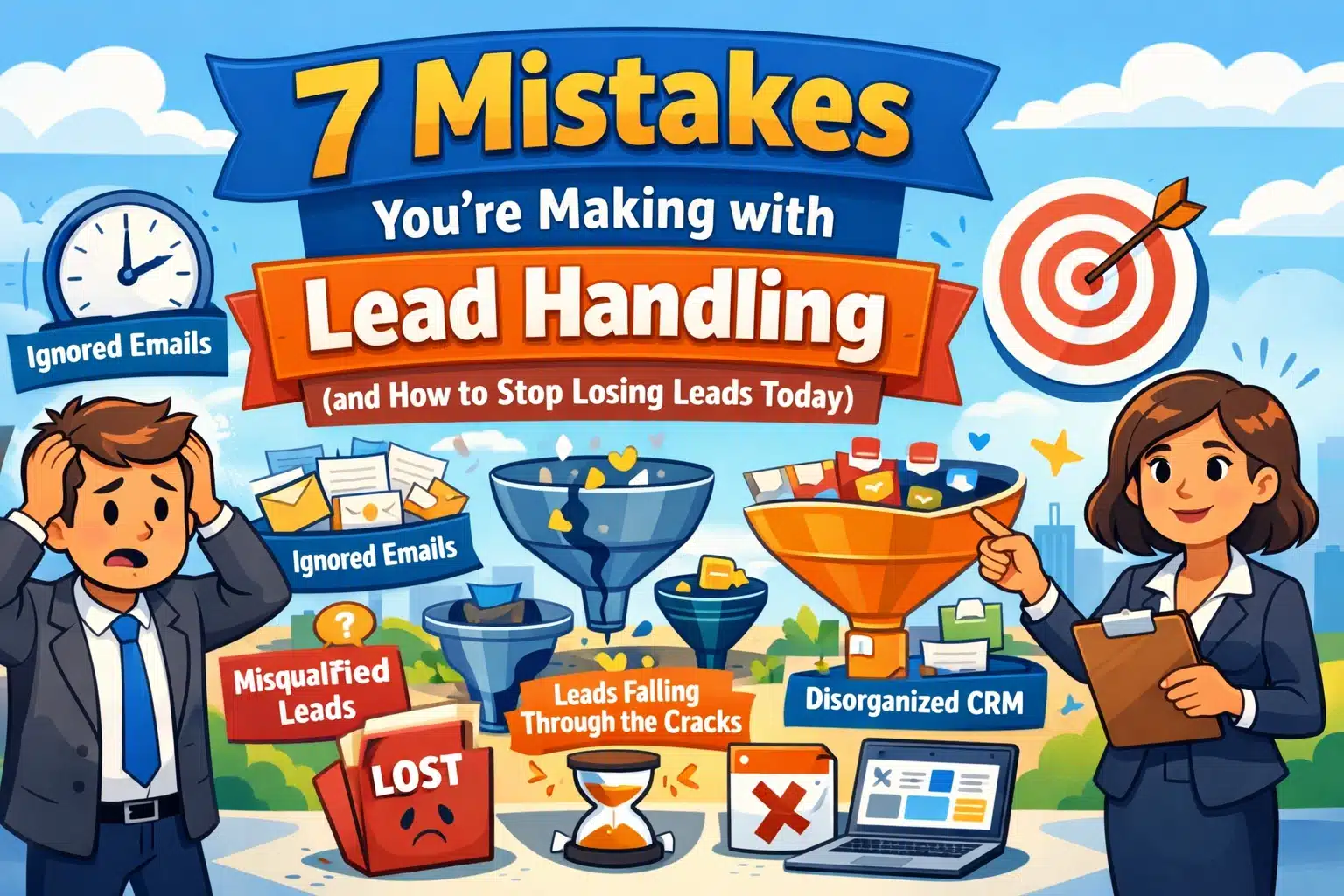
In this guide, we’re going to walk through the seven most common mistakes businesses make with their lead handling and, more importantly, how to fix them using the principles of transparency and promptness.
1. The "I'll Call Them Back Later" Trap (Slow Response Times)
The absolute biggest killer of conversions is speed, or the lack of it. In the digital age, your prospect is likely browsing three or four of your competitors at the same time. If they fill out your form and you wait four hours to call them, they’ve already spoken to someone else.
According to research by Harvard Business Review, businesses that attempt to reach out to leads within an hour are nearly seven times more likely to have a meaningful conversation than those who wait even sixty minutes. If you wait 24 hours? You might as well set that lead on fire.
The Fix: You need a response system that prioritises "Speed to Lead." This doesn't mean you have to sit by your phone 24/7. It means using automation or a dedicated enquiry management service to ensure every prospect gets an immediate acknowledgement.
At Every Enquiry, we preach the "5-minute rule." If you can respond within five minutes, your chances of qualifying that lead skyrocket. Read more about the power of prompt response to see how this shifts the needle.

2. Misaligned Handoffs Between Marketing and Sales
If you’re a slightly larger SME with a marketing person (or agency) and a separate sales person, this one is for you. Often, marketing thinks they’re doing a great job because "the leads are up," while sales thinks marketing is sending "rubbish leads."
This misalignment usually happens because no one has defined what a "qualified lead" actually looks like. Marketing is chasing volume; Sales is chasing revenue.
The Fix: Adopt the "They Ask, You Answer" philosophy. Sit both teams down and define exactly what a Sales Qualified Lead (SQL) is. Is it someone who just downloaded a PDF, or someone who asked for a quote? Create a Service Level Agreement (SLA) that dictates how fast a lead must be contacted once it hits the CRM.
When your conversion strategy is aligned, everyone wins. Marketing knows what to hunt for, and Sales knows that every lead they get is worth their time.
3. Treating Every Enquiry Like a Cold Call
Many business owners make the mistake of jumping straight into a "sales pitch" the moment they get a lead on the phone. You have to remember: they found you. They have a problem they think you can solve. They aren't a cold prospect; they are a warm enquiry.
If your first interaction is "Hi, we’re the best in the business, here’s our price," you’re missing the point. You haven’t built trust yet.
The Fix: Be a teacher, not a salesman. This is a core pillar of Marcus Sheridan’s methodology. Your initial handling should be about diagnosing the problem. Ask questions. "What are you trying to achieve?" "What’s been your biggest frustration with [Service] in the past?"
By being transparent and educational, you position yourself as an authority rather than a commodity.
4. Fragmented Data and the "Sticky Note" System
Where do your leads go? If the answer is "my inbox," "a spreadsheet," or "a pile of post-it notes on my desk," you are losing money. Fragmented data leads to leads falling through the cracks. You forget to follow up, you lose the phone number, or you can't remember what you discussed last time.
The Fix: You need a centralised CRM (Customer Relationship Management) system. It doesn't have to be a complex, expensive "suite of services." It just needs to be a single source of truth.
Every call, every email, and every form submission should live in one place. This allows you to track the journey from visibility to close. If you can’t measure it, you can’t manage it.

5. Weak or Invisible Calls-to-Action (CTAs)
Sometimes the mistake happens before the lead even reaches you. If your website is a maze and the "Contact Us" button is hidden in the footer, you’re making it too hard for people to give you their money.
Worse yet are "weak" CTAs. Phrases like "Submit" or "Click Here" are boring and don't tell the user what's in it for them.
The Fix: Make your CTAs bold, clear, and benefit-driven. Instead of "Submit," try "Get My Free Quote" or "Book My 15-Minute Consultation." Ensure there is a clear path on every page of your site leading back to an enquiry point.
We often see businesses forget to link their blog section articles back to their service pages. If someone reads an article about your expertise, don't let them leave without offering a clear next step.
6. The "One and Done" Follow-Up Approach
Most sales happen between the 5th and 12th contact. Yet, most SMEs stop after one phone call or one email. If the prospect doesn't answer the first time, the lead is often marked as "dead."
This is a massive waste of marketing spend. People are busy. They might have been in the middle of school run, a meeting, or just forgot to reply to your text.
The Fix: Implement a structured nurturing sequence. If they don't answer the first call, send a helpful email. Two days later, send a link to a relevant case study or a blog post that answers a common question.
Don't just nag them with "Are you ready to buy yet?" Provide value at every touchpoint. This builds the predictable growth that small businesses need to scale.
7. Pursuing Quantity Over Quality (The Lead-Buying Trap)
I get it. It’s tempting to go to a third-party lead provider and buy 100 leads for a few hundred quid. But these leads are often non-exclusive (sold to five of your competitors), outdated, or low-intent.
When you focus purely on lead volume, your handling process gets clogged with "tyre-kickers," leading to burnout for your team and a poor return on investment.
The Fix: Focus on organic website optimization. It’s better to have 10 leads from people who have read your content, watched your videos, and trust your brand than 100 leads from a generic "Get a Quote" site.
Quality handling starts with quality leads. Use your website to filter out the wrong customers by being honest about who you don't work with.
Comparison: DIY Lead Handling vs. Professional Management
To help you see where your business currently sits, I’ve put together this comparison table. Be honest, which column looks more like your current setup?
| Feature | DIY "Sticky Note" Method | Every Enquiry Standard |
|---|---|---|
| Response Time | "When I have a minute" (Often hours/days) | Under 5 Minutes (Automated or Managed) |
| Data Storage | Emails, Spreadsheets, Memory | Centralised CRM / Single Source of Truth |
| Follow-up Frequency | 1 or 2 attempts, then given up | Structured 7+ touchpoint sequence |
| Communication Tone | Direct Sales Pitch | Educational / Problem-Solving |
| Lead Quality | Mixed – No filtering | High – Educated through content |
| Success Tracking | "Feeling" like it's working | Hard Data: Conversion rate, ROI, Cost per Lead |
Moving from Visibility to Conversion
At Every Enquiry, we look at your business through three specific lenses:
- Visibility: Are people finding you? (SEO, Ads, Content)
- Response: What happens when they find you? (Enquiry handling, speed)
- Conversion: How many become paying customers? (Nurturing, closing)
If you only focus on visibility, you’re just filling a leaky bucket. You need to plug the holes in your response and conversion phases to actually see growth.
Imagine you spend £1,000 on ads and get 20 leads.
- If your handling is poor, you might close 1 lead. Cost per acquisition: £1,000.
- If your handling is excellent, you might close 5 leads. Cost per acquisition: £200.
The marketing spend stayed the same, but the business outcomes are worlds apart. That is the power of effective enquiry handling.

How to Audit Your Own Lead Handling Today
You don't need a fancy consultant to tell you if your system is broken. You can audit it yourself this afternoon.
- Mystery Shop Yourself: Have a friend fill out your contact form or call your business. How long does it take to get a reply? Was the person on the other end helpful or harried?
- Check Your Last 10 Leads: Go back through your last 10 enquiries. How many did you actually follow up with more than twice? How many are currently "lost" in your inbox?
- Calculate Your Lead-to-Sale Rate: If you don't know this number, you need to find it. Divide your total sales by your total leads for the last month. If it’s under 10% for a service business, you have a handling issue.
Final Thoughts from Martyn
Look, I know running an SME is a juggling act. You’re trying to manage the work, the staff, and the marketing all at once. It’s easy to let lead handling slide because it feels like admin.
But in reality, lead handling is the work. It’s the most important part of your sales process. Stop thinking about how to get "more" leads and start thinking about how to respect the ones you already have. Give them a fast, honest, and educational experience, and you’ll find that growth becomes a lot more predictable.
If you’re ready to stop losing leads and start building a system that works, have a look at our pricing or get in touch. We’re here to help you turn those enquiries into actual revenue.
Frequently Asked Questions (FAQ)
1. Why is responding in 5 minutes so important?
Because the internet has made us impatient. If a customer is looking for a plumber or a solicitor, they are likely clicking the top three results on Google. The first one to answer the phone or reply to the email usually wins the job. It’s about being there at the moment of highest intent.
2. We are too busy to answer the phone every time. What should we do?
This is a common hurdle. You can use a digital receptionist, a professional enquiry management service like Every Enquiry, or at the very least, an automated SMS/email reply that says: "Thanks for your enquiry! We’re on a job right now but will call you back at [Time]. In the meantime, check out our [FAQ page]!" This manages expectations immediately.
3. Is buying leads ever a good idea?
Generally, no. Bought leads are often shared with competitors, meaning you’re in a race to the bottom on price. It’s much more effective to invest in your own social media or SEO to attract people who actually want to work with you, specifically.
4. What is a "Nurture Sequence"?
It’s a series of pre-written communications (emails, texts, or scheduled calls) designed to keep your business top-of-mind. Instead of just asking for a sale, you send helpful content, like "5 Things to Ask Before Hiring a [Service Provider]" or "How Our Process Works." It builds trust over time.
5. Do I really need a CRM for a small business?
Yes. Even a simple, free CRM is better than a spreadsheet. It allows you to automate reminders so you never forget to follow up. Without a CRM, you’re relying on your memory, and when you get busy, your memory will fail you.
6. How do I know if my marketing agency is giving me bad leads?
Look at the data. If the leads are the right "profile" (right location, right service need) but aren't closing, it might be your handling. If the leads are asking for services you don't offer or are in the wrong country, then the marketing targeting is wrong. Open communication between you and your agency is key here.
Want to learn more about improving your business's response game? Check out our latest insights on the blog-section.