If you’re a business owner in the UK, you know the feeling. Your phone rings while you’re mid-meeting. An email notification pops up while you’re driving. A Facebook message lands while you’re finally sitting down for dinner.
You want the work. You need the leads. But the sheer volume of "enquiry noise" can be overwhelming. Most SME owners we talk to at Every Enquiry are caught in a frustrating loop: they spend money on marketing to get "Visibility," but they lack the "Response" infrastructure, which ultimately kills their "Conversion."
According to Harvard Business Review, businesses that try to contact potential customers within an hour of receiving an enquiry are nearly seven times as likely to have a meaningful conversation as those who wait even 60 minutes. Yet, many small businesses take 24 to 48 hours to reply, if they reply at all.
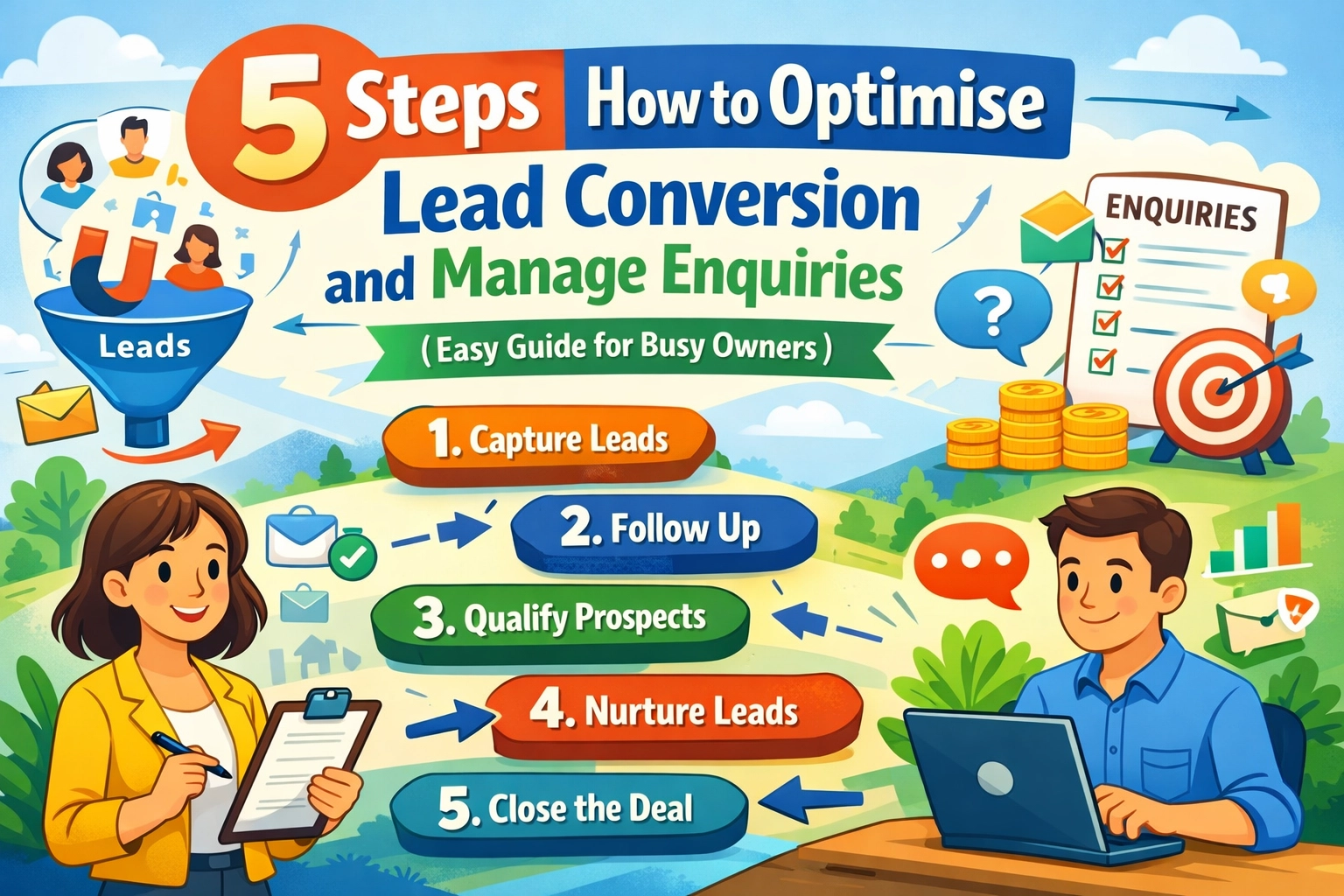
This guide isn't about fancy jargon or "disrupting the industry." It’s about Marcus Sheridan’s "They Ask, You Answer" philosophy: being honest, being helpful, and being fast. Here are the five steps to reclaim your time and turn more of those "just wondering" emails into paying clients.
Step 1: Qualify Leads Upfront (Visibility & Filtering)
The biggest mistake busy owners make is thinking every lead is a good lead. They aren't. If you treat every enquiry with the same level of urgency, you’ll burn out. To optimise your visibility, you need to ensure the people finding you are the right people.
Start by being radically honest on your website. Use your contact forms to do the heavy lifting. Instead of just "Name" and "Email," ask qualifying questions:
- "What is your estimated budget for this project?"
- "When are you looking to start?"
- "Have you worked with a professional in this industry before?"
Many owners fear that asking about budget will scare people away. Good. You want to scare away the people who can’t afford you. This is a core pillar of lead conversion. By the time a lead reaches your inbox, they should already know roughly what you cost and how you work.

Step 2: Master the "Speed to Lead" (Response)
If you take one thing away from this article, let it be this: The first person to answer the phone usually wins the job.
In the digital age, your prospects are doing "window shopping" on Google. If they email you and don't hear back within 10 minutes, they’ve already clicked the next link in the search results and messaged your competitor. This is where most SME growth plateaus. You’ve mastered the visibility part, but your response is a bottleneck.
We call this the "Golden Window." Ideally, you want to respond within five minutes. If you’re busy on-site or in consultations, this is impossible to do alone. This is why many businesses look into how to improve response times. Whether it’s an automated SMS that says, "Hey, I’m with a client, but I’ve got your message, I'll call you at 4 PM," or a dedicated enquiry management team, the silence must be broken immediately.
Step 3: Implement a Lead Scoring System
Not all enquiries are created equal. A lead scoring system helps you prioritise who gets a phone call and who gets an automated email sequence.
You can assign points based on:
- Intent: Did they download a free guide (1 point) or ask for a quote (10 points)?
- Fit: Are they in your local service area (5 points) or out of town (0 points)?
- Urgency: Do they need help today (10 points) or next year (1 point)?
When you score your leads, you stop "managing enquiries" and start "managing opportunities." You focus your limited energy on the "10-point" leads while your systems handle the rest. This shift is essential for improving your lead conversion.

Step 4: Build a Structured Follow-Up Cadence (Conversion)
Most owners stop after one follow-up. They think, "Well, I replied and they didn't get back to me, so they must not be interested."
This is a myth. People are busy. Their kids got sick, their boss called them into a meeting, or your email simply landed in their "Promotions" tab. The power of prompt response is only half the battle; the other half is persistence.
A structured cadence might look like this:
- Day 0: Immediate call/SMS/Email.
- Day 1: Follow-up email with a helpful resource (e.g., "5 things to check before hiring a [Your Profession]").
- Day 3: A quick "Just checking you got my last message" note.
- Day 7: A "break-up" email. "I haven't heard back, so I'll assume this isn't a priority right now. If things change, here’s how to reach me."
Surprisingly, the "break-up" email often gets the highest response rate. It triggers a "fear of missing out" and forces the prospect to make a decision.
Step 5: Test, Refine, and Replicate
You cannot improve what you do not measure. You need to know your numbers.
- How many leads came in this month?
- What was the average response time?
- How many turned into a conversion?
- Which source (Google, Facebook, Word of Mouth) provided the highest quality leads?
If you find that your social media management is bringing in 100 leads but zero sales, you have a visibility problem (you're visible to the wrong people). If you’re getting 10 leads and they are all "perfect" but you're only closing one, you have a response or sales process problem.
Comparison: Handling Enquiries Yourself vs. Managed Services
Many owners try to do it all themselves to save money. But have you calculated the cost of a missed lead? If your average contract value is £1,000 and you miss five calls a month, that’s £5,000 in lost revenue.
| Feature | Do-It-Yourself (DIY) | Digital Receptionist | Every Enquiry (Managed) |
|---|---|---|---|
| Response Speed | Varies (when you're free) | Fast (within seconds) | Instant & Qualified |
| Lead Quality | You filter them manually | They just take a message | Vetted & Scored for you |
| Follow-Up | Often forgotten | None | Structured & Persistent |
| Cost | "Free" (but costs your time) | Low monthly fee | Investment based on ROI |
| Customer Experience | Can feel rushed/stressed | Professional but robotic | Educational & Friendly |
| Focus on Growth | Low (busy with admin) | Medium | High (you only talk to buyers) |

The "They Ask, You Answer" Approach to Enquiries
Marcus Sheridan’s philosophy suggests that your potential customers have five main concerns: Price, Problems, Comparisons, Reviews, and "The Best."
When someone enquires, they are usually asking one of these things. If your enquiry management process addresses these honestly, even the uncomfortable ones like price, you build instant trust. Instead of being a "salesperson," you become a trusted advisor.
If a lead asks for a price and you hide it, they feel manipulated. If you say, "Our prices start at £X, and here is why some people might pay more or less," you've won their respect before you've even met them. This transparency is the "secret sauce" of successful enquiry handling.
The Cost of the "Leaky Bucket"
Imagine your business is a bucket. You are pouring money into the top of the bucket through SEO, Facebook Ads, and local networking. This is your visibility.
If you don't have a solid system for response and conversion, your bucket has holes in the bottom. No matter how much "water" (leads) you pour in, the bucket never stays full. You’re working harder, not smarter.
By fixing the enquiry management process, you plug those holes. You might actually find that you can spend less on marketing because you’re converting a higher percentage of the leads you already have. This is the path to predictable growth for small businesses.
How Every Enquiry Can Help
At Every Enquiry, we don't just "post on social" or "send you leads." We look at the entire journey. We help you with the visibility, but more importantly, we help you manage the mess that follows. Whether you need a better follow-up system or a way to ensure no call ever goes unanswered, we focus on the business outcomes, not just the digital features. You can check out our pricing to see how we fit into your growth plans.

Frequently Asked Questions (FAQ)
1. I’m a small business; do I really need a formal enquiry system?
Yes. In fact, small businesses need it more. A large corporation can afford to lose a few leads to inefficiency. For an SME, every missed call is a missed opportunity to pay the mortgage or grow the team. Systems create freedom.
2. Won't an automated response feel impersonal to my customers?
It depends on how you write it. If it’s "Your enquiry has been received, ticket #402," then yes, it’s cold. But if it’s, "Hi, it's Martyn here. I’ve got your message! I'm currently on-site, but I'll give you a shout at 4 PM to discuss your project. In the meantime, here’s a guide on our process," it feels helpful and professional.
3. What is the difference between a digital receptionist and what Every Enquiry does?
A digital receptionist usually just takes a name and number. Every Enquiry focuses on the entire conversion funnel. We don't just want to "take a message"; we want to ensure that lead is qualified, scored, and moved through a follow-up cadence that results in a sale.
4. How much time should I spend following up with a lead?
The "Rule of 7" suggests it takes seven touchpoints before a customer truly trusts a brand. We recommend at least 5-6 attempts across different channels (phone, email, SMS) over the course of two weeks before giving up on a lead.
5. Why shouldn't I just hire a full-time admin person?
You could! But a full-time employee comes with NI contributions, holiday pay, and overheads. They also have "down-time." A managed service like Every Enquiry provides 24/7 coverage and expert systems for a fraction of the cost of a full-time salary.
6. What if my industry is "different" and people expect to speak to the boss?
We hear this a lot. While people like "speaking to the boss," what they actually want is an answer. If "the boss" takes three days to call back, the "personal touch" is lost anyway. A professional response that schedules a specific time for you to talk is much better than a missed call and a frustrated prospect.
7. How do I know if my lead conversion is actually working?
Look at your "Close Rate." If you get 10 enquiries and only 1 becomes a customer, your conversion is 10%. If you can move that to 3 out of 10, you’ve tripled your business without spending an extra penny on ads. That’s the power of lead conversion optimisation.
Ready to stop the "leaky bucket" in your business? It’s time to move beyond just being "visible" and start being "responsive." If you’re ready to take the next step, feel free to contact us or explore our blog section for more tips on scaling your SME.