Let’s be honest for a second. You probably spend a fair bit of time: and likely a decent chunk of money: trying to get the phone to ring or your inbox to ping. Whether it’s SEO, Facebook ads, or just the hard graft of networking, getting someone to notice your business is a win.
But here’s the uncomfortable truth: for many small to medium-sized businesses (SMEs) in the UK, that’s where the success ends.
You’ve got the enquiry, but then what? If you’re like most busy directors, you’re probably juggling a hundred things at once. You see an email come in while you’re on a job or in a meeting. You think, "I’ll get to that later." But "later" becomes tomorrow, and tomorrow becomes next week. By the time you call them back, they’ve already hired your competitor who picked up the phone on the second ring.
At Every Enquiry, we see this every single day. We call it the "leaking bucket" syndrome. You’re pouring leads into the top, but because your follow-up system is full of holes, the profit is leaking out of the bottom.
In this guide, we’re going to show you how to plug those holes using a structured approach focused on Visibility, Response, and Conversion. This isn't about fancy jargon or high-pressure sales tactics. It’s about building a predictable system that treats every enquiry like the valuable asset it is.
Part 1: Visibility – If You Can’t See Them, You Can’t Sell to Them
Before we can even talk about following up, we have to talk about how you’re capturing enquiries in the first place.
Most SMEs rely on a messy mix of WhatsApp messages, post-it notes, missed call notifications, and emails buried under "20% off office supplies" spam. If your enquiry management lives in your head, it’s not a system: it’s a recipe for burnout.
Centralising the Chaos
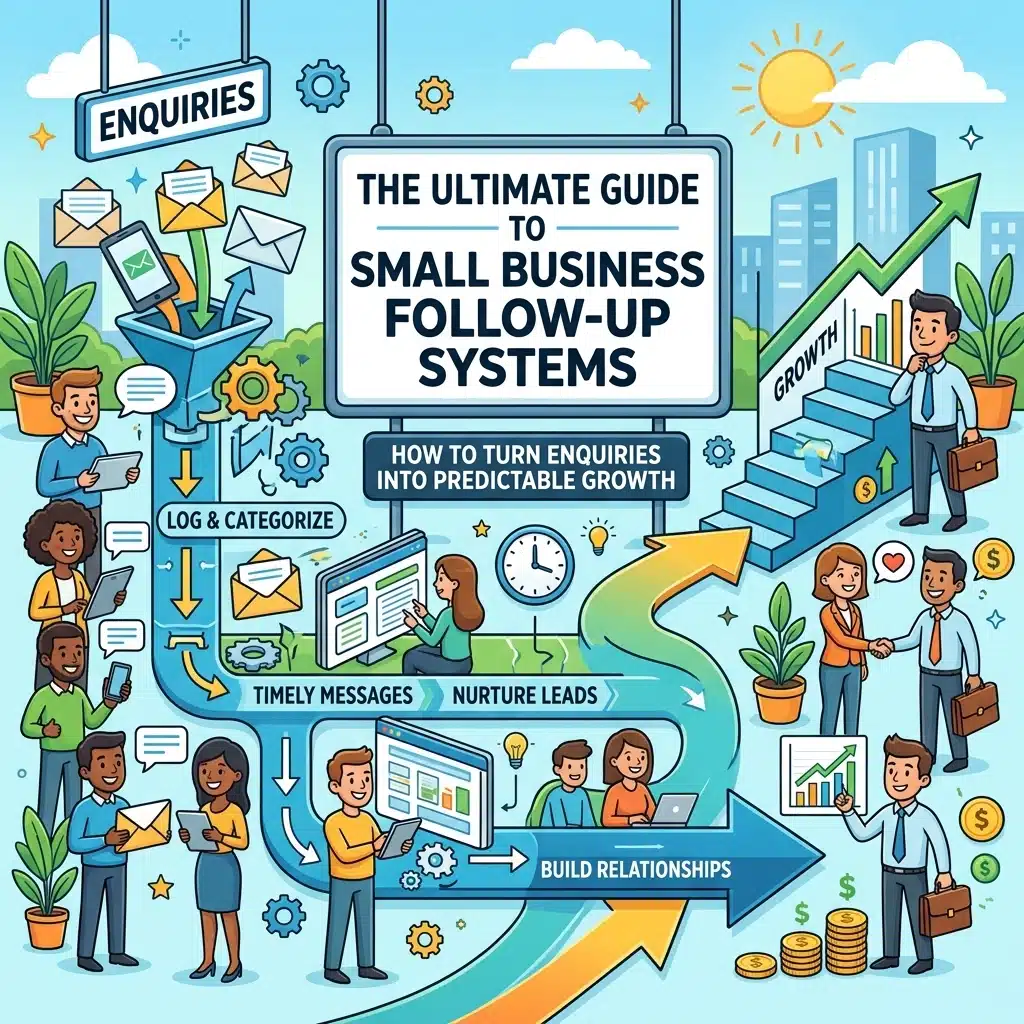
The first step to a professional follow-up is Visibility. You need one single source of truth where every lead lands. Whether it’s a form fill on your website, a DM on Instagram, or a phone call, it needs to be logged.
According to Marcus Sheridan’s "They Ask, You Answer" philosophy, your customers are looking for transparency and ease of access. If they have to go through an obstacle course just to ask you a question, they’ll go elsewhere.
The Visibility Checklist:
- Website Forms: Are they simple? Do they work on mobile?
- Phone Tracking: Do you know which calls are new leads and which are existing customers?
- Social Media: Are your DMs being monitored, or are they a "black hole" for potential revenue?
If you want to understand how this impacts your bottom line, have a look at our article on why your website might be losing you money.

Part 2: Response – The Need for Speed (and Quality)
The statistics around lead response times are, frankly, terrifying. A study famously cited by Harvard Business Review found that firms that tried to contact potential customers within an hour of receiving a query were nearly seven times as likely to have a meaningful conversation with a key decision-maker as those who waited even an hour longer.
Wait 24 hours? You might as well throw the lead in the bin.
The "Five-Minute" Rule
In the digital age, your prospect is likely clicking through the top three results on Google. They aren't just emailing you; they are emailing three of your competitors. The business that responds first isn't just "fast": they are perceived as the most professional and reliable.
But response isn't just about speed; it's about the quality of that first touch.
At Every Enquiry, we focus heavily on Enquiry Handling. A great response should:
- Acknowledge the specific problem they mentioned.
- Set clear expectations for the next steps.
- Provide immediate value (e.g., a pricing guide or a "what to expect" PDF).
The Digital Receptionist Gap
Many SME owners worry that they can't be "on" 24/7. This is where a Digital Receptionist approach comes in. You don't necessarily need to be the one answering the phone at 8 PM, but your system needs to acknowledge the lead.
An automated SMS saying, "Hi [Name], thanks for reaching out about [Service]. I'm on a job right now but I’ve seen your message and will call you at 9 AM tomorrow. In the meantime, here is our latest price list," is infinitely better than silence.
For a deeper dive into this, check out our 5-step framework for improving response times.
Part 3: Conversion – The Art of the Follow-Up Sequence
This is where most businesses fall down. They respond once, maybe twice, and if the prospect doesn't book right then and there, they give up. They assume the lead "wasn't serious" or "was just price-shopping."
The truth? Most people are busy. They get distracted by their kids, their own work, or their Netflix queue. They want to solve their problem, but they need you to lead them to the finish line.
The Power of "7 Touches"
Marketing wisdom suggests it takes an average of seven "touches" before a person is ready to buy. If your follow-up stops at one phone call, you are leaving 80% of your potential revenue on the table.
A structured follow-up system should be multi-channel and persistent without being annoying. Here is what a "Gold Standard" sequence looks like for a service business:
- Day 0 (Immediate): Automated SMS and Email acknowledgement + "Education" piece (e.g., a case study).
- Day 1: Personal phone call to discuss their specific needs.
- Day 2: Follow-up email with a formal quote or a link to book a discovery call.
- Day 4: The "Gentle Nudge" – an SMS asking if they had any questions about the quote.
- Day 7: Value-add touchpoint – send a blog post or video that addresses a common fear they might have (e.g., "How to avoid cowboy builders").
- Day 14: The "Break-up" email – "I haven't heard back, so I'll assume this isn't a priority right now. If things change, here’s how to find us."
By structuring your conversion process, you take the emotion out of following up. You aren't "bugging" them; you are providing a professional service and ensuring their problem gets solved.

Comparing Follow-Up Methods: Which is Right for You?
Not all follow-up systems are created equal. Depending on your size and budget, you might opt for a manual approach or a fully managed service.
| Feature | Manual (Post-its/Memory) | Basic CRM (DIY) | Every Enquiry (Managed) |
|---|---|---|---|
| Speed of Response | Slow / Inconsistent | Moderate (Automated) | Instant / 24/7 |
| Tracking | Non-existent | Good (if you update it) | Full Visibility & Reporting |
| Follow-up Cadence | Random | Scheduled (but needs manual input) | Automated & Persistent |
| Cost | "Free" (but high hidden cost) | £15 – £100 / month | Check our Pricing |
| Scalability | Low (you will hit a wall) | Medium | High |
As you can see, "Free" is often the most expensive option because of the hidden cost of missed enquiries.
Adopting the "They Ask, You Answer" Methodology
If you want your follow-up to actually convert, you need to stop selling and start teaching. Marcus Sheridan’s core principle is that if a customer has a question, you should answer it, honestly and thoroughly.
Common questions your follow-up system should address:
- How much will it cost? (Don't hide your pricing).
- What could go wrong? (Address the "elephants in the room").
- How do you compare to others? (Be honest about who you are a good fit for).
When you include these answers in your follow-up emails, you build a level of trust that a "just checking in" email can never achieve. You become an authority, not just another contractor.
If you're wondering why your current conversion rate is low, we’ve put together a list of 10 reasons your lead conversion isn't working that addresses these exact issues.

The Role of Technology: CRM and Automation
To make this sustainable, you need tools. You cannot scale a business to £1m+ turnover using a notebook.
According to research from Forbes, businesses that use a CRM (Customer Relationship Management) system see a significant increase in lead conversion and customer retention.
For a UK-based SME, you don't need a complex enterprise system. You need something that:
- Automates the boring stuff: Sending the first "Thank you" email.
- Reminds you of the important stuff: Telling you it’s time to call Mrs Smith back.
- Shows you the data: How many leads did we get this month? How many did we close?
We often talk about how social media management is more than just posting updates: it's about how those updates lead into a system that actually captures and nurtures the interest they generate.
Conclusion: Stop Chasing, Start Scaling
Predictable growth doesn't happen by accident. It’s the result of a system that works even when you are busy, tired, or on holiday.
By focusing on Visibility (capturing every lead), Response (answering in minutes, not days), and Conversion (a structured follow-up sequence), you transform your business from a chaotic "hustle" into a professional machine.
Remember, the goal of follow-up isn't to pester people. It's to be the most helpful, most responsive, and most transparent option in a sea of businesses that can't be bothered to call back.
If you’re ready to stop losing leads and start growing predictably, have a look at our services or get in touch to see how we can build this system for you.
Frequently Asked Questions
1. Isn't following up multiple times a bit "pushy"?
Not if you’re providing value. If you just call to say "Do you want to buy yet?", that’s annoying. If you send a helpful guide or answer a question they hadn't thought of, that’s service. Most people appreciate the persistence because it shows you actually want their business.
2. I’m a one-man band; how can I respond in 5 minutes?
You can't always do it personally, and that’s okay. This is where automation comes in. An automated SMS or email can buy you several hours of time by letting the prospect know you’ve received their enquiry and providing them with some initial information to look over.
3. What is the best channel for follow-up: Email, Phone, or SMS?
The answer is "All of them." Some people hate the phone; others never check their email. A multi-channel approach ensures you reach the customer where they are most comfortable. SMS has a 98% open rate, making it incredibly powerful for quick nudges.
4. How long should I keep following up before I give up?
For most service businesses, 14 to 30 days is the sweet spot. After that, you can move them to a "long-term nurture" list where they receive a monthly newsletter. You’d be surprised how many people come back six months later when the timing is finally right for them.
5. Why do I need a system? I’ve done fine with my current way of working.
"Fine" is the enemy of "Great." You might be doing okay now, but how much money are you leaving on the table? A system allows you to scale. It means you can hire staff who can follow a process, rather than everything relying on your memory and personal energy.
6. Can Every Enquiry help me set this up?
Absolutely. We specialise in helping SMEs manage the entire journey from the first click to the final conversion. You can see how we handle enquiry response here or check out our blog section for more tips.