Most small and medium-sized business owners think they have a lead generation problem. They spend thousands on Google Ads, hire "SEO gurus", and fret over their social media engagement numbers. But when we look under the bonnet of these businesses, we often find that the problem isn't a lack of interest. It is a lack of infrastructure.
Predictable business growth isn’t a mystery, and it’s certainly not a stroke of luck. It is the direct result of a system that can handle interest as efficiently as it generates it. At Every Enquiry, we see it daily: brilliant service providers who are essentially pouring water into a leaky bucket. You can turn the tap (your marketing) as hard as you like, but if your enquiry handling is full of holes, you will never see the growth you deserve.
In this guide, we are going to walk through the three pillars of predictable growth: Visibility, Response, and Conversion. We will explore why your current "system" (likely just you and a mobile phone) is costing you more than you think, and how to fix it using the "They Ask, You Answer" principles of radical honesty and transparency.
Phase 1: Visibility – Being Found by the Right People
Visibility is the first step, but it’s often where SMEs focus 100% of their energy, leaving nothing for the rest of the journey. To have predictable growth, you need a steady stream of people who know you exist. However, there’s a difference between "getting seen" and "being found."
In the world of service businesses, visibility usually comes down to three main channels: organic search, paid advertising, and social media. According to Statista, search engines remain the primary way consumers find local services. If you aren't visible there, you aren't in the game.
But here is the catch: being visible means answering the questions your customers are actually asking. Marcus Sheridan’s "They Ask, You Answer" philosophy dictates that you must address the uncomfortable stuff, price, problems, and comparisons, on your website. If a potential client searches for "How much does a new driveway cost in the UK?" and your website just says "Contact us for a quote," you’ve lost a chance for visibility.
When you provide honest answers, your visibility increases because search engines trust you. More importantly, the right kind of people find you, the ones who are actually ready to buy.

The Danger of "Vanity Metrics"
We see many businesses obsessed with likes and shares. While social media management is a vital part of a modern strategy, it shouldn't be your only eggs in the basket. Predictable growth comes from intent-based traffic. Someone searching for "emergency plumber near me" is worth a hundred people liking a photo of your new van. Your visibility strategy should prioritise the people who are ready to book a service right now.
Phase 2: Response – The "Make or Break" Moment
This is the most critical stage of the entire process. You’ve done the hard work; you’ve built a website, you’ve paid for ads, and the customer has finally decided to reach out. They fill out a form or they call your number.
What happens next?
For most SMEs, what happens next is… nothing. At least, not for a few hours. Maybe not even until the next day. This is the "Response Gap," and it is where most UK businesses lose their competitive edge.
Research from the Harvard Business Review shows that businesses that try to contact potential customers within an hour of receiving a query are nearly seven times as likely to have a meaningful conversation as those who wait even sixty minutes. In reality, in 2026, even an hour is too long. We live in an age of instant gratification. If you don't answer, your competitor who is one click away on Google will.
The 2-Minute Rule
At Every Enquiry, we advocate for the 2-minute rule. This isn't just a catchy phrase; it's a sales necessity. When a lead comes in, the clock is ticking. Within 120 seconds, the prospect is still thinking about their problem and your business. After five minutes, their attention has drifted. After an hour, they’ve likely already booked a site visit with someone else.
If you are out on a job, up a ladder, or in a meeting, you cannot meet this 2-minute rule. This is why many businesses turn to digital receptionists or automated bots. But there is a huge difference between a machine that says "We will call you back" and a dedicated enquiry handling system that actually manages the lead.
The Hidden Cost of Missed Calls
Every missed call has a price tag. If you spend £500 a month on marketing and get 50 leads, each lead costs you £10. If you miss 20 of those calls or fail to respond to the emails, you’ve just thrown £200 into the bin. But the cost is actually higher because of the "lifetime value" of a customer. One missed £500 job could have led to a £5,000 contract next year. Is your website losing you money? The answer is almost certainly yes if your response times are over 10 minutes.

Comparing Enquiry Handling Methods
To understand how to achieve predictable growth, you need to look at how you are currently handling your incoming interest. Let’s compare the three most common approaches.
| Feature | The "DIY" Approach | Digital Receptionist / Answering Service | Every Enquiry Management |
|---|---|---|---|
| Response Speed | Erratic (depends if you’re busy) | Fast (usually under 30 seconds) | Instant / Professional |
| Lead Qualification | High (you know your stuff) | Low (they just take a message) | High (trained to ask the right questions) |
| Data Capture | Poor (scribbled on paper) | Basic (name and number) | Full (integrated into your CRM) |
| Conversion Focus | Medium | None (they don't sell) | High (focused on the next step) |
| Cost | "Free" (but high opportunity cost) | Low monthly fee | Investment with clear ROI |
| Customer Experience | Frustrating if no answer | Robotic / Impersonal | Personal, helpful, and expert |
As you can see, the DIY approach is the most common but also the most dangerous for growth. It lacks any form of predictability. A digital receptionist is a step up, but they often lack the "They Ask, You Answer" depth required to actually help a customer make a decision. They are a gatekeeper, not a gateway.
Phase 3: Conversion – Turning Interest into Income
If Visibility is the search and Response is the handshake, Conversion is the contract. This is the stage where you turn a "looker" into a "buyer."
Many business owners think conversion happens in the sales meeting, but it actually happens much earlier. It starts with how you handle the initial enquiry. If your response is professional, fast, and educational, the "sale" is 70% done before you even provide a quote.
To master conversion, you need to address the "The Big 5" topics that Marcus Sheridan identifies:
- Pricing and Cost: Don't hide your prices. Explain what drives them up and what keeps them down.
- Problems: Be honest about the downsides of your service or who it isn't for.
- Comparisons: How do you stack up against the competition?
- Best of lists: Who are the best providers in your area (even if it’s not you)?
- Reviews: What are people really saying?
When your conversion strategy involves being the most helpful teacher in your industry, growth becomes inevitable. People buy from those they trust. Trust is built through transparency and speed.
The Power of the Follow-Up
Most sales are lost because of a lack of follow-up. We’ve all done it: we send a quote, don't hear back for two days, and then assume the customer isn't interested. In reality, the customer is just busy. A predictable growth system includes a rigorous follow-up framework.
If you aren't following up at least 3-5 times, you are leaving money on the table. This is why lead conversion often fails in small businesses; the owner simply doesn't have the time to be persistent without feeling like a "pest." A professional system handles this persistence for you, ensuring no lead ever withers on the vine.

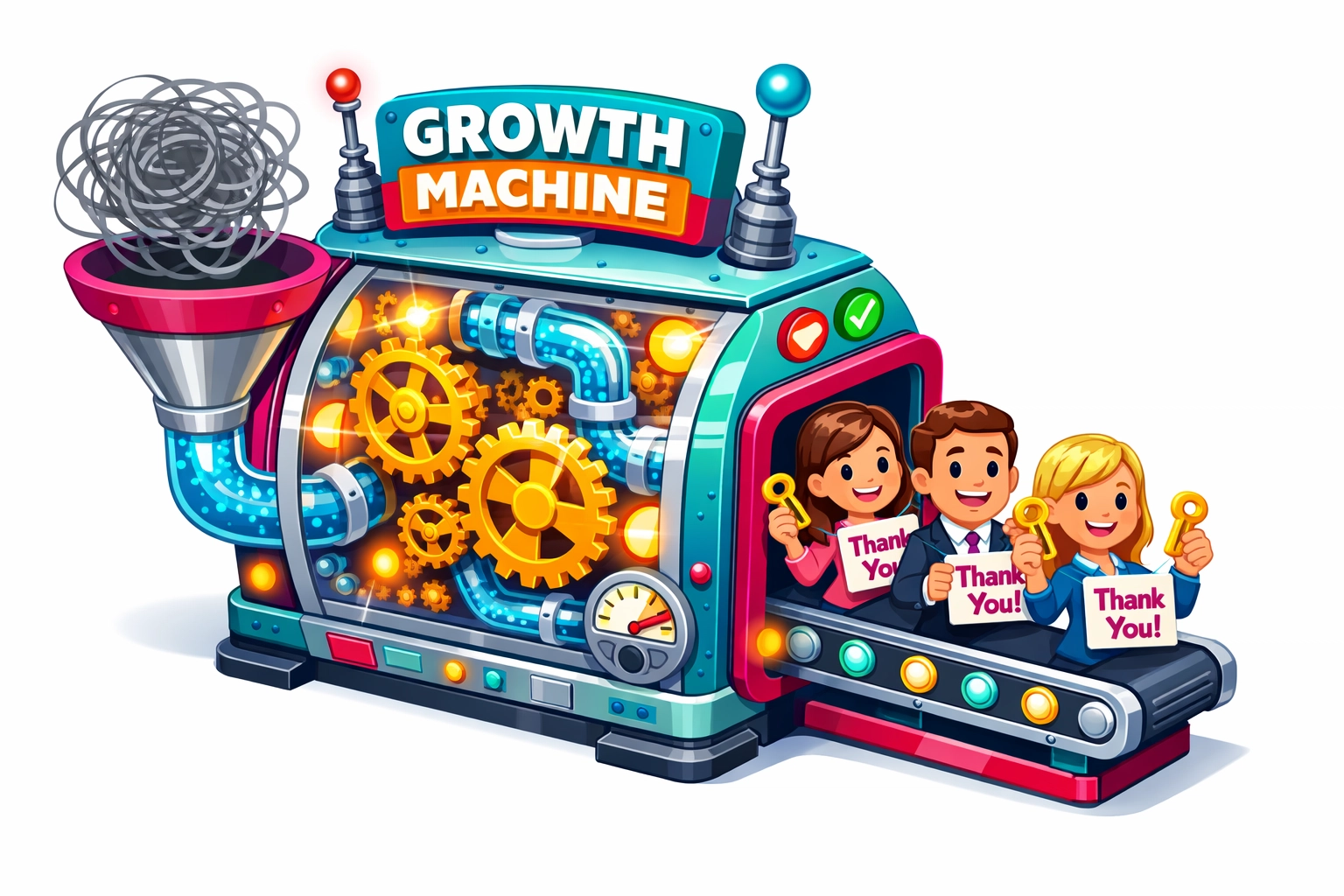
Building Your Predictable Growth Machine
So, how do you put this all together? It’s about moving from a "reactive" business to a "proactive" one.
- Audit Your Current Leakage: Spend a week tracking every enquiry. How long did it take to respond? How many calls were missed? What was the outcome? Use our 5-step framework to identify the gaps.
- Standardise the Experience: Every person who contacts your business should get the same high-quality response. This shouldn't depend on whether you’ve had your coffee or if you’re stuck in traffic on the M25.
- Invest in Handling, Not Just Leads: If you have £1,000 to spend on growth, don't put it all into ads. Put £600 into ads and £400 into a system that ensures those leads actually turn into customers. The ROI on improved response times is almost always higher than the ROI on more traffic.
- Educate Your Prospects: Use your website and your initial conversations to answer the questions they are afraid to ask. This reduces the friction in the sales process and filters out the time-wasters.
Why SMEs Struggle with This
Martyn Lenthall, our Director, often notes that SME owners feel they are the only ones who can talk to their customers. "Nobody knows my business like I do," is the common refrain. While that's true, you don't need a PhD in your business to answer the phone, qualify a lead, and book a consultation. In fact, being the "expert" often makes you too slow to respond because you're busy doing the expert work.
By separating "Enquiry Handling" from "Service Delivery," you create a scalable model. This is the secret to moving from a self-employed job to a growing company.
The Mathematics of Predictability
Let's look at the numbers. Imagine two businesses:
Business A (The Status Quo):
- Marketing Spend: £1,000
- Leads Generated: 100
- Response Time: 4 hours
- Conversion Rate: 10%
- Total Customers: 10
Business B (The Every Enquiry Model):
- Marketing Spend: £1,000
- Leads Generated: 100
- Response Time: < 2 minutes
- Conversion Rate: 25% (due to speed and professionalism)
- Total Customers: 25
Business B has 150% more customers for the exact same marketing spend. That is the power of mastering enquiry handling. It’s the difference between struggling to pay the bills and having the budget to hire more staff and expand. Check out our pricing to see how we can help you bridge this gap.
Final Thoughts
Predictable growth is not about finding a "magic" marketing channel. It is about respecting the interest you already have. If you treat every enquiry like it's the most important thing in your business (which, let’s be honest, it is), your conversion rates will soar, your reputation will grow, and your stress levels will drop.
Stop letting your hard-earned leads slip through your fingers. Focus on Visibility, master your Response, and the Conversion will follow.
Frequently Asked Questions
1. Why can't I just use a voicemail or an automated "we'll call you back" email?
Because your customers don't want a promise; they want progress. In a world where people expect instant answers, a voicemail is just a signal to call the next person on the list. An automated email is better than nothing, but it doesn't answer their specific questions or build a human connection.
2. Is a digital receptionist the same as enquiry management?
No. A digital receptionist usually just takes a name and a number. They are often reading from a generic script and don't understand your industry. Enquiry management is about qualifying the lead, answering initial questions based on your "They Ask, You Answer" content, and moving the prospect to the next stage of the sales funnel.
3. I’m a small business; can I really afford to outsource enquiry handling?
The real question is: can you afford not to? If missing just one or two decent jobs a month pays for the entire service, the system is essentially free. Most of our clients find that the increase in conversion pays for the service several times over.
4. Won't I lose the "personal touch" if I don't answer the phone myself?
Actually, the personal touch is often lost when you are stressed, busy, or shouting over the sound of a drill. A professional, calm, and helpful voice at the end of the line: one that represents your brand perfectly: is far more "personal" than a missed call or a rushed, distracted conversation.
5. How quickly can I see results from improving my response times?
Almost instantly. You will notice fewer "ghosted" enquiries and more booked appointments within the first week of implementing a rapid response system. Predictability starts the moment you take control of the lead journey.
6. What if my business is very technical?
We don't need to be technical experts to handle the enquiry. We need to be experts in customer service and lead qualification. We work with you to understand the "Big 5" questions your customers ask and ensure those are addressed correctly, before passing the qualified lead to you for the technical deep-dive.
7. How do I get started?
You can view our services to see which level of support fits your current business size, or simply contact us to discuss your specific challenges. We’re here to help you stop the leak and start the growth.