Let’s be honest for a moment. You’re likely spending a fair bit of money, or a huge amount of time, trying to get people to notice your business. You’ve got the website, maybe you’re running some ads, and you’re definitely posting on social media. But what happens when someone actually raises their hand and says, "I'm interested"?
In many UK small businesses, that’s where the wheels fall off.
A lead comes in via a contact form at 7:00 PM on a Tuesday. By the time you’ve finished on-site, grabbed some dinner, and sat down at your laptop on Wednesday afternoon, that lead has already called three of your competitors. Two didn't answer, but the third one did. They’ve booked the job. You’ve lost the race before you even knew you were running it.
At Every Enquiry, we see this every day. It’s not that you’re bad at your job; it’s that you don’t have a follow-up system.
In this guide, I’m going to break down exactly how to build a system that stops leads from slipping through the cracks. We’re going to follow a simple three-step framework: Visibility, Response, and Conversion.
Part 1: Visibility – Can You Even See Your Leads?
You can’t follow up on something you don’t know exists. For many SMEs, "leads" are a messy mix of WhatsApp messages, Instagram DMs, emails buried in a "Contact Us" folder, and missed calls on a mobile phone.
The Problem with Fragmented Enquiries
When your enquiries are scattered across five different platforms, you are guaranteed to miss someone. Perhaps you saw the Facebook message while you were at the supermarket, meant to reply later, and then forgot. That’s a lost opportunity.
According to research by Harvard Business Review, businesses that try to contact potential customers within an hour of receiving a query are nearly seven times as likely to have a meaningful conversation as those who wait even 60 minutes. But to do that, you need total visibility.
How to Fix Visibility
The first step in a professional follow-up system is centralisation. You need one place, ideally a CRM (Customer Relationship Management) tool, where every single enquiry lands.
Whether it's a phone call handled by a digital receptionist or a form fill on your website, it should all feed into one dashboard.

Part 2: Response – The 2-Minute Rule
Speed is your greatest sales tool. Period.
We talk a lot about the 2-minute rule. Why? Because in the digital age, consumers have zero patience. If they’re looking for a plumber, an accountant, or a landscaper, they are in "problem-solving mode." They want an answer now.
The Psychology of the Immediate Response
When you respond instantly, you signal three things to the customer:
- You are professional: You have your act together.
- You are available: You aren't too busy to care about them.
- You are reliable: If you’re this quick to reply, you’ll probably be just as good at the actual job.
If you can’t personally pick up the phone in two minutes because you’re actually doing the work, you need an automated response system. An immediate SMS or email acknowledging the enquiry can buy you the time you need.
“Hi [Name], thanks for getting in touch about [Service]. I’m currently on-site, but I’ve received your details and will give you a call at 4:00 PM today to discuss. Cheers, Martyn.”
That simple text stops them from calling the next person on Google. You can learn more about this in our framework on how to improve response times.
Part 3: Conversion – The Fortune is in the Follow-Up
This is where most businesses stop. They reply once, and if the customer doesn't book immediately, they give up.
Data shows that 80% of sales require five follow-up calls after the initial contact, yet 44% of sales reps give up after just one follow-up. In a small business, "sales rep" usually means "you."
The Multi-Channel Approach
A robust follow-up system uses multiple channels. People have preferences. Some love a phone call; others find them intrusive and prefer an SMS or an email. Your system should use all of them.
- Email: Great for sending over "They Ask, You Answer" style content (pricing guides, case studies, "what to expect" PDFs).
- SMS: Perfect for quick questions and appointment reminders. With a 90% read rate within three minutes, it’s the king of attention.
- Phone Calls: Still the best for building actual rapport and closing high-value deals.
Automation vs. Human Touch
You don’t want to sound like a robot. However, you can’t manually remember to email 50 different prospects every three days.
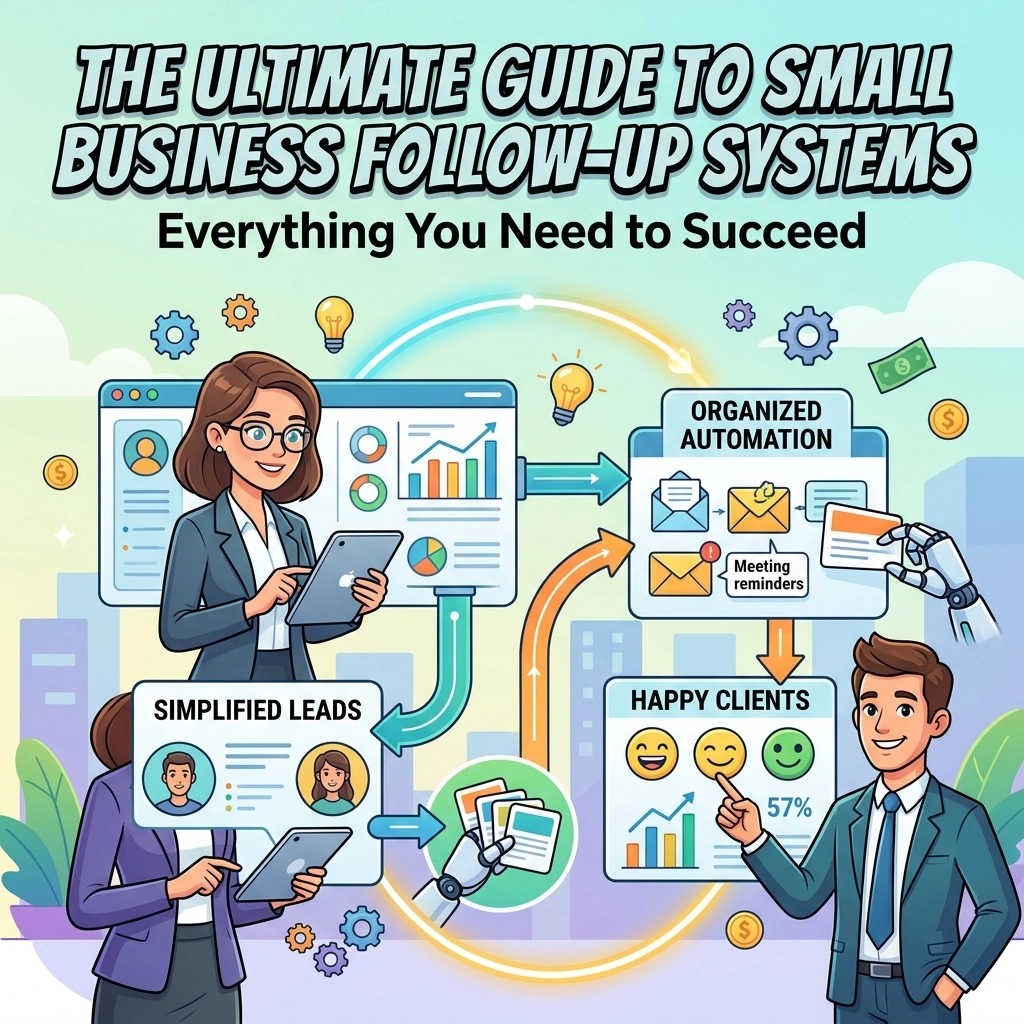
The secret is automated workflows with a personal tone. Set up a sequence that triggers as soon as a lead enters your system.
- Day 1: Immediate "Thanks" email + Personalised SMS.
- Day 2: Educational email (e.g., "5 things to check before hiring a [Your Profession]").
- Day 4: Phone call follow-up.
- Day 7: "Just checking in" email.

Comparison: Manual Follow-Up vs. Automated System
| Feature | Manual Follow-Up (The "In My Head" Method) | Every Enquiry Automated System |
|---|---|---|
| Speed of Response | Whenever you have a spare minute (usually hours/days later). | Instant (within seconds via SMS/Email). |
| Consistency | Highly variable. Depends on how busy you are. | 100% consistent. Every lead gets the same high-level care. |
| Lead Tracking | Post-it notes, spreadsheets, or memory. | Centralised CRM dashboard with full history. |
| Customer Experience | Can feel hit-or-miss or unprofessional. | Professional, attentive, and reliable. |
| Time Investment | Hours spent chasing and remembering who to call. | Set it once; it runs in the background. |
| Conversion Rate | Low (leads go cold quickly). | Significantly higher (persistent, helpful nurturing). |
Addressing the "They Ask, You Answer" Principles
In his book They Ask, You Answer, Marcus Sheridan argues that we must be the most transparent teachers in our industry. Your follow-up system shouldn't just be about "Are you ready to buy yet?" It should be about providing value.
"Will I be annoying my leads?"
This is the number one fear small business owners have. "I don't want to be a pushy salesman."
Here’s the truth: You only become annoying when you stop being helpful. If your follow-up is just "Buy from me, buy from me," then yes, it’s annoying. But if your follow-up is: "Hey, I know you were worried about the cost of [Service], so I wrote this guide explaining exactly what goes into our pricing," you aren't being annoying. You’re being a consultant.
"How much does a system like this cost?"
Transparency matters. Setting up a bespoke follow-up system involves software costs (CRM) and often management fees if you use a service like Every Enquiry. However, the real question is: What is it costing you NOT to have one?
If your average job is worth £1,000 and you’re losing just two leads a month because of poor follow-up, that’s £24,000 a year down the drain. Suddenly, a few hundred pounds a month for a managed service looks like the best investment you’ll ever make.
Step-by-Step: Building Your Follow-Up Machine
If you want to do this yourself, here is the blueprint:
1. Identify Your Triggers
What starts the process? Is it a form on your site? A message on Google My Business? List them all out. You need a way to capture these automatically.
2. Segment Your Leads
Not all leads are created equal. An "A-Tier" lead (someone ready to book now) needs a different follow-up than a "C-Tier" lead (someone just browsing for prices). Categorise them in your CRM so your messaging hits the mark.
3. Draft Your Templates
Write your follow-up emails and texts in advance. Keep them casual and "British." Use phrases you’d actually say in person. Avoid the "corporate speak" that makes people hit the delete button.
4. Layer Your Channels
Don't just rely on email. As mentioned in research from major CRMs, multi-channel marketing increases engagement by over 30%. Send the email, but follow it up with a text.
5. Review and Refine
Every six months, look at your data. Which email gets the most replies? Which step in your sequence is where people usually "drop off"? Adjust accordingly.

Why SMEs Struggle (And How to Stop)
The biggest hurdle isn't technology; it's the "busy trap." Small business owners wear too many hats. You’re the CEO, the technician, the bookkeeper, and the janitor.
This is why lead conversion isn't working for so many. You simply don't have the mental bandwidth to be a world-class salesperson at the same time as doing the work.
By implementing a structured system, you take the pressure off your brain. You don't have to "remember" to follow up because the system does it for you. This allows you to focus on the visibility of your brand and the actual delivery of your service, knowing the "middle bit", the enquiry handling, is bulletproof.
The Role of Every Enquiry
We built Every Enquiry because we saw too many great British businesses losing out to mediocre competitors who were simply faster on the draw.
We don't just give you a piece of software and wish you luck. We provide a full service that manages the response and conversion stages for you. From social media management that actually generates enquiries to the digital receptionists that answer them, we ensure your follow-up is flawless.
If you’re tired of seeing "missed call" notifications and wondering how much money just walked out the door, it’s time to move away from the "hope and pray" method of lead management.

Frequently Asked Questions
Isn't automation a bit impersonal?
It can be, but only if you write it that way. If your automation says "Dear Valued Customer, Your Enquiry #456 has been logged," then yes, it’s cold. But if it says "Hi John, it's Martyn from Every Enquiry. Just got your message: I'm tied up for the next hour but I'll ring you as soon as I'm free," it feels incredibly personal. The key is in the copywriting.
I’m a small one-man band; do I really need a "system"?
You need it more than the big companies do. A big company can afford to lose a few leads. For a small business, every enquiry is precious. A system acts as your virtual assistant, working 24/7 so you don't have to.
How many times should I follow up before giving up?
The "sweet spot" is usually between 5 and 7 touches over a two-week period. After that, you can move them to a long-term "nurture" list where you send a helpful email once a month. Never truly "give up" until they tell you to stop or they hire someone else.
Which is better: SMS or Email?
Both. SMS has higher open rates, but Email is better for sending detailed information and links. A good system uses both in tandem.
How long does it take to set up?
If you do it yourself, it can take weeks of fiddling with software. If you work with Every Enquiry, we can usually have your response system up and running in a matter of days.
Ready to stop losing leads?
Your business lives and dies by its ability to convert interest into income. Don't let a lack of a follow-up system be the reason you stay stuck. Whether you build it yourself or let us handle the heavy lifting, the most important step is to start today.
Check out our pricing or contact us to see how we can turn your enquiries into a consistent stream of loyal customers.