You’ve been there. It’s 7:00 PM on a Tuesday. You’re finally sitting down after a day of managing the team, handling site visits, or finishing off a complex report for a client. You check your inbox and see a list of enquiries from the last two weeks. Some you replied to, some you didn’t. Out of the ten people you actually sent quotes to, only two have signed off.
The other eight? They’ve gone "ghost."
In the world of SME service businesses, whether you’re a plumber in Preston or a solicitor in Solihull, those "dead" enquiries represent a massive hole in your bucket. You’ve already spent the money to get them there. You’ve paid for the Google Ads, the local SEO, or the social media management. To let them sit in your inbox without a fight is essentially burning cash.
At Every Enquiry, we talk to business owners every day who believe they have a "lead generation problem." Most of the time, they don't. They have a lead recovery problem.
This post is going to break down the exact framework we use to help SMEs stop losing leads and start converting the "no-responses" into loyal, paying customers. We’ll follow a simple path: Visibility, Response, and Conversion.
Why Leads "Die" (And Why They Aren’t Actually Dead)
Before we fix the problem, we need to be honest about why it happens. According to research by Harvard Business Review, the average response time for companies that responded within 30 days was 42 hours. Even worse, 23% of companies never responded at all.
In the SME world, "dead" leads usually happen for three reasons:
- Life got in the way: Your prospect enquired about a new boiler, but then their kid got sick, work got busy, and your quote got buried under 50 Groupon emails.
- Fear of the "Hard Sell": People hate being chased. If your follow-up feels like a desperate car salesman, they will retreat.
- Lack of Frictionless Communication: You called them while they were at work. They couldn't answer. You didn't leave a message or send a text, so the trail went cold.
The good news? These people still have the problem you can solve. They just need a nudge that doesn't feel like a shove.

Phase 1: Visibility – If You Can’t See It, You Can’t Recover It
The first step in our framework is Visibility. You cannot recover a lead if you don't know where it came from or exactly when it stopped moving through your sales funnel.
Most small firms track their "wins," but very few track their "silences." To build a recovery framework, you need a central place, a CRM or even a well-managed spreadsheet, that logs every single enquiry.
The "Leak" Audit
Ask yourself these questions:
- How many enquiries did we get last month?
- How many received a quote within 24 hours?
- How many of those quotes were followed up more than twice?
If you don't have these numbers, you’re flying blind. Improving visibility means knowing that "Mrs. Smith enquired via the website on Monday, I sent a quote Tuesday, and I haven't heard back since."
By integrating your digital marketing efforts with a clear tracking system, you can see which channels (Google, Facebook, Organic) produce the most "ghosts." Often, you’ll find that leads from certain sources require a different recovery approach. For example, a Facebook lead is usually earlier in the buying journey than someone searching "emergency electrician near me" on Google.
Phase 2: Response – The "Speed to Quality" Balance
We’ve all heard that you need to respond to a lead in five minutes. While speed is important, for an SME, it’s often impossible to be that fast while actually doing the work. This is where most businesses give up. They think, "Well, I couldn't call them back for four hours, so they’ve probably gone elsewhere."
Stop that.
The recovery framework starts with the second and third response. If you missed the five-minute window, your goal shifts from "Speed to Lead" to "Value of Response."
The Multi-Channel Poke
People have different communication preferences. If you only call, you’ll miss the person who hates the phone. If you only email, you’ll end up in the "Promotions" tab.
A structured response system uses a mix:
- The Immediate Acknowledgement: An automated (but friendly) text or email saying, "Got your enquiry! I’m on a job right now, but I’ll look at this by 4 PM." This sets expectations.
- The Video Quote: Instead of a dry PDF, send a 60-second Loom video explaining the quote. It builds massive trust.
- The SMS Follow-up: "Hi [Name], just checking you got that quote okay? No pressure, just didn't want it to get lost in your spam!"

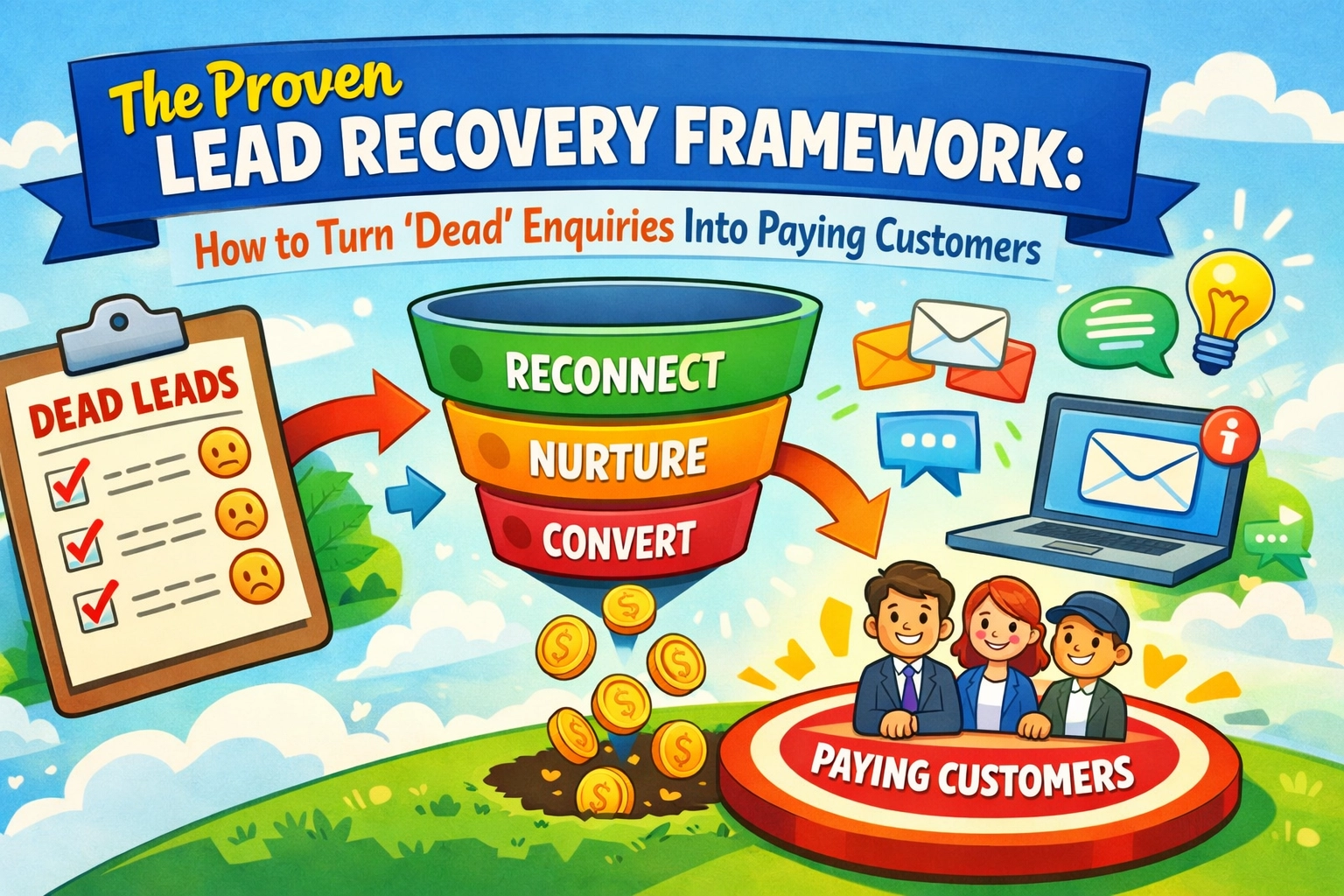
Phase 3: Conversion – The 5-Step Lead Recovery Framework
Now we get to the meat of the matter. How do you actually get a "dead" lead to say yes? We use a framework based on Marcus Sheridan’s "They Ask, You Answer" principles. It’s about being the teacher, not the hunter.
Step 1: Categorise Your "Cold" Leads
Don't treat all non-responders the same.
- The "Price Checkers": They asked for a price and vanished.
- The "Deep Researchers": They asked lots of technical questions then went quiet.
- The "Life Happened" Group: They were keen, then suddenly stopped.
Step 2: The "Help, Don't Sell" Email
Seven days after silence, send an email that isn't about the sale.
- Subject: A quick tip for your [Project Name]
- Body: "Hi [Name], I noticed we haven't touched base on the quote yet. While you’re thinking it over, I thought this guide we wrote on [Relevant Topic, e.g., '5 things to check before hiring a roofer'] might help you avoid some common mistakes. Hope it helps!"
This positions you as an expert, not a nuisance. Check out our blog section for ideas on what kind of helpful content you can share.
Step 3: Address the Elephant in the Room (The Fear)
Why haven't they replied? Usually, it's because of a fear. Fear that you're too expensive, fear the job is too big, or fear they’ll be ripped off.
Directness works. Send a message saying: "Usually when I don't hear back, it's because the price was higher than expected or the timing isn't right. If it's the price, I’m happy to look at different options to bring the cost down. If it's the timing, just let me know and I’ll stop bothering you!"
Step 4: The Comparison Table
Sometimes, people haven't replied because they are trying to compare you with three other quotes and they're confused. Do the work for them.
| Feature | The "Cheap" Option | The Every Enquiry Way (Structured) |
|---|---|---|
| Response Time | 3-5 Days | Under 24 Hours |
| Follow-up | None (You have to chase them) | Proactive & Scheduled |
| Transparency | Hidden costs in small print | All-in pricing, no surprises |
| Communication | Ghosting when things get tough | Constant updates via SMS/Email |
| Post-Job Support | Non-existent | 12-month guarantee & check-ins |
By showing them how to compare service providers, you empower them to make a decision (ideally for you).
Step 5: The "Permission to Close" (The Break-up)
If it’s been 30 days and no response, it’s time for the break-up. This is often the most successful email in the whole framework.
- Subject: Permission to close your file?
- Body: "Hi [Name], I haven't heard back regarding the [Service], so I’m assuming your priorities have shifted or you’ve gone in a different direction. I’m going to close your enquiry file now so I don't keep cluttering your inbox. If you ever need us in the future, you know where we are."
This triggers a "loss aversion" response. Many people will reply with, "Wait! No, I still want to do it, I’ve just been busy!"
Integrating Recovery into Your Business
You might be thinking, "Martyn, this sounds like a lot of work." You’re right. Doing this manually for every lead is a full-time job. This is why Every Enquiry focuses on building systems that do the heavy lifting for you.
From website optimization that captures better data to automated follow-up sequences that use your voice, the goal is to make lead recovery "set and forget."
If you want to see how we price these systems to fit an SME budget, take a look at our pricing page.

Stop Focusing on "More" and Start Focusing on "Better"
The biggest mistake SMEs make in digital marketing is thinking they need more traffic. If your website is currently converting 2% of visitors, and you double your traffic, you still have a 98% failure rate.
If you implement a lead recovery framework, you are essentially picking up the "discarded" leads and giving them a second chance to buy. It is the cheapest, most effective way to grow your revenue without increasing your ad spend.
As Marcus Sheridan says, "They Ask, You Answer." Your customers are asking for help, even when they’re silent. They’re asking for a sign that you’re professional, that you’re persistent without being annoying, and that you actually care about their project.
External Resources for Further Learning
- The Psychology of Following Up (Forbes) – Understanding why persistence pays off.
- Customer Reactivation Strategies (Marketing Week) – Professional insights into winning back dormant clients.
- Salesforce Research on Lead Management – Data-driven reasons to formalize your enquiry handling.
Frequently Asked Questions (FAQ)
1. Won't I annoy people if I keep following up?
Not if you provide value. If you just call to ask "Are you ready to pay yet?", you are annoying. If you send a helpful article, a video explanation, or a "break-up" email that respects their time, you are being a professional. Most people appreciate the persistence because it shows you actually want the work.
2. How many times should I follow up before giving up?
Our framework suggests a minimum of five "touches" over 30 days. Most sales happen between the 5th and 12th contact, yet most SMEs stop after one or two. By the fifth touch, you’ve outlasted 90% of your competitors.
3. I’m too busy to do this. How can I automate it?
You can use tools like HubSpot or specialized SME platforms that trigger emails and texts based on where the lead is in your funnel. We specialize in setting these up so they feel personal rather than "robotic." Check out our conversion services for more info.
4. What if they’ve already chosen a competitor?
That’s fine! The "Break-up" email will often prompt them to tell you that. It allows you to clean your list and maybe even ask why they chose someone else. That feedback is gold for your business.
5. Does this work for "old" leads from months ago?
Yes. You can run a "Reactivation Campaign." Send a bulk email to everyone who didn't buy in the last six months with a specific "Welcome Back" offer or a simple "Are you still looking to get [Problem] fixed?" You’d be surprised how many people just procrastinated for six months.
6. What is the most important part of the framework?
Visibility. If you don't know who hasn't replied, you can't help them. Start by tracking every "no" as carefully as you track every "yes."
Ready to stop losing leads?
If you’re tired of seeing potential profit slip through the cracks, it’s time to change how you handle your enquiries. At Every Enquiry, we don’t just get you clicks; we help you build a system that converts.
Contact us today or read our post on 10 reasons your lead conversion isn't working to find out how we can help your business grow.