If you are running a small to medium-sized service business in the UK, you probably think your biggest problem is "not enough leads." You spend money on SEO, you dabble in Facebook ads, and you might even pay a local agency to keep your social media ticking over. But here is a hard truth we see every day at Every Enquiry: most businesses don’t have a lead generation problem. They have an enquiry handling problem.
Think about the last three people who messaged your business or called while you were on a job. Do you know exactly where they are in your sales process? Did they get an answer within five minutes, or did they wait four hours until you finished your lunch?
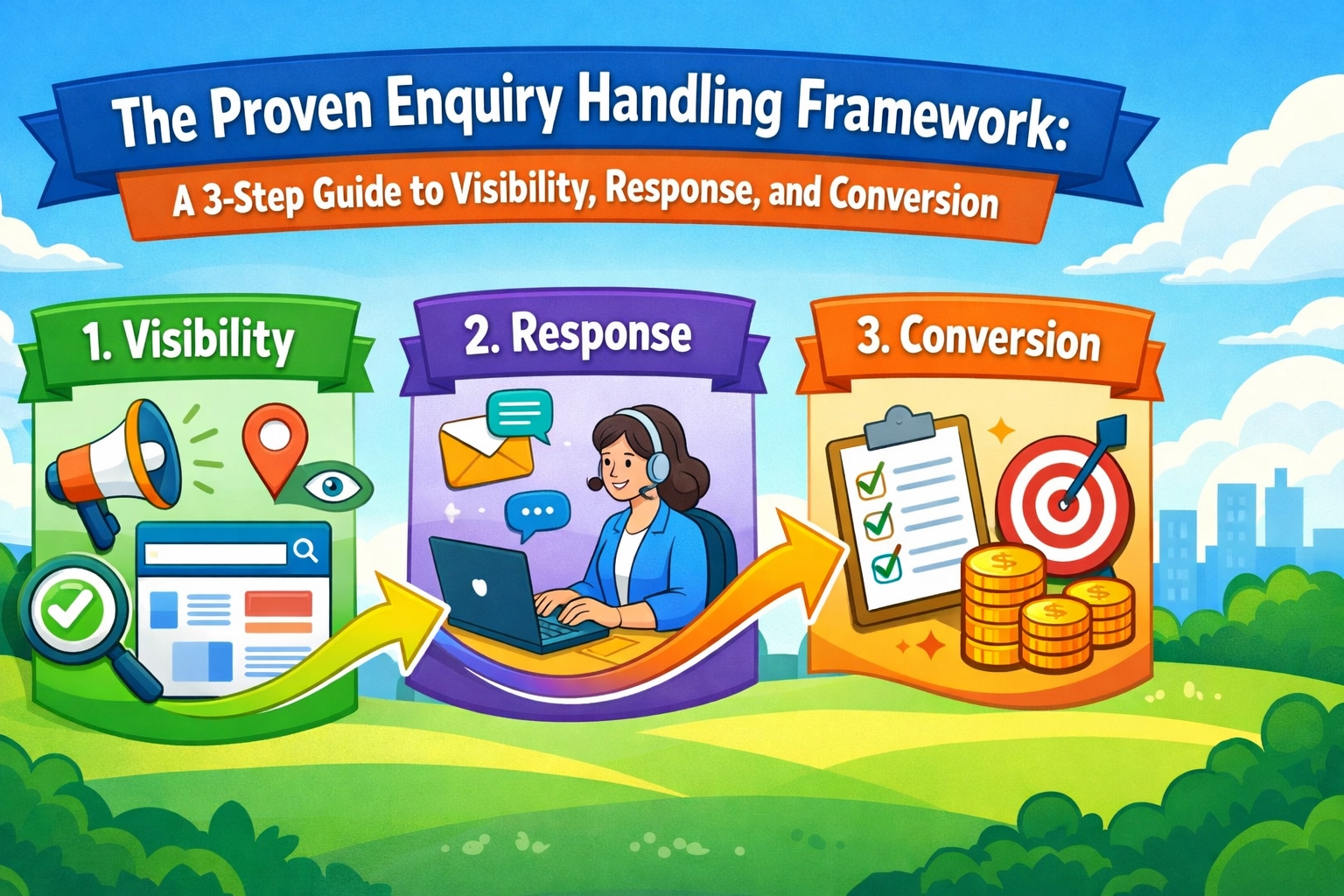
In the digital age, silence is a deal-killer. If you aren't visible, responsive, and focused on conversion, you are essentially throwing your marketing budget into a black hole. We’ve developed a 3-step framework, Visibility, Response, and Conversion, designed to stop the leaks and start growing your business predictably. This isn't about fancy software; it’s about a system that works even when you are busy on-site or in meetings.
Pillar 1: Visibility – You Can’t Fix What You Can’t See
Most SME owners manage their enquiries through a chaotic mix of WhatsApp messages, "unread" emails in an Outlook inbox, and scribbled notes on the back of a cigarette packet (or a very messy desk). This is the "Post-it Note Trap."
When your leads are scattered, you have zero visibility. You don't know your conversion rate, you don't know which marketing channel is actually making you money, and you certainly don't know how many thousands of pounds are sitting in your "ghosted" pile.
Identifying the Leaky Bucket
The first step in our framework is gaining absolute clarity. You need to see the entire journey of a prospect. According to Marcus Sheridan’s "They Ask, You Answer", buyers today want to do about 70% of their research before they even talk to you. If you don't have visibility into what they are asking and where they are dropping off, you are flying blind.
To gain visibility, you need to track:
- Total Enquiries: Every single person who reached out.
- Source: Did they come from Google, Facebook, or a referral?
- Quote Value: What is the potential revenue of these enquiries?
- Status: Are they quoted, waiting for a callback, or have they gone quiet?
Without this data, you are making emotional decisions about your business rather than logical ones. We often find that when businesses implement better visibility systems, they realise they already have enough leads to double their turnover, they just weren't closing them.

Pillar 2: Response – The Speed-to-Lead Game
Once you can see your leads, you have to talk to them. And you have to do it fast.
The "Speed-to-Lead" concept is backed by heavy-duty data. Research published in the Harvard Business Review suggests that businesses that try to contact potential customers within an hour of receiving a query are nearly seven times as likely to have a meaningful conversation as those who wait even sixty minutes.
If you wait 24 hours? Forget it. They’ve already booked your competitor.
The Systematic Re-engagement Sequence
At Every Enquiry, we don't believe in generic "just checking in" emails. Those are annoying and offer zero value. Instead, we use a Value-First Sequence. This is a 30-day systematic approach to improving response times and keeping the conversation alive without being "salesy."
- Day 1: Immediate Phone Call + Text. Catch them while the problem is fresh in their mind. If they don't answer the phone, send a text. People read texts; they ignore voicemails.
- Day 3: The Helpful Resource. Send an email that answers a common question. For example, "How much should a kitchen renovation cost in 2026?" Link to a blog post or a video.
- Day 7: The Social Proof. Share a quick photo or a story of a recent project similar to theirs. Show them you can do the work.
- Day 14: The Multi-Channel Nudge. Try a different platform. Maybe a quick LinkedIn message or a voice note if appropriate for your industry.
- Day 21: The Simple Question. Ask one closed question. "Are you still looking to get that boiler replaced before April?"
- Day 30: The Break-Up. This is the "Permission to Close" email. Tell them you’re closing their file so you don't clutter their inbox. Ironically, this often gets the highest response rate.
By staying helpful and visible for 30 days, you become the "safe" choice. Most of your competitors gave up after one phone call. You are the one who stayed professional and persistent. You can learn more about why prompt responses are key to acquisition here.

Pillar 3: Conversion – Turning Conversations into Cash
Conversion isn't just about getting a "yes." It's about a clear outcome for every enquiry. In our framework, an enquiry only leaves the system when it hits one of three markers:
- A Sale: Great, the job is booked.
- A "Not Now": They have a valid reason to delay (budget, planning permission, etc.). We move them to a long-term nurture list.
- A "No": They went with someone else or changed their mind.
The biggest mistake SMEs make is leaving enquiries in "limbo." Limbo is where profit goes to die. If a lead hasn't responded in 30 days and you've followed the sequence, you must move them out of your active pipeline.
Maximising Every Outcome
Even a "no" is valuable for conversion optimization. If they went with a competitor, ask why. Was it price? Was it because the competitor offered a 10-year guarantee while you only offered 5? This data is gold. It tells you exactly how to change your marketing and sales pitch to win the next one.
We often talk about the hidden cost of missed enquiries. If your average job is £2,000 and you miss just two calls a week, you are losing over £200,000 a year in potential revenue. When you look at it that way, a proper enquiry handling framework isn't an "expense", it's the most profitable investment you can make.
Comparison: The Chaos Method vs. The Every Enquiry Framework
To help you understand the difference, let’s look at how most businesses operate compared to a business using a structured framework.
| Feature | The "Chaos" Method (Standard SME) | The Every Enquiry Framework |
|---|---|---|
| Lead Tracking | Post-its, memory, and unread emails. | Centralised dashboard with 100% visibility. |
| Initial Response | "When I get a minute" (usually 4-24 hours). | Under 5 minutes (Automated or Managed). |
| Follow-up | One callback, maybe an email. | 30-day value-based nurture sequence. |
| Data Usage | "I think we're doing okay." | Conversion rates and ROI tracked per channel. |
| Customer Perception | Unreliable or "too busy" for new work. | Professional, helpful, and authoritative. |
| Predictability | Feast or famine. | Stable, predictable growth. |
Why a "Digital Receptionist" Isn't Enough
Many businesses try to solve the response problem by hiring a simple call-answering service. While having someone answer the phone is better than a busy tone, it’s only 10% of the solution.
A digital receptionist takes a message. They don't handle the enquiry. They don't nurture the lead. They don't send out the "They Ask, You Answer" style content that builds trust. At Every Enquiry, we believe in Enquiry Management, not just answering phones. Our services are built to bridge the gap between a stranger clicking your website and a happy customer paying an invoice.

Implementing the "They Ask, You Answer" Principle
Marcus Sheridan’s philosophy is simple: if your customers are asking it, you should be answering it on your website. This plays a massive role in your visibility and conversion.
When a lead comes in, they usually have fears.
- "Will this be a mess?"
- "Are they going to rip me off?"
- "How long will it actually take?"
Your enquiry handling framework should address these fears immediately. Instead of a boring "Thanks for your enquiry" email, send them a "What to Expect on Our First Visit" guide. By being transparent and educational, you eliminate the friction that stops people from buying. You aren't just another contractor or service provider; you are an expert advisor.
The Cost of Doing Nothing
If you continue to manage your leads the way you are right now, where will you be in twelve months? Probably in the same place, stressed, wondering why the phone isn't ringing more, and frustrated that your marketing spend isn't "working."
The reality is that your marketing probably is working, but your lead conversion system isn't. By focusing on Visibility, Response, and Conversion, you stop the leak. You start to see every enquiry as a valuable asset that deserves a professional, systematic process.

Final Thoughts from Every Enquiry
Building a predictable business doesn't happen by accident. It happens by design. Whether you are a plumber in Manchester or a consultant in London, the rules of the game are the same: the business that responds the fastest and provides the most value wins.
Ready to see how we can help you implement this framework? Check out our pricing or get in touch today. Let's stop the ghosting and start the growing.
Frequently Asked Questions (FAQ)
1. I’m a one-man band; how can I respond in five minutes while I’m working?
This is the most common challenge for SMEs. You can't be on the tools and on the phone at the same time. This is where automation and managed services come in. You can use automated SMS replies to acknowledge the enquiry instantly, or better yet, use a service like Every Enquiry to manage the initial touchpoints for you.
2. Is 30 days of follow-up too much? Won’t I annoy people?
If you are calling them every day saying "Do you want to buy yet?", then yes, you will annoy them. But if you are sending helpful resources, answering their questions, and providing social proof, you aren't being annoying: you're being helpful. Remember, people are busy. Often they want to hire you, they just got distracted by life.
3. We get most of our leads from word-of-mouth. Do we still need this?
Absolutely. Even a referral will check your website and likely message you. If a friend recommends you, but you take three days to reply, that trust starts to erode. A framework ensures that your hard-earned reputation for quality work is matched by a professional enquiry experience.
4. What is the "Break-up" email, and why does it work?
The "Break-up" email is a short, professional note saying something like: "I haven't heard back from you regarding the [Project Name], so I've gone ahead and closed your enquiry for now to keep our files tidy. If you need anything in the future, feel free to reach out." This works because of "loss aversion." People don't like doors being closed on them. If they were just being slow, this usually prompts an immediate "Wait, I'm still interested!" reply.
5. How much does it cost to fix my enquiry handling?
The real question is: how much is it costing you not to fix it? Most businesses are losing thousands of pounds every month in missed opportunities. We offer various pricing tiers designed to fit different sizes of service businesses, from small local firms to larger regional companies.
6. Can I just use a CRM to do this?
A CRM is a tool, not a framework. A CRM is the "Visibility" part, but it won't do the "Response" or "Conversion" for you unless you have the systems and content to plug into it. We help you build the system that makes the CRM actually useful.
7. Does this framework work for social media enquiries too?
Yes. Whether it's a DM on Instagram or a message on Facebook, the principles are identical. In fact, social media management is more than just updates; it's about being responsive where your customers are. Our framework integrates all channels into one visible stream.