Let’s be honest for a second. Most small business owners in the UK are working themselves into the ground. You’re likely spending a small fortune on Google Ads, shouting into the void on LinkedIn, and making sure your van looks pristine. You’re getting the visibility. People are seeing your name. But then, something goes wrong.
The phone rings while you’re on a job, and it goes to voicemail. An email lands in your inbox at 2:00 PM on a Tuesday, and you don’t reply until Thursday night. Or worse, you spend three days trading messages with a "lead" who eventually tells you they only have a budget of fifty quid for a three-thousand-pound job.
It’s frustrating, isn't it? You’re doing the "marketing," but the bank balance isn't reflecting the effort.
At Every Enquiry, we see this every single day. We specialise in helping service-based SMEs bridge the gap between being "seen" and being "hired." The truth is, most businesses don’t have a lead generation problem; they have a lead conversion problem.
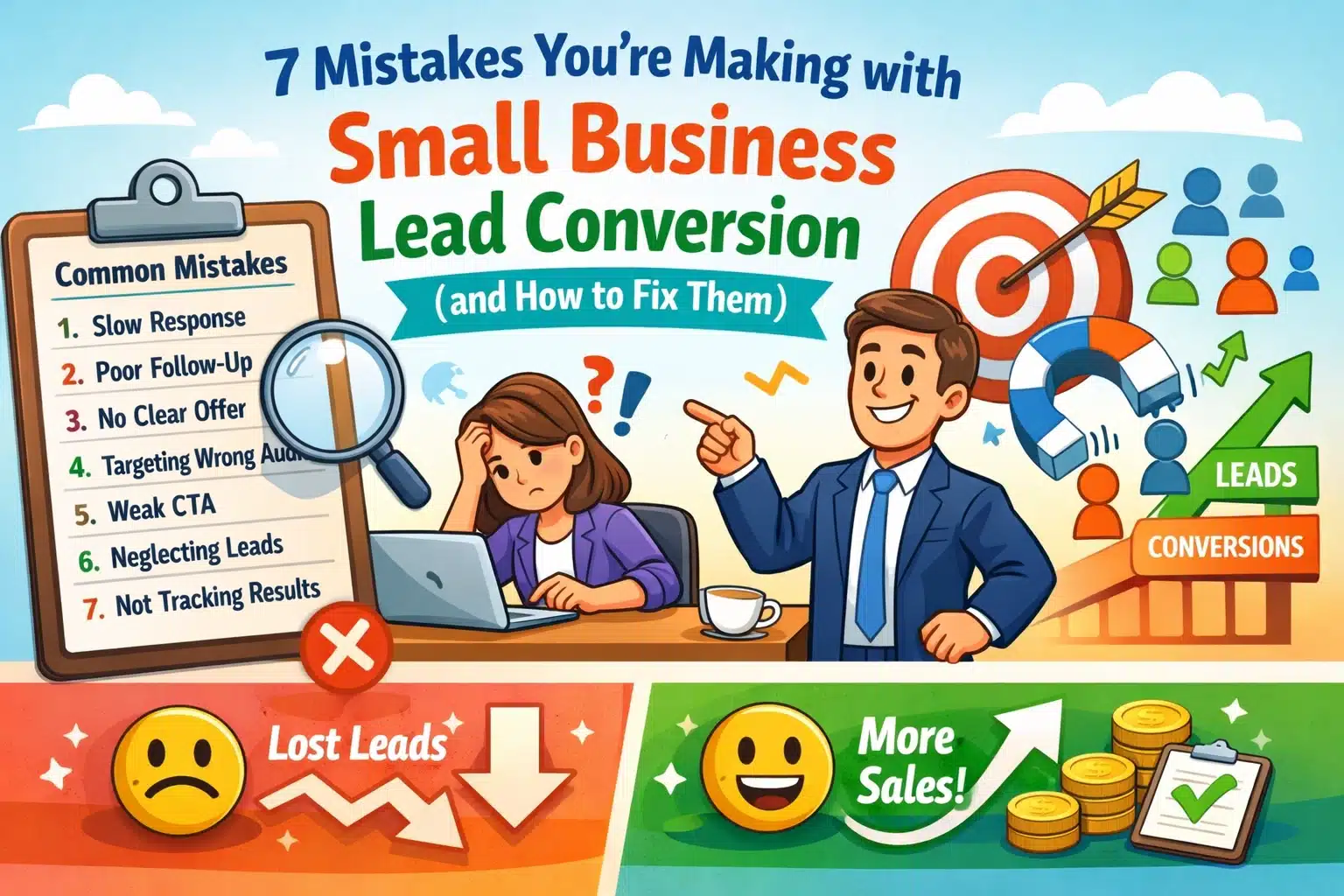
In this guide, I’m going to walk you through the seven most common mistakes we see small businesses making. More importantly, I’m going to show you how to fix them using our core framework: Visibility -> Response -> Conversion.
1. The "Cast a Wide Net" Trap (Visibility)
One of the biggest mistakes you can make is trying to be everything to everyone. I get it: when you’re growing, you don’t want to turn down work. But by trying to appeal to "anyone who needs a plumber" or "any business that needs IT support," you end up appealing to no one.
Vague messaging leads to unqualified leads. If your website says, "We do all types of building work," you are going to get calls for everything from a leaky tap to a full house extension. This wastes your time and your team's time.
The Fix: Define Your Ideal Customer Profile (ICP)
You need to be brave enough to say who you don't work with. According to HubSpot’s research on buyer personas, targeted marketing is significantly more effective than "spray and pray" tactics.
Ask yourself:
- Who do we serve best?
- What specific problem do we solve better than anyone else?
- What is the minimum project value we’re willing to take on?
When your visibility is focused on the right people, your conversion rate naturally climbs because you’re talking to people who actually want what you’ve got. Check out our thoughts on social media management to see how targeted content beats generic posting every time.

2. Prioritising Quantity Over Quality (Visibility)
There is a weird obsession in the digital marketing world with "number of leads." Agencies love to send reports saying, "We got you 100 leads this month!"
But if 95 of those leads are "tyre kickers" or people who didn't realise you’re based in Manchester and not Milton Keynes, those leads are actually a liability. They cost you time to filter, and they demotivate you.
The Fix: Quality Filters
Don’t be afraid to put a few hurdles in the way. Use lead scoring or filter questions on your contact forms. If you’re a high-end landscaping business, ask for their estimated budget on the form. If they select "Under £5,000," you can automatically send them an email explaining your services start at £10,000, but here’s a helpful DIY guide.
This protects your time for the "Gold" leads. This is a core part of our visibility strategy: ensuring the traffic you get is the traffic that converts.
3. The "Ghosting" Mistake: Slow Response Times (Response)
This is the big one. If you take away only one thing from this article, let it be this: Speed to lead is the single most important factor in modern conversion.
We live in an era of "I want it now." If a prospect searches for a service, finds three companies, and calls the first one but gets no answer, they don’t wait. They call the second one. If that person answers, they’ve likely won the job before the first person has even checked their voicemail.
Research from the Harvard Business Review shows that businesses that attempt to reach out to leads within an hour are seven times more likely to have a meaningful conversation than those who wait even sixty minutes. If you wait 24 hours? You might as well not bother.
The Fix: An Enquiry Management System
You cannot rely on your own memory or your ability to answer the phone while you’re in a meeting. You need a system. This might be a digital receptionist, an automated "we’ve received your enquiry" SMS, or a dedicated response management service like the one we provide.
The goal is to let the customer know they’ve been heard immediately. Even an automated text saying, "Hi [Name], thanks for the enquiry! I'm on-site right now but will call you at 4:00 PM today. Does that work?" is enough to stop them from calling your competitor.
For more on this, read our framework on improving response times.
4. Treating Your Website Like a Brochure (Conversion)
Most small business websites are "ego trips." They have big pictures of the owner, a list of services, and a "Contact Us" page that looks like it was designed in 2008.
A brochure tells people who you are. A conversion tool tells people how you solve their problem.
According to Stanford University research, 75% of users judge a company’s credibility based on their website design. If your site looks unprofessional or is hard to navigate, you are losing leads before they even reach out.
The Fix: The "They Ask, You Answer" Approach
Incorporate Marcus Sheridan’s principles. Your website should be a library of answers.
- How much does your service cost? (Be honest!)
- What are the common problems with your industry?
- How do you compare to competitors?
When you answer the questions your customers are actually asking, you build trust. Trust is the currency of conversion. You can see how we apply this on our pricing page: we don't hide behind "call for a quote" for everything.

5. Lacking a Clear Call to Action (CTA) (Conversion)
You’d be amazed at how many websites expect the customer to do the hard work. If I have to hunt for your phone number or guess which "Contact" link to click, I’m leaving.
A "Call to Action" isn't just a button; it’s a direction. "Click here" is rubbish. "Book Your Free 15-Minute Consultation" is a promise of value.
The Fix: One Primary Action per Page
Every page on your site should have one clear goal.
- Blog post? Subscribe or download a guide.
- Service page? Request a quote.
- Home page? Schedule a call.
Make your CTAs stand out visually. Don't bury them in the footer. If you’re not sure why your current site isn't working, check out our 10 reasons your lead conversion isn't working.
6. Not Offering Value Upfront (Conversion)
In the service industry, there is often a "high barrier to entry." You’re asking someone to potentially spend thousands of pounds with a stranger. If your only offer is "Buy Now" or "Get a Quote," you’re missing out on the 90% of people who are "just looking" but will be ready to buy in three months.
The Fix: Lead Magnets and Education
Give them something for free that proves you know your stuff.
- A "Budgeting Guide for Home Extensions."
- A "Checklist for Moving Offices."
- A "5-Minute Video on How to Save 20% on Your Energy Bills."
By providing value upfront, you position yourself as the authority. When they are ready to pull the trigger, you are the only person they’ll call. This is the "Conversion" part of our Conversion framework.
7. The Referral Trap (Visibility)
"We get all our work through word of mouth." I hear this all the time. While referrals are great: they are the highest converting leads: they are also unpredictable.
You cannot scale a business on "hope." If the referrals stop for a month, your revenue drops to zero. Relying on one source of traffic is dangerous.
The Fix: Diversify Your Channels
You need a mix of:
- Owned Media: Your website and email list.
- Earned Media: Referrals and reviews.
- Paid Media: Google Ads or Social Ads.
A healthy business has multiple "taps" it can turn on and off. If you have a quiet month, you should be able to increase your ad spend or send an email campaign to your list to drum up business.
Comparison: Lead Handling Methods
When it comes to fixing these mistakes, you have a few options. Here is how they stack up for a typical UK service business.
| Feature | DIY (Owner Managed) | Virtual Assistant (VA) | Every Enquiry Managed System |
|---|---|---|---|
| Response Time | Slow (depends on workload) | Moderate (working hours) | Instant / Near-Instant |
| Lead Quality | High (you know your stuff) | Low to Moderate | High (Custom Filters) |
| Cost | "Free" (but high opportunity cost) | £15 – £30 per hour | Predictable Monthly Fee |
| Consistency | Poor | Variable | 100% Consistent |
| Scalability | Zero | Limited | High |
| Follow-up | Often forgotten | Manual | Automated & Tracked |

The Cost of Doing Nothing
Let’s look at the maths. If your average job is worth £2,000, and you miss just two calls a week because you're busy, that’s £4,000 a week in lost potential revenue. Over a year, that is over £200,000.
Most small businesses are "leaky buckets." You’re pouring money into marketing (Visibility), but the leads are leaking out through slow response times and poor follow-up.
By fixing these seven mistakes, you aren't just getting "more leads": you're making more money from the leads you already have. That is the most efficient way to grow.
If you’re ready to stop the leaks, we’re here to help. From initial visibility to managing the response and final conversion, we’ve built a system designed specifically for SMEs who are tired of missing out.
Frequently Asked Questions (FAQ)
1. I’m a one-man band; how can I respond instantly?
You don't necessarily have to pick up the phone yourself every time. Using automated SMS replies ("I'm on a job, I'll call you at X time") or a dedicated call handling service ensures the customer feels acknowledged immediately. The goal is to stop them from calling the next person on Google.
2. Is "Lead Scoring" too complex for a small business?
Not at all. It can be as simple as a dropdown menu on your contact form asking, "When are you looking to start?" or "What is your estimated budget?". Those who select "Immediately" and have a "High" budget get a phone call within 5 minutes. Others get an automated email.
3. Why shouldn't I just hire a cheap VA from overseas?
While VAs can be great for admin, lead conversion requires a deep understanding of your local market and high-level English communication skills (especially for UK service businesses). There’s also the time zone issue. A lead that comes in at 9:00 AM GMT needs a response by 9:05 AM GMT, not when the VA starts their shift.
4. How much should I spend on lead conversion vs. lead generation?
In our experience, most SMEs spend 90% on generation (Ads, SEO) and 10% on conversion (Website, Response). We recommend moving toward a 60/40 split. There is no point in buying more leads if you are already failing to convert the ones you have.
5. My industry is "different": does this still apply?
Whether you are a lawyer, a plumber, or an IT consultant, human psychology remains the same. People want to feel heard, they want their problems solved, and they generally hire the person who makes the process easiest. These principles are universal.
6. What is the "They Ask, You Answer" principle?
It’s a philosophy developed by Marcus Sheridan. It posits that the most successful businesses are the ones that are the most transparent. If you answer every question a customer has: including the uncomfortable ones about price and competition: you become the trusted authority in your space.
7. How do I know if Every Enquiry is right for me?
If you are generating enquiries but struggling to keep up with them, or if you feel like your marketing spend isn't resulting in enough "booked" jobs, then we should talk. We focus on the middle and end of the funnel: ensuring your visibility actually turns into revenue. You can contact us here to find out more.
Ready to turn your enquiries into outcomes?
Stop letting your hard-earned leads go to waste. Explore our services or check out our pricing to see how we can help you build a predictable growth engine for your small business. Cheers for reading!