Let’s be honest for a second. Most SME owners are running on a treadmill that’s set just a little too fast. You’re spending money on Google Ads, you’re posting on LinkedIn, and you’re probably even trying to "do" SEO. But at the end of the month, the bank balance doesn't always reflect the amount of sweat you’ve put in.
The problem usually isn't a lack of effort. It’s a leaky bucket. You’re pouring leads into the top of your business, but they’re trickling out through the cracks before they ever reach your bottom line. If you want to stop the "feast or famine" cycle, you don't need more "hacks." You need a predictable business growth framework.
At Every Enquiry, we live and breathe this stuff. We see service businesses every day that are one or two tweaks away from doubling their revenue, simply by fixing how they handle the people who are already trying to give them money.
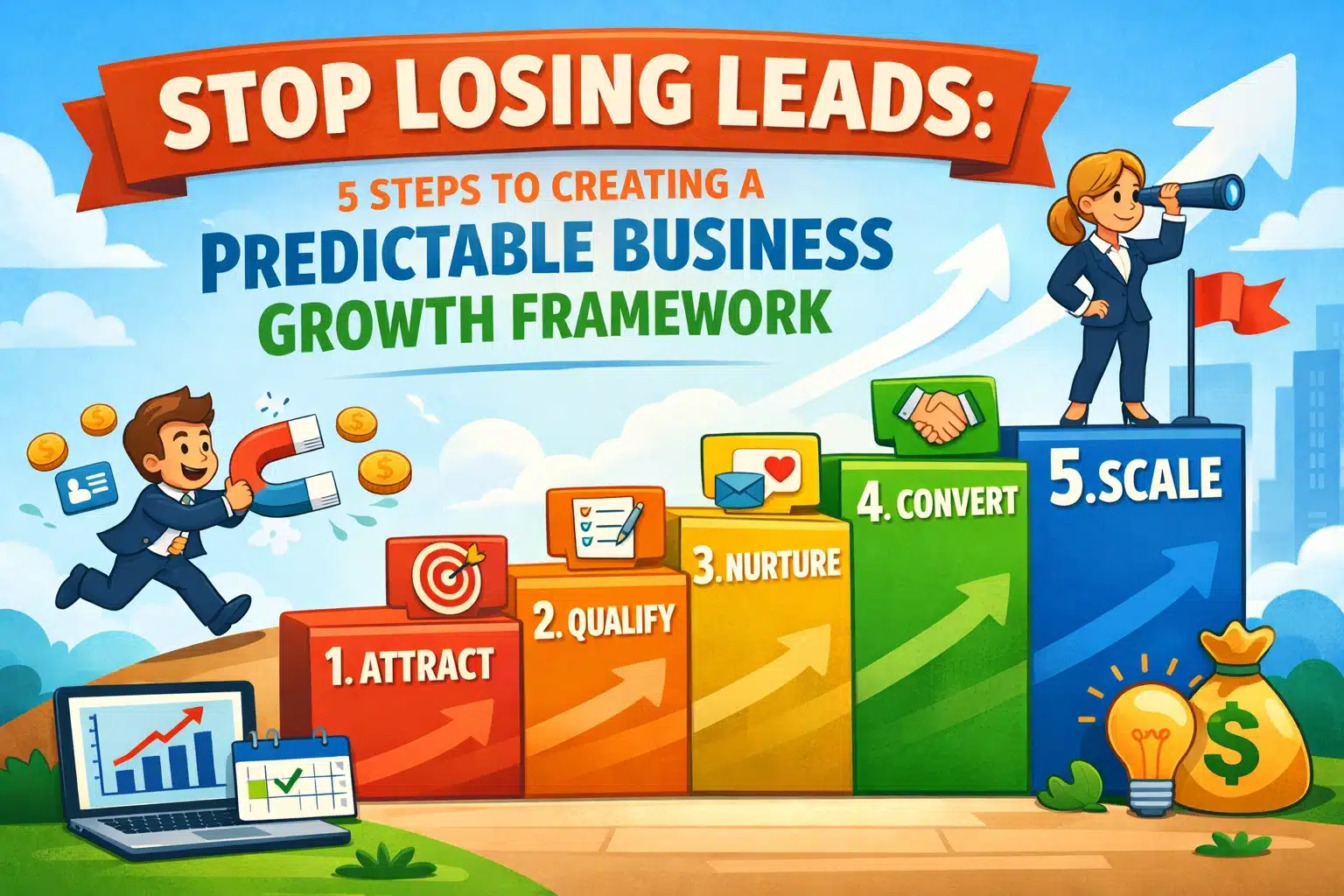
In this guide, I’m going to walk you through the five steps to building a framework that ensures you stop losing leads and start seeing predictable growth. We’re going to use the Visibility -> Response -> Conversion model because, quite frankly, it’s the only one that actually works for small businesses.
Why Most Growth Strategies Fail
Before we dive into the steps, we need to address the elephant in the room. Most marketing advice tells you to "get more traffic." But traffic is expensive and, on its own, it’s useless.
According to Harvard Business Review, businesses that attempt to contact potential customers within an hour of receiving a query are nearly seven times as likely to have a meaningful conversation as those who wait even sixty minutes. Yet, most SMEs take a day or two to reply. That is a massive disconnect.
As Marcus Sheridan points out in They Ask, You Answer, today’s buyers are more informed than ever. They don’t want to be "sold" to; they want their problems solved. If your growth framework doesn't prioritise the customer's experience from the moment they find you, you're just throwing money away.

Step 1: Visibility – Being Found for the Right Reasons
The first pillar of our framework is Visibility. But let’s be clear: visibility doesn't mean just being seen. It means being seen by someone who has a problem you can solve, at the exact moment they are looking for a solution.
Stop Hiding Your Prices
One of the core tenets of the "They Ask, You Answer" philosophy is transparency. One of the biggest fears SMEs have is putting prices on their website. "But Martyn," I hear you say, "if I put my prices up, my competitors will see them, or I’ll scare people off!"
Here’s the truth: your competitors probably already know what you charge. And if you don't talk about cost, you aren't "building value", you're just annoying your prospects. People search for "cost of [service]" more than almost anything else. If you provide that answer, you earn trust. Trust leads to enquiries.
Focus on Education over Self-Promotion
Your blog and social media shouldn't be a series of "Look how great we are" posts. They should be educational resources. Address the "Big 5" topics that every buyer cares about:
- Pricing and Costs
- Problems and Negatives (be honest about what you can't do)
- Comparisons (You vs. The Other Guy)
- Reviews and Best-of Lists
- How-to Guides
By focusing on website optimisation that prioritises these topics, you stop being a salesperson and start being a trusted advisor. That’s the kind of visibility that sticks.
Step 2: Response – The "Make or Break" Phase
This is where the wheels usually fall off. You’ve done the hard work of getting the lead, but then… nothing. Or at least, nothing fast enough.
In the digital age, a "lead" has a shelf life shorter than a pint of milk in a heatwave. If someone fills out a form on your site, they are likely doing the same on three of your competitors' sites. The business that calls back first wins. Period.
The Cost of a Missed Call
We’ve written extensively about the hidden cost of missed enquiries. If your average customer value is £1,000 and you miss five calls a week, that’s £5,000 in potential revenue gone. Over a year? That’s a quarter of a million pounds.
Most SMEs rely on a busy director or a stressed receptionist to handle calls. When things get busy, the phone doesn't get answered, or it goes to a generic voicemail. This is where enquiry handling becomes your competitive advantage.
Human Response vs. Digital Receptionists
There is a massive difference between a service that just "takes a message" and one that manages the enquiry. A digital receptionist is a glorified answering machine. An enquiry management partner (like us) actually qualifies the lead, books the appointment, and moves the needle.
| Feature | Standard Answering Service | Every Enquiry Management |
|---|---|---|
| Primary Goal | Take a message | Convert the lead |
| Speed | Varies | Instant / Real-time |
| Lead Qualification | None | Deep screening against your criteria |
| Outcome | An email with a name and number | A booked appointment in your diary |
| Business Growth | Passive | Active and Predictable |

Step 3: Conversion – Turning "Hello" into "Hire"
Once you have a responsive system in place, you need to look at conversion. Conversion isn't a one-time event; it’s a process.
The 5-Step Follow-Up Rule
Most leads don't close on the first call. In fact, research from LeadSquared suggests that 80% of sales require five follow-up calls, yet 44% of sales reps give up after just one follow-up.
Your framework must include a documented follow-up process. If you want to improve your response times and stop losing leads, you need to automate the "boring" parts of the follow-up so your team can focus on the "human" parts.
Transparency in the Sales Process
Just like with your pricing, be transparent about what happens next. On your "Thank You" page or in your initial email, tell the prospect exactly what to expect:
- "We will call you within 15 minutes."
- "Our initial consultation takes 20 minutes."
- "You will receive a quote within 24 hours."
When you set expectations and then meet them, you are proving that you are a professional organisation. This builds the momentum needed for a high conversion rate. If you're struggling here, check out our post on 10 reasons your lead conversion isn't working.
Step 4: Systems and Accountability – The Engine Room
Predictable growth isn't about luck; it's about systems. You need a way to track every single enquiry from the moment it hits your ecosystem until the moment the invoice is paid.
Clear Ownership
Who owns the lead? If "everyone" is responsible for answering the phone, then "no one" is. In a small team, this is the biggest cause of lead leakage. You need a dedicated person or partner whose sole job is to protect your leads.
This is why many service businesses move away from handling everything in-house. It’s hard to be a world-class plumber, lawyer, or accountant while also being a world-class sales operator. By outsourcing the response phase, you create a firewall around your time.
Documenting the "Winning Play"
When you find a script or a follow-up email that works, write it down. Create a "Sales Playbook." This allows you to scale. If you hire a new staff member tomorrow, can they step into your process and achieve the same results? If the answer is no, you don't have a framework; you have a job.

Step 5: Iteration and Data – Closing the Loop
The final step in a predictable growth framework is the feedback loop. You cannot manage what you do not measure. You need to know:
- Cost Per Acquisition (CPA): How much did that lead cost in ad spend and management fees?
- Lead-to-Appointment Rate: Of the 100 people who contacted you, how many actually sat down for a meeting?
- Customer Lifetime Value (CLV): How much is a client worth over 2, 3, or 5 years?
Regular Review Cycles
At Every Enquiry, we recommend a monthly "Deep Dive." Look at the leads that didn't convert. Why? Was it a price issue? Was the response too slow? Was the lead unqualified?
By identifying patterns, you can adjust your social media strategy or your website content to filter out the "tyre kickers" before they ever get to your phone line. This saves you time and increases your profit margins.
The Power of Prompt Response
We often talk about the power of prompt response as the "secret sauce" of SME growth. It’s the easiest lever to pull. You don't need a bigger marketing budget to answer the phone faster. You just need a better system.
When you combine high visibility with an elite response system and a transparent sales process, growth becomes a mathematical certainty rather than a hopeful guess.

Is Your Website Losing You Money?
Most business owners look at their website and see a digital brochure. We look at it and see a 24/7 lead generation machine that is either working or broken. If your site isn't driving people toward a clear, fast response channel, it is losing you money every single day.
Stop treating your leads like a burden and start treating them like the lifeblood of your business. If you aren't ready to handle an enquiry within minutes, you aren't ready to grow. It sounds harsh, but in 2026, it’s the reality of the market.
Frequently Asked Questions (FAQ)
1. I’m a small business, do I really need a "framework"?
Absolutely. In fact, SMEs need it more than big corporations. Large companies can afford to waste 20% of their leads because they have massive budgets. You can't. A framework ensures that every pound you spend on marketing has the best possible chance of returning as profit.
2. Is it better to have an automated chatbot or a human answering my leads?
While AI is getting better, for service-based businesses (where trust is everything), nothing beats a human. A chatbot can answer basic questions, but it can't handle the nuances of a customer's specific problem or build the emotional rapport needed to close a high-value deal. We advocate for human-led enquiry management.
3. How quickly do I really need to respond to a lead?
The "Golden Rule" is 5 minutes. After 5 minutes, your chances of qualifying the lead drop by 10x. By the time 30 minutes have passed, the lead has likely moved on to a competitor. If you can’t hit the 5-minute mark consistently, you need to look at an external response partner.
4. Why should I put my prices on my website? Won’t I lose leads?
You will lose the wrong leads: and that’s a good thing. By being transparent about your pricing, you filter out people who can't afford you, saving your team hours of wasted sales calls. The leads that do come through will be much higher quality and closer to a buying decision.
5. What is the biggest mistake SMEs make in lead handling?
Relying on "hope" as a strategy. Hoping someone will see the email. Hoping the receptionist isn't on lunch when the big client calls. Predictability comes from removing "hope" and replacing it with a documented, managed system.
6. Can I just use a standard virtual assistant (VA)?
A VA is great for admin, but enquiry management is a sales role. You need someone who understands your services, knows how to qualify a prospect, and is trained to move them toward a conversion. A VA might take the message, but an enquiry manager will win the client.
7. How do I know if my growth framework is working?
The numbers won't lie. You should see a decrease in your "cost per lead" and an increase in your "conversion rate." Most importantly, you’ll feel it in the business: less stress, fewer "dead" leads, and a more consistent flow of work.
Ready to stop the leak?
If you're tired of seeing great leads go to waste, it’s time to change your approach. Let’s talk about how we can help you build a predictable growth framework that actually delivers. No fluff, just results.