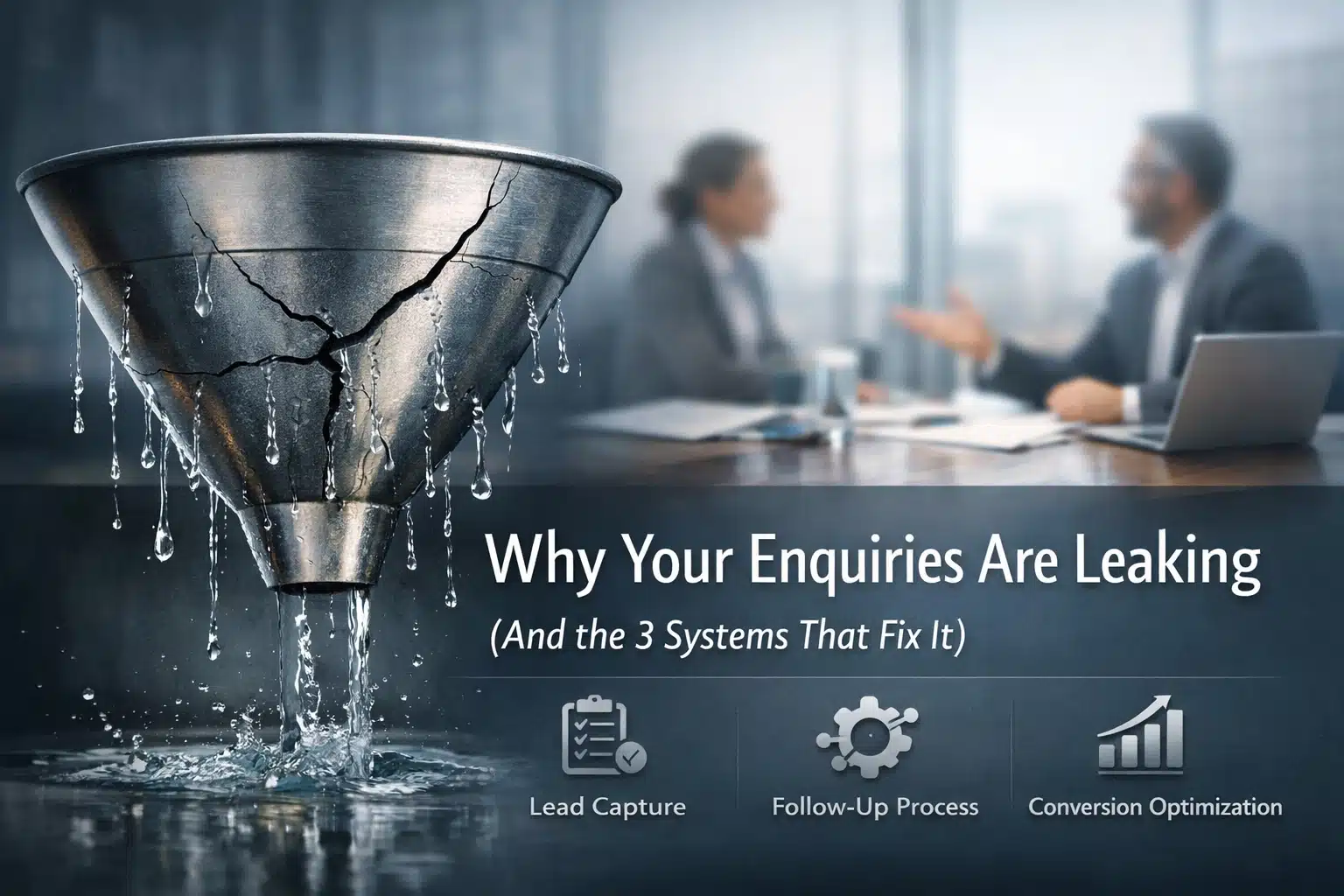
You're spending money to generate enquiries. Google Ads, SEO, referrals, networking. The leads are coming in. But somewhere between that first contact and the sale, they're disappearing.
This isn't a marketing problem. It's a systems problem.
Most service businesses lose between 30-50% of their enquiries before they even get a proper response. That's not because the leads are bad. It's because the business doesn't have the right infrastructure to catch them, respond quickly, and follow up consistently.
Let's talk about where the leaks happen, and the three systems that plug them.
Where Enquiries Actually Leak
Before we talk about solutions, you need to understand where you're losing money right now.
Missed calls during busy periods. Your phone rings. You're on another call, in a meeting, or on site. The enquiry goes to voicemail. They ring your competitor. You never knew they existed.
Delayed email responses. Someone fills in your contact form at 7pm on a Tuesday. You see it Thursday morning. By then, they've already spoken to two other companies. First reply wins.
Forgotten follow-ups. You send a quote. They say they'll think about it. You mean to chase them up. Three weeks pass. The moment's gone.

Lost enquiries between team members. A call comes in. Someone scribbles a note. It sits on a desk. No one follows up because everyone assumes someone else did.
No visibility on what's working. You don't know how many enquiries you're actually getting, where they're coming from, or which ones are converting. You're flying blind.
These aren't exceptional circumstances. This is what happens every single day in businesses without proper lead handling for SMEs.
The Three Systems That Stop the Leaks
Here's the truth: you can't fix leaking enquiries with effort alone. You need systems that work whether you're available or not.
These three systems align with how customers actually move through your business: Visibility, Response, Conversion.
System 1: Visibility – Know Every Enquiry That Comes In
You can't manage what you can't see.
The first leak happens when enquiries come through multiple channels (phone, email, contact form, social media) and there's no central place to see them all.
An enquiry handling system consolidates everything. Every phone call, every form submission, every email enquiry lands in one place. Nothing gets lost in an inbox or on a Post-it note.
This isn't about fancy software. It's about having a single source of truth that shows you:
- How many enquiries came in today
- Which channels they came from
- Who's handling them
- Which ones haven't been responded to yet
When you have visibility, you can spot patterns. You'll notice that most enquiries come in Tuesday mornings. Or that your website contact form gets more traffic than you thought. Or that three enquiries came in last Thursday and nobody replied.
What this looks like in practice: Every enquiry is logged automatically. You can see at a glance which enquiries are new, which are awaiting quotes, which are waiting for follow-up. No spreadsheets. No guesswork.

System 2: Response – Reply Fast, Every Time
Speed kills. Or in this case, speed wins.
Research shows that responding to an enquiry within five minutes makes you 100 times more likely to convert that lead compared to waiting 30 minutes. Most businesses take hours, or even days.
Your competitor who replies in 10 minutes gets the job. It's that simple.
But you can't reply fast if you're relying on someone manually checking emails three times a day. You need a system that alerts the right person immediately when an enquiry comes in.
This is where proper lead handling for SMEs makes a real difference. You're not hiring more staff. You're building a system that ensures every enquiry gets acknowledged within minutes, even if you're on site or in a meeting.
Instant acknowledgement matters. Even if you can't give a full response immediately, an automated acknowledgement that says "We've received your enquiry and will respond within two hours" stops that person ringing your competitor.
The right person gets it straight away. Enquiries are routed to whoever should handle them. Not sitting in a general inbox. Not waiting for someone to notice. Immediate notification to the person who can respond.
Follow-up is automatic. If a quote is sent and three days pass without a reply, the system prompts a follow-up. You're not relying on memory or good intentions.

System 3: Conversion – Turn Enquiries Into Customers
Getting the enquiry and responding quickly is half the job. Converting it into a sale is the other half.
This is where most businesses have a massive leak. The enquiry gets a response, maybe even a quote, but then it drifts. No systematic follow-up. No clear process to move them from "interested" to "booked".
An enquiry handling system tracks every enquiry through your pipeline. You can see exactly where each one sits:
- New enquiry
- Quote sent
- Awaiting decision
- Follow-up needed
- Won or lost
Nothing falls through the cracks because the system shows you which enquiries need action today.
You know what's working. You can see your conversion rate. You know how many enquiries it takes to win a job. You can identify where enquiries are getting stuck and fix it.
You can actually improve. When you have data, you can experiment. Does a phone call follow-up work better than email? Do enquiries from Google convert better than referrals? You'll know, because you're tracking it.
Your team stays accountable. Everyone can see which enquiries they're responsible for. No more "I thought you were dealing with that."

What This Actually Costs You
Let's talk numbers.
Say you get 50 enquiries a month. Your average job value is £2,000. If you're losing 40% of those enquiries due to poor handling, that's 20 lost sales.
That's £40,000 a month you're leaving on the table. £480,000 a year.
You're already paying for those enquiries through your marketing. You're just not converting them.
The cost of a proper enquiry handling system is a fraction of what you're losing. We're talking hundreds a month, not thousands. And the ROI is immediate, because you're plugging leaks that are costing you real money right now.
How to Get Started
You don't need to overhaul your entire business overnight. Start with visibility.
Get all your enquiries flowing into one place. It might be a CRM, it might be a dedicated lead handling platform. The tool matters less than the system.
Once you can see every enquiry, you'll immediately spot the leaks. Then you can layer in faster response times and consistent follow-up.
The businesses that grow predictably aren't the ones with the best marketing. They're the ones that handle every enquiry professionally, respond fast, and follow up systematically.
That's not luck. It's systems.
If you're serious about stopping enquiries from leaking out of your business, you need to look honestly at where the gaps are right now. Visibility, response, conversion. Fix those three, and you'll convert more of the leads you're already paying to generate.
Because the best marketing in the world won't help you if you can't handle the enquiries it creates.